

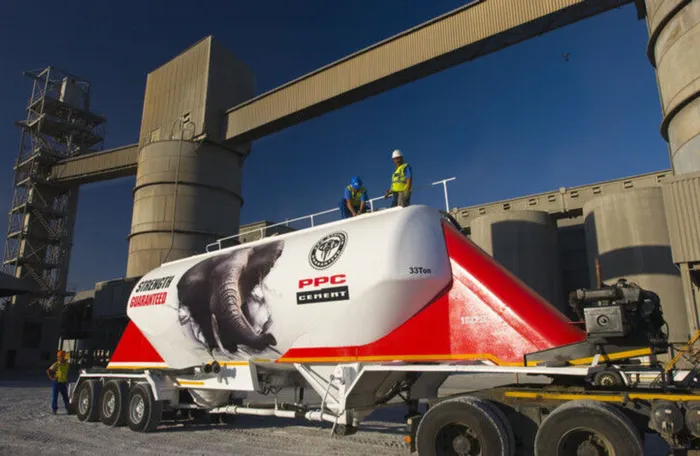
PPC is constructing a R3.1 billion cement plant in the Western Cape which it plans to open in the first quarter of 2027, within budget, and on time.
Image: Supplied
PPC delivered a second consecutive year of financial turnaround to March 31, with a step-change across all key financial metrics and despite muted South African cement sales volume growth.
The strong performance led to a dividend of R469 million for the 2026 financial year, a 72% increase. Group earnings before interest, tax, depreciation and amortisation (EBITDA) increased by 31% to R2.1 billion. EBITDA margins expanded by 4.2 percentage points. Earnings a share increased by 75% to 56 cents, in line with the significant increase in profit.
This follows the first two years of the implementation of PPC’s “Awaking the Giant” turnaround strategy. In this period, EBITDA increased by 62% from R1.2bn in 2024 to R2.1bn for 2026. Also, the EBITDA margin increased markedly by eight percentage points over two years to 20.3%.
Profitability and cash flow generation improved materially compared to the 2025 financial year. South Africa cement was the main driver of results expansion, while Zimbabwe registered a good performance in the second half of the year.
“This performance is significantly ahead of expectations and has positioned PPC for its next step change, anticipated in the 2028 financial year, following conclusion of the construction of the new state-of-the-art cement plant in the Western Cape,” said PPC CEO, Matias Cardarelli.
He said in an interview that while the strength of the past year’s performance was even a surprise to him, a benchmark of the group’s assets with comparable companies elsewhere in the world indicates there remains considerable efficiencies and other benefits to be obtained from operating the business better.
Group revenue increased by 3.9% to R10.2bn, essentially due to a 14.3% increase in Zimbabwe’s revenue, with PPC’s SA & Botswana group revenue marginally down by 0.4%.
Cement sales volumes in South Africa and Botswana, including clinker sales to Zimbabwe, were up 1.3% when compared to the prior year. In South Africa, volumes remained stable. Sales volumes in South Africa post-financial year end, and barring slightly better volumes in the Western Cape, remain muted, he said.
The weak demand environment had reinforced the need for a focus on value-accretive sales and a lower cost base. This drove measurable progress for a second year. In South Africa, EBITDA increased by 43% to R1.2bn, and EBITDA margin increased by 5.5 percentage points to 19,1%.
PPC Zimbabwe cement sales volumes increased by 18%, reflecting the benefit of its national footprint and turnaround actions in a growing demand market. The Zimbabwean operations’ EBITDA increased by 19% to $56m, with the EBITDA margin lower by 0.3 percentage points to 26.9%. In the second half, the EBITDA margin recovered and reached 30.9%.
Cardarelli said the turnaround strategy drove a second step-change in operational leverage, with the group cost of sales contained to a 2% increase at R8.07bn. This was the main driver of the trading profit improvement of 50% to R1.47bn.
This followed a 59% increase in the 2025 financial year from the R619m in 2024, demonstrating the compound impact of the group’s two-year turnaround.
The group’s net cash before financing activities, adjusted for the new cement plant being built in the Western Cape (RK3), increased by 23% to R1.29bn, up significantly from R260m in 2024.
Cardarelli said the R3.1bn RK3 plant was expected to come on stream in the first quarter of 2027, while options were being explored for a plant in Zimbabwe. He said RK3, apart from additional production, would result in considerable cost and efficiency gains, and a reduction in harmful emission targets.
He said PPC had consistently demonstrated over the last two years that profitability was driven by competitiveness and is not dependent on top-line expansion.
“Through disciplined execution, PPC has structurally improved its margin profile, and will continue creating significant operating leverage, remaining cautiously optimistic on a recovery of the South African operating environment in the near term,” he said.
BUSINESS REPORT