

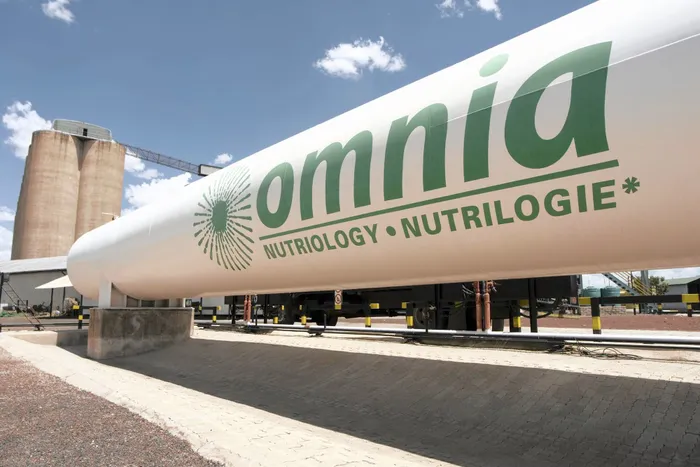
Omnia Holdings returned R1.2 billion in dividends and a special dividend to shareholders in the year to March 31 after good earnings growth and the maintenance of a strong balance sheet.
Image: Supplied
Omnia Holdings is paying out a special dividend of 280 cents a share and a 470 cents final dividend after strong profit growth in 2025 and after navigating supply and pricing disruptions arising from the conflict in the Middle East.
The 18% increase in the final dividend brought the total dividend to 750 cents, which means the group will return R1.2 billion to shareholders, with the payment supported by a strong financial position of the group to March 31, CEO Seelan Gobalsamy said yesterday. Last year the group also paid out at 275 cents a share special dividend.
“Omnia delivered a strong 2026 performance, demonstrating disciplined execution in a complex operating environment. This was driven by strong volume and margin growth, supported by strengthening competitiveness, with both Agriculture and Mining contributing robust earnings, margins, and cash generation,” Gobalsamy said in an online presentation.
Since its turnaround in 2020, the group has returned R6.8bn to shareholders in dividends and share repurchases.
Gobalsamy said there had been disruption in the supply of key chemicals for its explosives and fertiliser businesses due to the Middle East crisis, but the group counteracted this by, for instance, sourcing some finished products as an alternative during different parts of the value chain. These factors had only impacted the last month of its financial year under review.
In addition, elsewhere in the world, companies tended to be either explosives or fertiliser production focused, so the group is able to interchange its input chemicals, such as urea and ammonia, and from many different markets, he said.
The group had also acquired its own rail wagons, and in this regard, logistical services from Transnet had improved in the past 18 months, said Gobalsamy.
He said the group had proven its resilience, having managed, in the past few years, to grow through the Covid pandemic, after-effects of the Russia-Ukraine War, a crisis in the Suez Canal, and the ports, rail, and electricity infrastructure crisis in South Africa.
He said, however, the group had to pass on to customers the additional costs of input supply, and for instance, the price of a bag of fertiliser was about 70% higher at the height of the Middle East crisis, but this had since reduced to about 50%.
He said they had ensured continuous supply of its products to the market, and it had to weigh the effects of increasing prices to farners and mining group, and not being able to supply to the local market. For instance, a lack of explosives to the mining industry in Southern Africa would be very detrimental to the industry, he said.
The Mining segment saw a resilient underlying performance over the past year, supported by volume growth across SADC and West Africa, new contract wins, and an increased contribution from BME Metallurgy.
Revenue increased by 8% to R9.8bn, while operating profit rose by 1% to R1.1bn. Operating margin of 11.7% remained within the segment’s medium-term guidance range.
Mining RSA volumes increased due to strong demand in the iron ore and platinum markets, contract extensions, and organic growth. This was partly offset by the downturn in the diamond market, coal sector volatility, and periods of higher rainfall.
Mining International revenue increased, supported by strong SADC demand for both BME Blasting Solutions and BME Metallurgy, although operating profit and margin were impacted by foreign exchange losses in Zambia and the expansion in Canada and Australia.
In West Africa, there was strong demand in Mali, while overall volumes were lower due to the suspension of operations in other jurisdictions. Indonesia contributed positively.
In Australia, the AXXISTM electronic detonator assembly plant in Western Australia had been commissioned and in-country manufacturing started.
Agriculture performed strongly, driven by sales growth in South Africa and a strong recovery in the Rest of Africa, following operating model changes. The restructuring in Chemicals resulted in a release of capital and improved financial performance.
Agriculture revenue increased by 13% to R13,1bn, operating profit increased by 28% to R1.3bn, and operating margin improved to 9.6%.
BUSINESS REPORT