

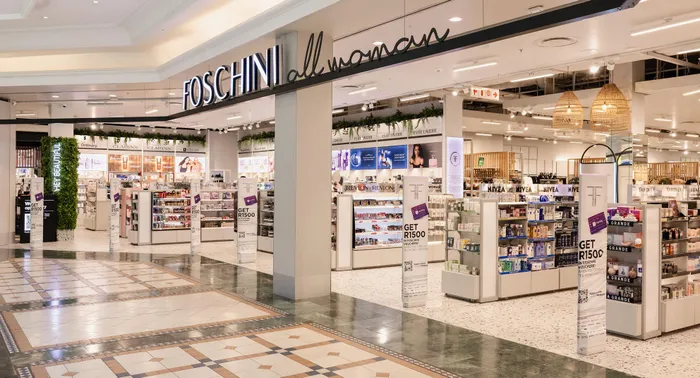
The Foschini Group said trading conditions remained tough in all three of its key operating segments, TFG Arica, TFG London and TFG Australlia, in the year to March 31, and further constrained consumer demand was expected.
Image: Supplied
The Foschini Group (TF) increased market share in South Africa in the year to March 31, growing by 50 basis points (bps) in womenswear, and by 40 bps in homeware and furniture, as it began to position for more constrained consumer demand.
The share price recovered slightly by 3,93% on Friday to R57,87, but the price is over 55% lower from R131,52 a year ago.
The group said trading conditions were challenging and management responded decisively in the second half of the year. Planned expenditure was reduced, capital investment was tightened, inventory levels were actively managed, cash generation was prioritised, and a disciplined approach was maintained to credit granting to ensure the business remains resilient in a prolonged period of constrained consumer demand.
TFG CEO Anthony Thunström said they were focused on strengthening business resilience in the face of expected continued adverse trading conditions.
“We have invested significantly over the years to build scaled retail, digital and logistics platforms that position us well for the future. As online penetration continues to grow and our omni-channel capabilities scale, we believe we are able to drive growth through a more capital-light model while remaining focused on improving profitability and returns,” he said.
The results for the JSE-listed group that trades in 18 countries saw group sales up by 7,1%, and excluding White Stuff in the UK, group sales grew 2,8%.
Online sales increased by a strong 31,7% and contributed 14,8% to total retail sales.
Group operating profit before brand impairments and acquisition costs declined by 22,1%. Headline earnings per share (HEPS) fell 33,5% to 675,4 cents. The final dividend was 39,1% lower at 140 cents per share from 230 cents a share.
The performance was adversely affected by a weaker second half, with trading conditions deteriorating across all operating regions.
The impact of softer peak season demand and lower gross margins resulted in negative operating leverage.
Non-cash impairment charges were recognised against the Phase Eight brand in the UK and the Tarocash and yd. brands in Australia, reflecting the revised long-term cash flow expectations for these businesses.
Two hundred and thirty-three stores were opened in the year, 141 of which were in TFG Africa, and 242 were closed. The group now trades out of 4,914 stores.
In TFG Africa, market share in menswear declined by 110 bps. Like-for-like sales for TFG Africa grew by 3,5%.
Online sales grew by 49,2%, driven by the continued strong performance of the Bash platform. Online contributed 8,2% to total sales, reaching a 10% contribution in the fourth quarter, with scale benefits continuing to improve profitability.
Credit sales grew by 4,6%, contributing 25,8% to total TFG Africa sales. Gross margin contracted by 100 bps to 41,6%. Earnings before interest and tax declined 14,7%.
TFG London’s sales increased by 29,4% in UK pounds. Sales for the year, excluding White Stuff, remained flat, as the UK continued to experience difficult trading conditions. White Stuff continued to perform well.
Management remained focused on the protection of operating profit margin through cost containment and reduction initiatives; however, negative operating leverage resulted in a 65,4% decline in segmental EBIT before the impairment of Phase Eight and the acquisition costs in the prior year.
At TFG Australia, sales declined by 1,5%, with a 3.,% decline in Australian dollars on a like-for-like basis.
Trading conditions in the Australian apparel retail market remained challenging throughout the period due to subdued consumer confidence impacting demand across the sector, leading to an increase in promotional activity. EBIT declined by 27,2% before the impairment of the Tarocash and yd. brands.
The group said the South African macroeconomic environment remains challenging. The UK continues to experience a challenging retail environment, with discretionary consumer demand constrained by elevated living costs and subdued consumer confidence. In Australia, inflationary pressures and the recent interest rate increase were expected to weigh on consumer confidence and discretionary spending, which may temper any near-term recovery in retail demand.
Sales in TFG Africa grew by 2,2% for the 9 weeks ended 30 May 2026, supported by improved product availability, disciplined inventory management, and continued momentum across key growth categories. Trading conditions remained mixed during the period, however.
In the UK, sales volumes remain resilient despite continued weak consumer confidence. Sales in TFG London grew 1,7% (in GBP) for the 9 weeks ended May 30, 2026.
In Australia, sales for the 9 weeks contracted by 2,3%, as trading conditions remained challenging amid persistent cost of living pressures.
Visit:www.businessreport.co.za