

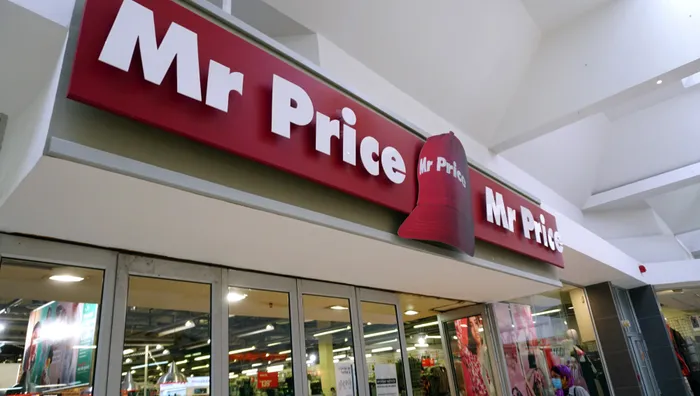
Mr Price's share price surged over 14% on Friday after resilient annual results for the year to end-March 2026 and despite signs that consumer spending may come under pressure in both Europe and South Africa in the months ahead.
Image: Ian Landsberg/Independent Newspapers.
Mr Price Group’s share price was a top mover on the JSE Friday, soaring more than 14% after it reported market share gains and resilient earnings growth for the year to March 28.
The value clothing, homeware and accessories retailer’s share price closed 14,7% higher on Friday at R172 per share, although the price is still 29% lower than the R242,99 that it traded at a year ago.
“The agility of our operating model and the strength of our value retailing DNA have enabled operating leverage in a challenging retail environment. We are confident in our ability to perform across economic cycles, while continuing to deliver value to our customers,” said CEO Mark Blair in the results.
Total revenue increased by 4,2% to R42,7 billion, and normalised diluted headline earnings per share growth of 8% was achieved in a volatile trading environment.
Blair warned that renewed inflationary pressures on food and fuel and a reversal in the interest rate cutting cycle had compromised the early signs of consumer recovery.
In both markets, Europe and South Africa, post year-end April trade was challenging as consumer confidence deteriorated after the unexpected inflation increase due to the US-Iran conflict.
However, “trade improved into May and early June, and the group is confident its value chain agility enables it to respond positively to changing conditions,” said Blair.
The earnings were impacted by all once-off transaction costs relating to the R9,6bn acquisition of Pegasus Group Holding, which trades as the retail business of NKD Group in Germany and central Europe, which became effective post year-end.
Basic, headline and diluted headline earnings per share increased by 8%, 7,7% and 8%, respectively, on a normalised basis. Basic, headline and diluted headline earnings per share of 1,449,5 cents, 1,453,9 cents and 1,411,8 cents increased by 2,3%, 2,1% and 2,4%, respectively, on a statutory basis.
The group’s retail sales growth of 4,3% (2025: 7,8%) was higher than the Retailers’ Liaison Committee (RLC) growth of 4% (5%). The group expanded its annual gross profit margin by 70 bps to 41,2%, despite the retail sector being highly promotional.
Operating profit grew by 4,3% (normalised: +8%) exceeding R6bn for the first time, with its operating margin maintained at 14,2% (normalised: up 50 bps to 14,7%).
A final dividend of 592,8 cents (593,5 cents) per share was declared, and a pay-out ratio of 63% was maintained.
Blair said household disposable income showed some signs of recovery during 2025; however, external research indicated that the discretionary retail sector was not an immediate beneficiary of the improvement.
“The group was up against a firm retail sales base in the second half of the financial year of 9,9%, which was predominantly driven by the withdrawals from the introduction of the two-pot retirement system in South Africa,” said Blair.
The group opened 196 new stores across its 15 trading chains, bringing the total store footprint to 3,182. Trading space increased by 3,6% on a weighted average basis.
Blair said new store returns remain healthy, and with South African customers continuing to favour in-store shopping, this channel remained a high-yielding avenue for capital deployment.
Operating profit of R6bn increased by 4.3%. Group retail sales of R41,1bn increased by 4,3%, and comparable store sales increased by 1,1%. Group store sales increased by 4,4%, and online sales increased by 4,9%. Group unit sales increased by 0.5%, with retail selling price (RSP) inflation of 3.8%.
Consumers remained cautious in their credit utilisation as debt servicing levels remained high and in anticipation of an inflection in the interest rate, which had now materialised. Blair said they would continue to manage the credit book conservatively.
The two newest divisions continued to expand, with Power Fashion nearly doubling its store footprint since acquisition to 354 stores, while Studio 88 surpassed 1,000 stores. These two divisions collectively delivered well in excess of R1bn in operating profit, supporting the expansion of the segment’s operating margin by 70 bps.
The Homeware segment grew retail sales by 3,8% (comparable store sales up 1,8%) to R6,9bn. The segment delivered increased GP margin, up 50 bps, supported by strong markdown management.
Capital expenditure of R1,1bn was mainly allocated towards new stores, as well as to expansions and revamps. The remaining capex was primarily allocated to technology projects and the expansion of the Gosforth Park distribution centre in Gauteng.
Visit:www.businessreport.co.za