

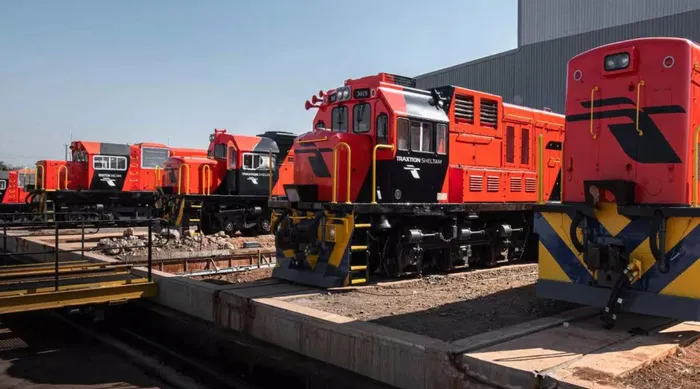
Traxtion has spent more than a decade building a business focused on extending the operational life of rail assets through refurbishment, maintenance and operational optimisation.
Image: Supplied
South African rail operator Traxtion has secured an $86 million (about R1.5 billion) equity capital raise, marking a major vote of confidence in the country’s rail sector and providing the funding needed to complete its ambitious rolling stock investment programme.
The latest funding round brings together infrastructure investors STANLIB Infrastructure Investments, Standard Bank and Harith InfraCo, alongside existing investor Harith through its PAIDF2 fund.
The transaction, facilitated by Pallidus Capital, is expected to strengthen Traxtion’s position as one of Africa’s leading independent freight rail operators at a time when South Africa is pursuing reforms aimed at opening the rail sector to greater private-sector participation.
Pallidus capital executive director, JD Symington, said transactions of this nature prove growing alignment between institutional infrastructure capital and strategic industrial operators.
“This capital raise unlocks significant rail capacity and plays a critical role in advancing South Africa’s rail and logistics ambitions. Moving South Africa’s logistics future in the right direction is paramount to the country’s long-term economic sustainability,” said Symington.
The investment completes the equity funding required for Traxtion’s previously announced R3.4bn rolling stock programme, which includes the acquisition of 46 locomotives and 920 wagons. The capital raise also creates additional capacity for future expansion projects as demand for rail services continues to grow.
Traxtion CEO James Holley said the funding demonstrates strong confidence in the future of rail and the company’s long-term growth strategy.
“This additional investment clearly demonstrates the confidence we have long held in the future of rail and is yet another step toward unlocking rail’s full potential as a catalyst for growth,” said Holley.
“The backing of South Africa’s largest financial institutions sets us up perfectly to deliver that.”
The investment comes as South Africa seeks to address longstanding logistics bottlenecks that have constrained economic growth, reduced export competitiveness and increased pressure on road infrastructure. Rail has been identified as a critical area for reform, with government encouraging greater private-sector involvement to improve efficiency and capacity.
Traxtion has spent more than a decade building a business focused on extending the operational life of rail assets through refurbishment, maintenance and operational optimisation.
The company says its approach enables customers to access more cost-effective freight solutions while reducing congestion and damage on the country’s roads.
Board chairman Brian Myerson described the transaction as the culmination of years of investment and strategic planning.
“This investment reflects recognition of a decade-long journey at Traxtion, focused on deliberately building the capability, capacity and credibility to deliver large-scale freight rail projects,” he said. “It is the culmination of years of disciplined execution and long-term vision.”
The new funding will support ongoing refurbishment programmes, fleet upgrades and operational expansion while also advancing localisation and supplier development objectives. Traxtion’s rolling stock programme includes a minimum local content target of 60% and is expected to support 662 direct jobs during the manufacturing and deployment phases.
The first locomotives acquired under the programme are expected to enter service in March 2027.
Institutional investors backing the transaction say the deal aligns with broader efforts to improve South Africa’s logistics infrastructure and stimulate economic growth.
STANLIB infrastructure investments principal, Muhammed Munshi, said rail remains one of the country’s most significant growth constraints and that Traxtion is well positioned to support reforms aimed at increasing freight capacity and efficiency.
Standard Bank’s vice president for investment banking, Willem Els, said the investment reflects confidence in the rail sector’s transformation and the role strategic partnerships can play in improving freight logistics.
Harith InfraCo chairman Frans Baleni added that investments in rail infrastructure have the potential to improve competitiveness, boost trade, create jobs and support broader economic development.
Business organisations also welcomed the announcement.
Business Unity South Africa CEO Khulekani Mathe said the investment signals growing confidence in reforms under way in the freight logistics sector.
“South Africa’s logistics constraints continue to weigh heavily on economic growth and competitiveness. Initiatives that mobilise investment and improve freight efficiency will be important in supporting growth, trade and job creation,” Mathe said.
Business Leadership South Africa CEO Busisiwe Mavuso said the transaction demonstrates that policy reforms are beginning to translate into tangible operational improvements.
“Business Leadership South Africa has consistently supported structural reform in the freight logistics sector. The participation of private capital in strengthening logistics infrastructure is an important step toward building a more competitive, efficient, and growth-enabling economy,” Mavuso said.
The announcement comes as industry stakeholders await further updates to Version 4 of South Africa’s Network Statement, a key regulatory framework expected to provide greater certainty for private rail operators.
BUSINESS REPORT