

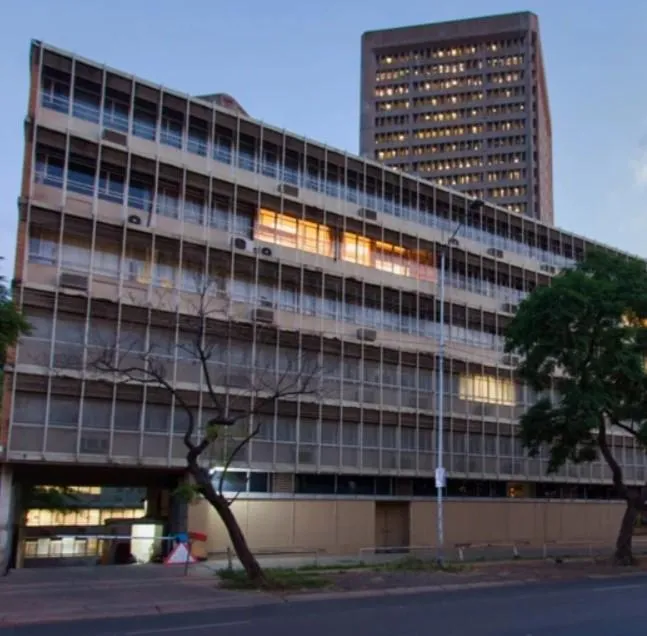
Delta's Forum Building in central Pretoria. A significant number of Delta's properties offer street-level retail, ideal for fast-food restaurants, fashion and furniture retailers, banks, mobile phone operators and repair shops.
Image: Supplied
Delta Property Fund, the JSE’s only Level 1 B-BBEE sovereign-underpinned REIT, has returned to profitability, and its further turnaround will see it reduce its portfolio of 72 properties to 48, CEO Bongi Masinga said Tuesday.
She said in an online presentation that the continuing disposal of non-core assets will result in better quality of earnings, which will put the group on a more sustainable path going forward.
This was indicated by the fact that in the past year to February 28, the core portfolio of 48 properties generated some R1 billion of rental income, while the 24 properties in the non-core portfolio generated R145 million in rental income.
Masinga said the disposal program remains central to the group’s medium-term recovery.
“The properties being sold are generally non-core, high-vacancy assets that place pressure on costs, income quality, and capital allocation. Exiting these assets allows Delta to sharpen the portfolio, reduce income drag, and focus management’s attention on the core portfolio,” she said.
She said the 2026 financial year was one of meaningful operational and financial progress.
“We returned to profitability, reduced debt, improved our vacancy position, strengthened rental collections, and continued to execute on our non-core disposal program,” she said.
“The office market remains highly competitive, particularly for B- and C-grade space. However, the progress through the year shows Delta’s turnaround strategy is gaining traction and that management is focused on areas that matter most: covenant improvement, leasing, collections, cost control, and disposals,” she said.
Delta reported a R127m net profit, compared with a R104.2m loss in 2025. The improvement was supported by stable revenue, lower administration expenses, reduced finance costs, and a positive swing in fair value movements.
Rental income increased by 0.9% to R1.15bn, despite the impact of strategic property disposals, vacancies, and rental reversions. Administration expenses fell by 7.7% to R93.9m, reflecting the benefit of cost-saving initiatives and the continued focus on operating as a leaner business.
The group recorded a fair value gain of R5.1m, compared with a fair value loss of R222.5m in the 2025 year. This positive movement was supported by portfolio optimisation, asset management initiatives, and the disposal of weaker non-core assets.
Finance costs decreased to R412.4m from R463m, supported by lower debt, the application of disposal proceeds to borrowings, and the benefit of lower average interest rates during the financial year.
Total interest-bearing debt reduced to R3.6bn from R3.9bn. Capital repayments were funded by R170.1m from property disposal proceeds, R18.1m from the disposal of the group’s Grit shareholding, and R103.1m from amortisation payments.
Group chief financial officer, Fikile Mhlontlo, said Delta’s funding strategy is focused on improving resilience and reducing refinancing risk.
Delta renewed maturing debt facilities with key funders. The revolving credit facility was increased from R64.3m to R82m, of which R56.5m was drawn at year-end.
During the year, 16 properties with a combined fair value of R336.1m were sold for R318m.
Delta also disposed of its 14,869,210 shares in Grit Real Estate Income Group in November 2025. The shares were sold at 5,45 pence per share, with proceeds applied to debt reduction.
Masinga said the disposal program remained central to their medium-term recovery.
“The properties being sold are generally non-core, high-vacancy assets that place pressure on costs, income quality, and capital allocation. Exiting these assets allows Delta to sharpen the portfolio, reduce income drag, and focus management’s attention on the core portfolio.”
Overall portfolio vacancy improved to 27.3% from 31.9%. Core portfolio vacancy increased to 16.6% from 15.2%. Reducing core vacancy remained a key management priority.
“Delta’s sovereign tenant base remains a key strength, but the short-term nature of several renewals continues to weigh on WALE (weighted average lease expiry). Our leasing focus is therefore on retaining existing tenants and converting short-term occupancy into longer-term lease commitments wherever possible, whilst diversifying the tenant mix,” said Masinga.
“Our priorities are clear: reduce debt, improve covenant metrics, conclude non-core disposals, protect cash flows, renew leases, and reduce vacancies,” she said.
BUSINESS REPORT