

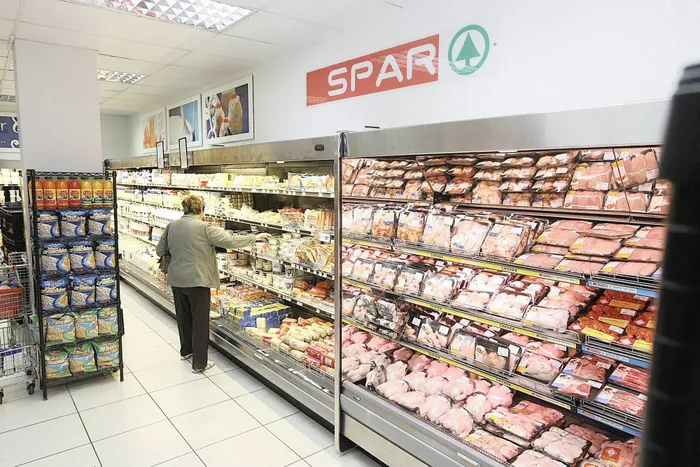
As South Africans brace for the financial implications of the higher fuels and interest rates, Spar is working hard to restore profit margins in its Southern Africa business.
Image: Independent Newspapers
SPAR Group, the JSE-listed supermarket group, saw its share price plunge 16% on Friday after it warned that headline earnings are expected to fall by between 60% and 50% for the 26 weeks to March 27 as margins in Southern Africa shrank.
Continuing problems in the KwaZulu-Natal operations once again featured among the main reasons for the earnings decline, and “key senior management changes” had been made.
The earnings decline comes at a precarious time for South African retailers, as consumer disposable incomes and the grocers themselves come under pressure from higher fuel prices, inflation, and interest rates. SPAR's directors warn they may also face headwinds in the form of a need for further provisioning, intensifying competition from peers, and continuing macroeconomic uncertainty.
The share price was trading at R48.05 on Friday afternoon, 15.08% lower than the opening price, while the price is 56.77% lower over a year, a significant decline.
The company stated in a trading statement that while second-quarter sales were better than the first, it expects diluted headline earnings a share to be between 173 and 216 cents a share for the six-month period when it reports its interim results on June 10, compared with 433 cents at the same time a year ago.
Diluted earnings per share are expected to be 65% and 55% lower, or between 139 cents and 179 cents a share, compared with the 398 cents reported at the same time last year.
“The earnings decline reflects a combination of underlying trading conditions, current period operational anomalies (primarily KwaZulu-Natal performance and elevated Black Friday spend), further impairments of historical asset carrying values, and a more conservative approach to debtors provisioning,” the group directors said on Friday.
They noted there had been margin compression in Southern Africa, which was only partially offset by a positive contribution from Ireland.
In Southern Africa, the gross profit margin fell by between 20 and 40 basis points. This was largely attributed to elevated Black Friday promotional subsidy spend and underperformance at the KwaZulu-Natal distribution centre.
Above-inflation cost growth and elevated debtor impairments in SA Groceries & Liquor contributed to the “substantial decline in operating profit” relative to the prior period, the directors said.
In Ireland, gross profit margin improved, supported by better supplier trading terms and a favourable sales mix. The operating margin was slightly ahead of the comparable period.
They said that KwaZulu-Natal’s first-half performance was weighed down by short-term strategies that prioritised top-line growth over profitability.
They also mentioned that an analysis attributed the sharp decline in the first quarter primarily to insufficient logistics capacity planning, which in turn disrupted service levels and resulted in increased costs.
“KwaZulu-Natal performance remains a key ongoing risk for the group and continues to be closely monitored at executive and board level,” the directors said.
They indicated that corrective measures had been implemented, including key leadership changes.
They said that the gross profit margin improved toward the end of the six-month period, “although it remains below targeted levels.”
They noted that KwaZulu-Natal had delivered three consecutive profitable months in February, March, and April of 2026, “but further work is required to fully stabilise operations.”
While Black Friday 2025 delivered strong sales growth over the campaign period, it came at a meaningful cost to gross profit margin and drove elevated marketing and promotional costs in November 2025.
The appointment of the new group chief marketing officer had seen corrective steps being implemented to introduce a “more disciplined and tightly controlled promotional investment model.”
On the existing impairments, the directors said most of them relate to legacy asset positions, with a smaller portion arising from current-year reassessments.
“The impairments reflected management's focus on balance sheet integrity and ensuring that asset carrying values accurately represented the underlying economic reality of the business,” they said.
BUSINESS REPORT