

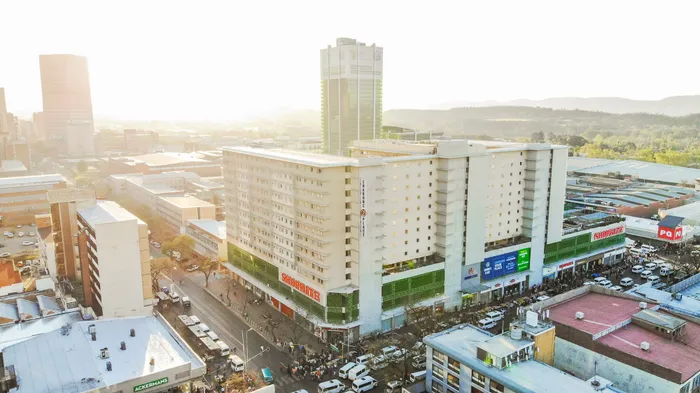
Octodec Investments' Sharon Place in Tshwane.
Image: Supplied
Octodec Investments made progress in simplifying its portfolio of apartments and commercial properties in the Johannesburg and Tshwane CBDs, recycling its capital and improving earnings quality in the six months to February 28.
Distributable income per share increased 11.1% to 92,6 cents, while the dividend was raised 4% to 64.5%. The loan-to-value (LTV) ratio improved to 37.3%, comfortably within the targeted range, while R1.1 billion in available facilities provided flexibility for ongoing capital allocation. Debt was refinanced at more favourable margins and tenor, contributing to improved funding efficiency.
The previously provided guidance of a 0% to 4% growth in distributable income per share was revised upward, to between 3% and 5% per share, while maintaining a minimum dividend payout ratio of 77.5% of distributable income.
“We are seeing the benefits of a focused strategy. The business is becoming more streamlined, more efficient, and better positioned for growth as we reshape the portfolio and deploy capital,” said Jeffrey Wapnick, the CEO.
Octodec experienced an increase in leasing activities in the period. Although core vacancies increased, this was mostly as a result of the two large tenants vacating Capitol Towers North and Talkar, and had it not been for these two vacates, core vacancies would have improved to 11.8% from 12.5%.
Management revised its previous guidance of a 0% to 4% growth in distributable income per share for the 2027 financial year, to between 3% and 5% per share, while maintaining a minimum dividend payout ratio of 77.5% of distributable income.
The double-digit growth in distributable income was supported by improved funding costs, strategic asset sales, stable property income, and continued leasing momentum across key segments.
During the period, 10 non-core properties were sold for R88.7 million, while the disposal of Killarney Mall for R397.5m was also announced, subject to conditions.
The transactions were part of an initiative to reduce exposure to smaller, non-core and underperforming assets, while redirecting capital into larger, higher-quality opportunities with stronger income potential and scalability, said Wapnick.
“We are making steady progress to reduce the long tail of smaller assets and concentrate the portfolio around properties that offer scale, stronger income profiles, and long-term relevance,” said deputy CEO and CFO, Riaan Erasmus.
Operationally, the portfolio performed steadily. Rental collections were strong at 98,5%, reflecting “consistent tenant engagement and cash flow stability,” while vacancies trended down, particularly within the residential portfolio.
Rental income increased by 5.5%, vacancies reduced to 7.7%, and like-for-like rental growth of 5.7% reflected better occupancy, steady rental escalations, and asset enhancements.
“Demand for our well-located, cost-effective accommodation remains a key underpin of our performance, particularly in our core Tshwane portfolio,” said Wapnick.
The retail portfolio showed signs of stabilisation, with street retail performance beginning to recover in key nodes, supported by improving footfall and trading conditions. Shopping centres saw like-for-like rental growth of 7.7%, and the portfolio, excluding Killarney Mall, was effectively fully let.
The office portfolio was stable, with management continuing to assess assets for potential disposal or conversion. The industrial portfolio delivered steady growth, with rental income increasing 6,8%, supported by continued demand for smaller warehouse and mini-industrial space.
The Yethu City apartment development launched in Tshwane was fully let within three months of launch and had maintained near-to-full occupancy, while also being recognised as the Best New Affordable Housing Development at the 2025 API Summit Awards.
Octodec planned to expand the Yethu City concept. The group had identified a pipeline of potential conversion opportunities in its existing portfolio and was engaging with funding and development partners. Ongoing feasibility work continued to support the scalability of the model, said Wapnick.
During the period capital projects were focused on upgrades, energy and water resilience initiatives, and improvements to tenant experience. Recent solar installations returned approximately R5,2m in cost savings.
Last month, Emira Property Fund aimed for a greater stake in Octodec after announcing it had acquired a 20.17% interest in Octodec for R891.77m, and it made an offer to acquire further shares in Octodec, which, if accepted, would bring its stake to 34.9%.
BUSINESS REPORT