

.
Image: Supplied
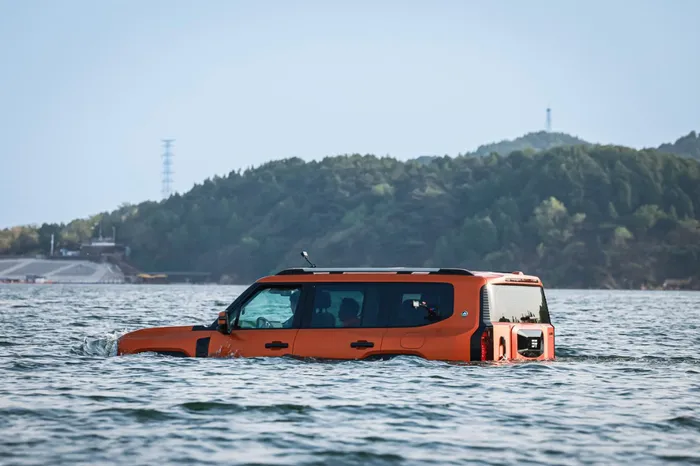
At Auto China 2026 in Beijing, Chinese automaker Jetour staged an unusual demonstration: an SUV that doesn’t just survive water crossings, it actively drives through them.
The test, featuring the G700 “Ark Edition,” builds on a previous high-profile stunt in which the vehicle crossed the Yangtze River in 2025.
But this latest showcase is less about spectacle and more about a deeper technological pivot: rethinking what “all-terrain” actually means.
Traditional off-road vehicles are designed to endure water, not operate within it. Raised air intakes, sealed chassis components, and reinforced electrics help vehicles wade through rivers—but only briefly, and with risk.
Jetour’s approach attempts to move beyond this limitation. The G700 uses what it calls “GAIA Ark” technology to transition from passive resistance to active control in water. Instead of simply pushing through, the system allows the vehicle to maintain directional movement and stability while partially afloat.
This suggests a shift in design philosophy: treating water not as an obstacle, but as another terrain type.
At the core of this capability is the GAIA architecture, paired with a system referred to as the CEM-O amphibious range extender.
Unlike conventional hybrid drivetrains, the system temporarily decouples wheel-driven propulsion when entering water. Energy is redirected toward dedicated propulsion and stabilisation mechanisms designed for aquatic movement. At the same time, multiple layers of sealing—rated to IP68 standards—protect critical components, while onboard systems manage buoyancy and directional control.
In effect, the vehicle transitions modes: from ground-based traction to a controlled floating state with propulsion.
While still experimental in nature, this kind of architecture hints at future vehicle platforms that dynamically adapt to radically different environments without mechanical intervention from the driver.
On land, the G700 still resembles a high-performance off-roader: body-on-frame construction, multiple differential locks, and advanced manoeuvres like crab-walk and tank turns. But the more interesting story lies in how extreme scenarios—like water fording—are being used as stress tests for broader system resilience.
These are not everyday use cases. Most drivers will never need amphibious capability. But designing for rare, high-risk conditions often results in more robust systems overall—from better sealing and redundancy to smarter power management.
In that sense, amphibious functionality may be less about utility and more about engineering validation.
The G700 demonstration reflects a wider trend in the automotive industry: the expansion of mobility design into edge environments. As electrification, software-defined vehicles, and modular architectures evolve, automakers are experimenting with capabilities that would have been impractical—or unnecessary—a decade ago.
Whether amphibious SUVs become commercially viable remains to be seen. But the underlying technologies—adaptive drivetrains, environmental sensing, and system-level resilience—are likely to influence mainstream vehicle design.
For now, the G700 serves as a proof of concept: not just for driving across rivers, but for how far the definition of “terrain” can be stretched.
BUSINESS REPORT