

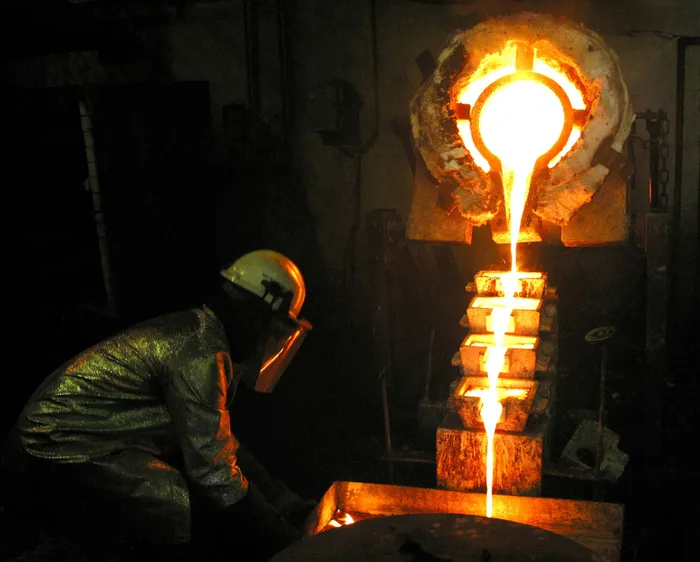
A worker pours gold at the AngloGold Ashanti mine at Obuasi, Ghana. The group posted a record dividend of $585 million, or 116 US cents per share for the first quarter to March 31, 2026, compared to 12.5 US cents per share declared in the first quarter of 2025.
Image: Reuters
AngloGold Ashanti posted record free cash flow of $1,2 billion in the first quarter of 2026, almost triple the 2025 first quarter amount, following steady performances from most of its operating assets and after benefiting from the high gold price.
The company said on Friday that it is on track to meet its 2026 guidance. An interim dividend of $585 million, or 116 US cents per share, was declared, a new record, compared to 12,5 US cents per share declared in the first quarter of 2025.
The news heartened the global gold producer’s investors, and the share price went up 1,61% to R1697,90 on the JSE on Friday morning, building upon a more than doubling in the share price from R811,96 a year previously.
AngloGold’s directors also proposed a $2bn share repurchase program, subject to shareholder approval.
"Our focus remains to control what we can control - managing underlying costs and ensuring safe, predictable operating results,” said CEO Alberto Calderon.
“That has again enabled us to deliver record free cash flow and cash returns to our shareholders, while moving our organic growth projects forward," he said in a statement.
AngloGold Ashanti is focused on a series of initiatives: delivery of predictable operating results; competitive returns to shareholders; bringing a large, new production centre into operation in southern Nevada; ramp-up of its Obuasi mine in Ghana; and realising a series of organic growth projects at its mines in Tanzania, Guinea, Egypt, and Brazil.
Free cash flow, the strongest for a single quarter, represented a 190% increase year-on-year to $1,2bn. Net cash flow from operating activities was up 136% to $1,7bn. The average gold price received per ounce was 69% higher compared to the first quarter of 2025.
EBITDA (earnings before interest, tax, depreciation, and amortisation) increased 130% to $2,3bn, while headline earnings were up 187% to $1,3bn, or 252 US cents per share.
The balance sheet strengthened, swinging from $755m of debt in the first quarter of 2025 to $868m net cash by the end of the first quarter of 2026, all while making a series of record dividend payments in the intervening quarters. About $666m of outstanding bonds were bought back.
The decision for a share repurchase programme was underpinned by strong cash generation and the financial outlook for the business. The program would offer another vector for shareholder returns and align the capital return framework with its North American peers.
External pressures from inflation, exchange rates, and royalties led to an increase in total cash costs per ounce to $1,391/oz from $1,223/oz.
Structural efficiencies via a “Full Asset Potential” program reduced underlying costs by $22/oz in the first quarter. Targeted optimisation of plant throughput (-$103/oz), improved open pit volume efficiencies (-$15/oz), and by-product credits (-$64/oz) absorbed residual operating pressures.
Gold production remained stable, increasing to 724,000oz in the 2026 first quarter, from 720,000oz (or 710,000oz excluding Serra Grande) in the first quarter of 2025.
The result was driven by a solid performance from most managed operations, partially offset by lower gold production at Kibali.
At managed operations, gold production rose 1% year-on-year to 666,000oz, while total cash costs per ounce and all-in sustaining costs per ounce increased by 14% and 19% year-on-year to $1,377/oz and $1,980/oz, respectively.
Meanwhile, non-managed joint ventures experienced an 8% year-on-year reduction in gold production to 58,000oz. Total capital expenditure was $467m, up 39% year-on-year.
In response to the ongoing crisis in the Middle East, global supply chain resilience protocols were activated, with measures such as increasing fuel stocks and inventory buffers of critical spares and consumables at key African and Australian operations.
A pre-feasibility study for the Arthur Gold Project in Nevada showed an initial probable mineral reserve of 4.9Moz of gold (88Mt at 1.75g/t), establishing the project as “a cornerstone of the company’s US growth platform,” said Calderon.
Visit:www.businessreport.co.za