

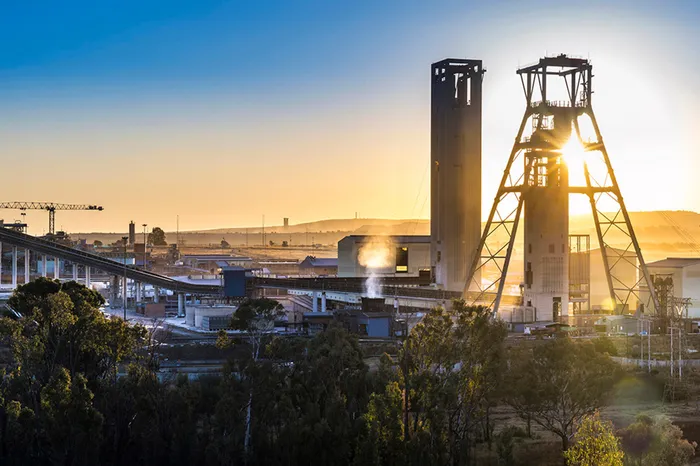
Gold Fields' South Deep gold mine in South Africa. The global mining group is confident it can meet its production and cost guidance as long as the cost increases experienced in the first quarter did not continue to increase.
Image: Siupplied
Gold Fields delivered a solid start to 2026 but warned its cost guidance for the full year might not be attained if costs continued to rise as they had in the first quarter.
CEO Mike Fraser said in a quarterly operational update on Thursday that there had been significant increases in a number of their key commodities since the Iran war commenced.
Since February, the group saw diesel increases of between 30% to 70%, explosive increases of about 10%, cyanide increases of around 10%, freight increases of approximately 40%, and LNG increases of about 30%.
“The forecast impact of this, assuming an oil price of $100/bbl, is between $40/oz to $50/oz on a portfolio level,” he said.
“We are confident we can remain within our guidance range, but if prices move higher, this will place significant pressure on our ability to deliver costs within the guidance range. Management have initiated several measures to mitigate these cost pressures, including asset optimisation and broader cost optimisation initiatives,” said Fraser.
He said the group had, in its first quarter to March 31, built on the positive safety, operational, and financial delivery of 2025, with strong cash flow generation in the quarter, driven by increased sales volumes and higher gold prices.
“Our operations delivered largely according to plan during the quarter, underpinned by strong delivery from Salares Norte following the achievement of steady-state operations in the fourth quarter of 2025,” said Fraser.
Group attributable gold-equivalent production for the quarter was 15% higher year-on-year, although lower by 7% quarter-on-quarter. All-in costs (AIC) increased by 10% YoY versus 4% QoQ, while all-in sustaining costs rose by 13% YoY (9% QoQ).
“These costs were in line with planned additional discretionary activity, but negatively impacted by higher royalties, stronger producer currencies, and recent global inflationary price impacts,” said Fraser.
Net debt decreased by 34% YoY to $1.31 billion as at March 2026. This was after payment of the final dividend of $1.23bn on March 16.
In February, the group announced $100 million had been allocated to a share buyback program as part of a revised capital allocation framework.
However, share repurchases had been limited in the quarter, mainly due to the high volatility in global markets since the beginning of the US–Iran war.
“This volatility adversely affected gold and gold equity prices. We continue to look for opportunities to execute this program with discipline,” said Fraser.
Attributable gold-equivalent production was 633koz compared to 551koz in the first quarter of 2025.
Salares Norte’s first full year of production started positively, with strong performance in the second half of 2025 continuing into the quarter.
Production was 173koz gold-equivalent, an increase of 245% year-on-year, and an 8% increase quarter-on-quarter. This was driven by higher throughput and higher gold and silver recoveries.
Gruyere’s gold production was 25% lower at 53koz primarily due to heavy rainfall, affecting ex-pit mining activities and lower equipment and operator availability.
Ore production rates improved through the quarter, with run rates restored by the end of the period. A recovery plan was being implemented.
Agnew delivered 45koz, a 31% decrease after seismic events impacted the Kath orebody, the mine’s primary high-grade source, which required additional rehabilitation and slowed stoping cycles.
The mine was clearing the pastefill backlog and increasing mined tons to offset lower grade feed, to support a return to more stable production levels.
Labour availability and workforce stability continued to present challenges across the group’s Australian operations.. Workforce initiatives were progressing.
Tarkwa’s production fell by 25% YoY to 94 koz driven by lower yield and lower tons milled.
This was due to a lower average feed grade as the mill processed a higher proportion of low-grade stockpile material versus ex-pit ore. In addition, throughput was constrained by reduced plant availability following unplanned downtime.
“We remain confident in achieving our full-year production guidance. While Gruyere, Agnew, and Tarkwa faced operational challenges this quarter, each site is executing a defined recovery plan,” said Fraser.
“The balance of the operations delivered production in line with the plan.”
Gold Fields’ management was confident it was on track to obtain the final environmental approval for the Windfall project during 2026, and final investment decision thereafter.
BUSINESS REPORT