

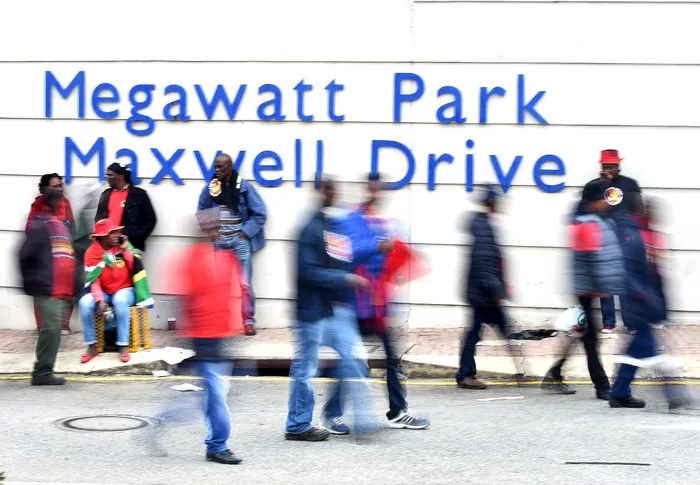
Eskom paid its staff R3.7 billion in a reintroduced short-term performance incentive award in 2025.
Image: : Itumeleng English/Independent Newspapers
Hard on the heels of a first profit from a financial turnaround, Eskom paid its employees R5.4 billion in bonuses last year, equivalent to R128,000 each, when it reintroduced a short-term bonus scheme, the integrated annual report discloses.
The Democratic Alliance, one of the two largest parties in the Government of National Unity, on Friday said the bonus is “unacceptable” in light of rising electricity prices, spiralling municipal debt owed to Eskom, and the utility's ongoing financial weakeness.
However, Eskom states in the report that it reintroduced the short-term performance incentive because “the performance gains from a motivated workforce outweigh the cost of the incentives.”
According to the report, Eskom paid its employees R3.7bn for the short-term performance last year, as employees had not received annual short-term incentives for the previous six years due to “poor operational performance and severe financial constraints.” The utility only saw the first signs of a turnaround last year.
Eskom staff also received a R1.21bn production bonus and their R1.55bn annual bonus, essentially a 13th cheque, for 2025, apart from the short-term performance incentive. Eskom’s total salary bill increased by over 9% to R29.54bn in the 2025 financial year from R27.08bn the year before.
“While South Africans buckle under double-digit electricity increases and rising inflation, Eskom has rewarded its staff with over R5.4bn in performance incentives. This is unacceptable,” said the DA spokesperson on energy and electricity, Kevin Mileham.
This comes as the National Union of Metalworkers of South Africa (Numsa) has declared a deadlock in wage negotiations with Eskom, rejecting the utility’s offer of a 7% annual increase over three years and warning of escalating tensions if the impasse is not urgently resolved.
Numsa last month criticised what it called a “double standard” in remuneration, pointing to significant increases awarded to senior executives, alleging that top management received salary hikes of more than 100%, with annual packages rising from about R2.8 million to R5.8m, alongside bonuses of at least R2m.
However, Eskom rejected claims made by Numsa regarding its 2026 wage budget and executive remuneration as “incorrect and misleading”, saying that its internal budgeting for wage adjustments was determined by what is affordable and sustainable within approved parameters.
Meanwhile, while Eskom may be back in the black, it remains beset with financial problems. For instance, the annual report stated that some R7.2bn of losses were reported due to alleged criminal conduct in its year to March 31, 2025, some 7.5% higher than a year before.
The cumulative balance of its irregular expenditure amounted to R103.9bn (2024: R103.2bn), most of which related to historic transgressions.
The fruitless and wasteful expenditure came to an estimated R14.2bn - of which R13.3bn related to expenditure in prior years - and it was being assessed before it could be confirmed and disclosed as fruitless and wasteful expenditure, the report said.
Last year, Eskom reported a profit before tax of R23.9bn, a turnaround from a loss of R25,5bn the previous year, supported by a 12.74% standard tariff increase, coupled with easing cost pressures and cost recoveries, mostly linked to reduced spending on OCGTs and the recovery of previously disallowed fuel levy rebates from SARS.
Mileham, however, called Eskom's return to profitability “a statistical mirage,” as the R23,9bn "profit" was dwarfed by R64bn in government support throughout the year.
In addition, municipal arrear debt surged 27% in a single year to R94.6bn, with the amounts owed by the Johannesburg and Tshwane municipalities rising by staggering 309% and 81% respectively, fover the year.
Meanwhile, the report showed that the utility also received a “qualified” audit opinion from its auditors because its alleged R16.3bn in savings from turnaround initiatives were found to be overstated by R6.3bn.
BUSINESS REPORT