

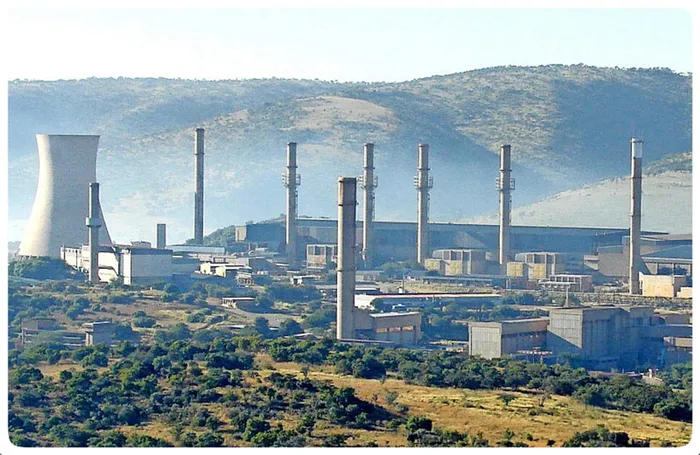
The Pelindaba nuclear research facility outside of Tshwane. The Nasdaq-listed ASP Isotopes intends develop low enriched uranium using its enrichment technology.
Image: Supplied
ASP Technologies, a Nasdaq emerging growth company that listed on the JSE in August with the acquisition of local gas producer Renergen, has warned that it expects to report losses for some time and that it will also require substantial future funding.
The producer of enriched isotopes used in medicine, energy, and industry such as semiconductors, and a company that also plans to produce low enriched uranium in South Africa, said in its annual report Tuesday it has incurred significant net losses since inception, and further “significant net losses” were expected for the foreseeable future.
“We also have a limited operating history, which may make it difficult to evaluate our prospects and likelihood of success,” the company’s directors warned in the section of the report that assesses risks to the company.
“We expect these losses to increase as we continue to invest in our research and development activities; develop Phase 2 of the Virginia Gas Project; seek applicable regulatory approvals; experience any delay, hire additional engineering and production personnel, and build internal resources, including those related to audit, patent, other legal, regulatory, and tax-related services,” directors said.
As of December 31, 2025, the company held cash and its equivalent of about $285.6 million, and short-term investments were some $47.7m. The directors said this, along with IDC Debt Funding, a Standard Bank loan, and a DFC Credit Facility, was estimated to be sufficient to fund operations for at least the next 12 months.
“We have not yet demonstrated the ability to produce commercial quantities of enriched isotopes using the ASP technology or QE technology nor an ability to overcome many of the risks and uncertainties frequently encountered by companies in the medical, technology, and energy industries, including an ability to obtain applicable regulatory approvals, manufacture any isotopes at commercial scale, or conduct sales and marketing activities necessary for successful isotope commercialization,” the directors warned.
“In addition, we have not yet sought any regulatory approval that may be necessary for the application of isotopes that we may produce for the medical industry or the production of enriched U-235,” they said.
An example of future capital cost commitments included Phase 2 of the Virginia Gas Project, which the company estimated would require at least about $1.16 billion in costs to complete.
ASP's headline loss per share, basic and diluted, amounted to 83 US cents for the 2025 financial year, well up from 45 US cents the year before. Net loss per share came to $2.11 versus 63 US cents the year before.
Operations to date had been mainly focused on acquiring assets, organizing and staffing the company, research and development activities, business planning, raising capital, and providing general and administrative support for the operations.
General and administrative expenses for the year were $48.2m, compared to $24.8m in 2024. The overall increase was primarily due to an increase in personnel-related costs of $12.4m from an increase in headcount, salaries, and related costs; and an increase in professional fees of $7m due to corporate development activity and consulting costs related to a new general ledger system.
Other expenses for the year were $99.7m, which included a $123.7m expense due to the change in the fair value of convertible notes, partially offset by interest income of $6.8m, a change in the fair value of investments of $17.9m, and other income of $0.2m.
“Our initial focus with respect to our isotope enrichment platform is on the production and commercialization of enriched Carbon-14 (C-14), Silicon-28 (Si-28), and Ytterbium-176 (Yb-176). We commenced commercial production of enriched isotopes at both of our ASP enrichment facilities located in Pretoria, South Africa, during the first half of 2025.”
“The second ASP enrichment facility, substantially larger than the first, should have the potential to enrich kilogram quantities of relatively heavier isotopes,..We are targeting initial commercial shipments of enriched C-14 in mid-2026. We are targeting initial commercial shipments of enriched Si-28 during the second quarter of 2026,” the directors said.
The commissioning phase of a third enrichment facility was completed and commercial samples of highly enriched Yb-176 were being produced, with initial commercial shipments of Yb-176 envisaged in mid-2026 or the third quarter of 2026.
The group was also considering using its enrichment technologies to enrich Uranium-235 (U-235) in South Africa, which could be commercialised as a nuclear fuel component for the new generation of high-assay low-enriched uranium-fueled small modular reactors that were now under development for commercial and government uses.
BUSINESS REPORT