

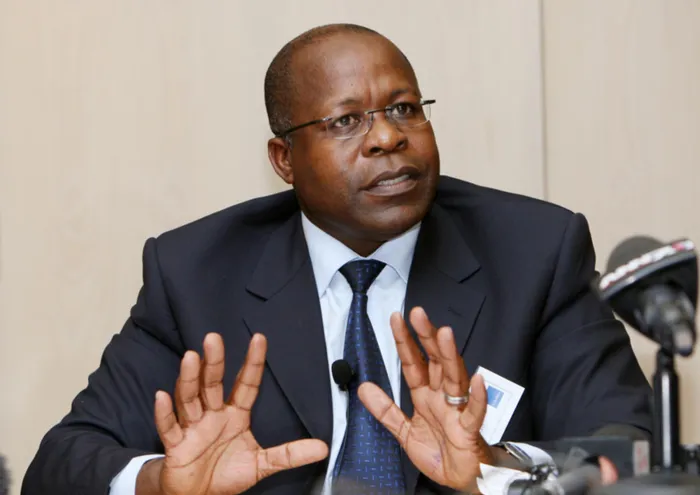
Exxaro Resources CEO Ben Magara
Image: Simphiwe Mbokazi/independent Newspapers
Exxaro Resources, the large diversified South African resources group, lifted its final dividend by 15% for the year to December 31 to R10 per share and enhanced its dividend payout ratio for shareholders.
Revenue from its coal, energy, and metals market interests increased by 3% to R41,8 billion, while profit fell by 7% to R7,1bn. CEO Ben Magara said in an online presentation that this was a good, resilient performance given that coal prices fell between 14% and 15%. Headline earnings per share increased by 8% to 3,247 cents.
“Despite weaker export coal pricing, our strong marketing capabilities, disciplined cost management, and good production, combined with the defensive nature of Exxaro’s portfolio, enabled us to sustain a resilient EBITDA (earnings before interest, tax, depreciation, and amortisation) performance, slipping marginally by 2% to R10,23bn,” he said.
He said that after a difficult first half, when production was impacted by heavy rainfall, notable improvements in the performance of Eskom and Transnet allowed the group to report a 9% increase in export coal volumes.
He also mentioned that Transnet Freight Rail (TFR) ended the year at 57 million tons of coal transported, which was well up from 52 million tons the year before, but this was still far below the Richards Bay Coal Terminal capacity of 91 million tons per year.
Furthermore, TFR’s Waterberg freight line was operating well below capacity. Exxaro indicated to the government that it wishes to participate in freight rail public-private partnerships and is willing to invest capital into these partnerships.
Highlights for the group over the year included adding manganese to the portfolio of natural resources. Exxaro entered the manganese sector by acquiring stakes in key South African manganese mines — Tshipi Borwa, Mokala, and Hotazel for R11,67bn.
FerroAlloys was divested on October 31, 2025, marking an exit from a non-core asset and a pivot to energy transition minerals.
Leeuwpan Mine’s turnaround strategy progressed well, and all employees issued with Section 189 notices were relocated to other operations in the group, he said.
The Matla mine extension project was well ahead of schedule, with coal production from the new shaft — the mine reported a 14% increase in production, the largest within the group, as a result, said Magara.
Construction of the 140MW Karreebosch project was advancing, with commercial operation expected in the first half of 2027. The 68MW Lephalale solar plant supplying the Grootegeluk mine was commissioned.
Competition Tribunal approval was received to acquire the 138MW Gouda wind farm and the 75MW Sishen solar plant. Cennergi was selected as the joint preferred bidder for the 240MW Corona solar project. The group was recovering around R100m a year on electricity costs, he said.
A revised dividend policy reinforced their commitment to superior shareholder returns, he said. The dividend cover was reduced to a range of between 1,5 to 2,5 times on adjusted earnings, from 2,3 to 2,5 times previously. Some R1,2bn of share buybacks was completed last year.
He said their diversified natural resources are underpinned by a strong coal base, with global demand likely to stretch well beyond 2050; a growing energy solutions business; equity-accounted investments in iron ore and base metals; and the recent acquisition of select manganese assets in the Kalahari Manganese Field, which boded well for the group's future.
The group recorded zero work-related fatalities in the financial year, marking 40 consecutive months without a fatality, which Magara said was an industry-leading performance. He said that while he did not like to measure performance in terms of fatalities, it was an acknowledgment of “where we come from.”
Following the completion of the acquisition of the manganese assets, the group will no longer maintain the previously targeted cash buffer of R12bn to R5bn.