

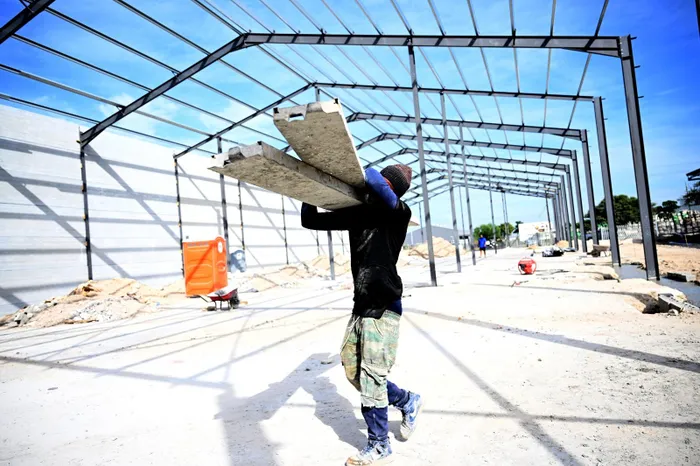
The development of a new industrial park in Blackheath, Western Cape. The Afrimat Construction Index (ACI) has shown that activity increased for a second consecutive quarter during the last three months of 2025.
Image: Ayanda Ndamane / Independent Newspapers
The Afrimat Construction Index (ACI) increased for a second consecutive quarter in the last three months of 2025, the first time this has happened since the brief recession of 2020, indicating improving activity levels in the sector.
The ACI, released Thursday, showed a marginal year-on-year increase in activity in the fourth quarter, boosted by a 5.4% surge in building materials produced and a 2.2% increase in building materials sales values.
Dr Roelof Botha, economist and compiler of the ACI, said although the activity levels in South Africa’s construction sector remain subdued, the ACI’s seasonally adjusted reading has increased for the second consecutive quarter.
He said the most impressive aspect of the latest index is the positive growth trend for the indicators that carry the largest weighting, namely sales values and volume of production of building materials. He said Afrimat, a major provider of materials for the construction industry, had reopened quarries due to the increased demand.
“Five of the 10 indicators recorded positive year-on-year growth rates, whilst seven recorded positive quarter-on-quarter growth during the fourth quarter of 2025,” he said.
He said the rate-cutting cycle of the monetary policy authorities had played a crucial role in lowering the cost of capital formation, which invariably involves construction works and building activity.
“Hopefully, the current hostilities in the Middle East will not derail the shift to a more accommodating monetary policy stance, as further interest rate declines are necessary to lift the ACI from its current stable level to an expansionary trajectory,” he said.
He said higher oil prices would increase costs for the construction industry, but it was possible the oil price would fall swiftly if the war in Iran is short lived, as significantly oil reserves had been opened to the market through the crisis.
Botha believes it is encouraging that the value of construction works managed a quarter-on-quarter increase of 6.1% during the fourth quarter of last year, which it was often a subdued quarter due to the traditional winding down of building activity in mid-December.
He said the strong performance of private sector capital formation in buildings and construction works arose since interest rates were lowered from a 15-year high towards the end of 2024.
“After a period of lethargy caused by the deterioration of the country’s infrastructure and high interest rates, the private sector has started to invest substantially in capital formation, with an increase in the average quarterly value of these investments of 24% since the fourth quarter of 2024.”
He said public-private partnerships with infrastructure repair and expansion hold the promise of expanding economic activity within sectors that were labour-intensive and that affect ordinary citizens at the heart of their daily existence.
He is hopeful that the R141 billion that the National Treasury had set aside for water resources and road infrastructure would result in the speedy implementation of new projects.
Afrimat CEO Andries van Heerden said the group’s deliberate diversification strategy had again proven successful, and the group’s Construction Materials segment, particularly aggregates, was delivering strong results, which aligned with the findings of this ACI.
“Our strategic national footprint has ensured we are well-positioned to supply products to Transnet as it maintains the rail corridors. Afrimat continues to supply products and aggregates for national, provincial, and rural road construction, as well as for public-sector maintenance and private-sector building projects,” he said.
Earlier this month, the FNB/BER Building Confidence Index showed sentiment remained relatively stable in the first quarter of 2026 relative to the fourth quarter.
The important exceptions, however, were residential builders and building material manufacturers. A non-residential building recovery was on track, although off a low base, underpinned largely by additions and alterations. In contrast, new developments, especially in the residential building sector, were still relatively elusive.
BUSINESS REPORT