

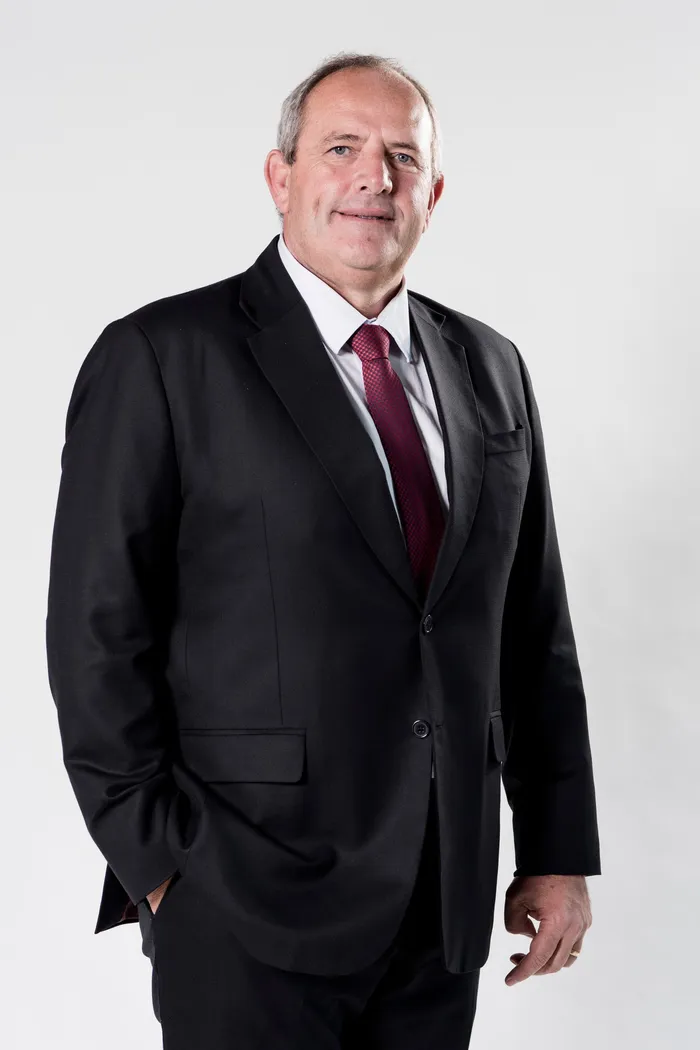
Chris Vorster, CEO of STADIO Holdings. .
Image: Supplied
STADIO Holdings’ share price shot up over 5% in the JSE on Tuesday after the private higher education group reported a strong 22% increase in core headline earnings.
The group also announced it is well on track to reach its pre-listing target of 56,000 students by 2026, and that it is now aiming for 80,000 students by 2030.
The share price had stepped up 5,77% to R11.37 on Tuesday early afternoon, a price that is fully 55,8% higher than where it traded at 12 months ago.
CEO Chris Vorster said in an interview they were excited to see such good growth in a weak economy, and with consumer disposable incomes under pressure.
A trend they had noticed was that students now tended to not abandon their studies if they could not pay their fees; instead, they stopped studying for a while until the arrear fees were paid before they resumed their studies.
STADIO provides access to higher education through its three registered private Higher Education Institutions - STADIO Higher Education, Milpark Education, and AFDA, which offer undergraduate and postgraduate programs in both contact and distance learning modes of delivery.
Revenue for the year increased by 14% to R1.8 billion, earnings before interest, taxation, depreciation, and amortisation increased 21% to R553 million, and core headline earnings per share, a benchmark of the underlying performance, grew by 22% to 38,5 cents per share.
An annual dividend of 18.4 cents a share was 22% higher than last year’s 15.1 cents.
Student numbers in the first semester increased by 9% to 51,197 and in the second semester by 7% to 53,303.
“We continue to work towards widening access for more students to quality higher education. In 2025, we saw student numbers continue to grow; 2026 also sees the group shifting gears to focus on key steps to reach more than 100,000 students in time,” he said.
The first phase of the new Durbanville campus had been completed, and 1,300 students were welcomed to the campus this year, well up from an initial target of 1,000. The second phase, completing in August, should push student capacity of the campus up to 5,000 from 1,800, said Vorster.
“We had good contact learning growth in 2025, while technology and process improvements continue to provide efficiencies coupled with enhanced student experience,” he said.
The development and accreditation of new qualifications continued, and the group now offers more than 100 qualifications.
Distance learning remains STADIO’s main mode of delivery, and now represents 87% of group enrolments, exceeding the long-term target of 80% distance learning to 20% contact learning.
“Distance learning underpins margin expansion and geographic scalability in the group. Contact learning supplements the distance learning offering and provides support to our distance learning students,” said Vorster.
Contact Learning at STADIO Higher Education has seen solid growth, with the Centurion campus students increasing by 30% in the 2026 year to date, with registrations not yet finalised.
“What is clear to us is that our investment in key comprehensive campuses is paying off. We also see opportunities in the market for other contact learning offerings. The group has therefore decided to create more capacity at our existing campuses,” he said.
At the Centurion campus, the hall had been converted into additional lecture space, and a new 2,000-seater hall was being constructed. At Waterfall, a Curro building was acquired for further expansion on the same site, and at Musgrave, more space was leased to increase capacity.
Vorster said tthe Higher Education sector continues to grow and the share accorded to the Private Higher Education sector represented 21% of the total market in 2023 against a global average that is closer to 33%.
Current challenges included uncertainty being created by the announcement of "Free Education" in Namibia, where the group has some 3,000 students. Milpark’s business-to-business operations continued to lag, and there was extreme pressure on the film industry, which was impacting AFDA.
However, “we believe the higher education landscape is set to change materially with new regulations to allow Private Higher Education institutions to be called universities,” said Vorster.
The group remained committed to preserving stakeholder value and limiting dilution of shareholders' shareholding where feasible. Accordingly, the repurchase of 6.9 million shares for R75.7 million was completed, and the shares were immediately cancelled.
BUSINESS REPORT