

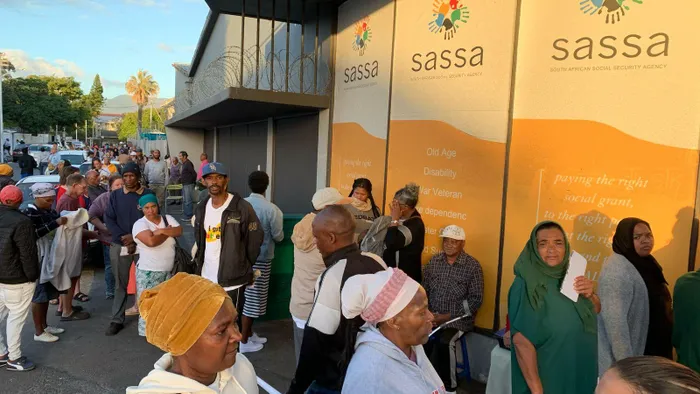
Elderly grant beneficiaries queue from as early as 3am outside the Wynberg Sassa office to replace their gold cards. According to the IEJ research, the majority of fraud cases in the social grant system over the past decade were committed by insiders rather than beneficiaries.
Image: Tracey Adams/Independent Newspapers
New research has warned that South Africa’s intensified crackdown on fraud in the social grant system is increasingly targeting beneficiaries rather than the main sources of wrongdoing, and that the measures risk excluding vulnerable people who depend on social protection.
The findings from the Institute for Economic Justice (IEJ) research presented on Wednesday said new surveillance and verification mechanisms introduced by the government - including bank account monitoring, biometric checks and algorithmic risk detection systems - are often inaccurate and disproportionately affect the poor, elderly and disabled.
According to the IEJ research, the majority of fraud cases in the social grant system over the past decade were committed by insiders rather than beneficiaries.
Dr Kelle Howson, a senior researcher on workers’ rights and social security at the IEJ, said the data shows that between 2014 and 2025, about 75% of reported social grant fraud cases involved government employees or contractors.
Howson said that by contrast, fraud committed by grant beneficiaries accounted for only 17% of reported cases.
“Historically we’ve seen fraud being perpetrated much more by government insiders and officials than by actual grant recipients and beneficiaries,” Howson said.
“These measures are being justified by alarmist narratives of widespread fraud. But the evidence suggests the problem is being overstated, while the consequences are falling on the most vulnerable members of society.”
Despite this, the current fraud detection systems largely focus on monitoring beneficiaries themselves.
The government has introduced a range of digital verification measures aimed at identifying ineligible grant recipients. These include monitoring beneficiaries’ bank accounts, cross-checking credit bureau records, and matching biometric data with information held by the Department of Home Affairs.
Authorities are also checking multiple government databases, including records from the South African Revenue Service (Sars), the Unemployment Insurance Fund (UIF), correctional services and government payroll systems, to determine whether beneficiaries have undeclared income.
These data streams are fed into automated systems that flag individuals who may be suspected of fraud or ineligibility.
However, researchers warned that these systems are prone to errors and can lead to wrongful exclusion.
One major concern is that the bank verification system cannot distinguish between different types of deposits into a beneficiary’s account.
For example, payments such as child maintenance, remittances, short-term loans or gifts can be misinterpreted as income exceeding the eligibility threshold for social grants.
Research into the Social Relief of Distress (SRD) grant found that in cases where applications were rejected because of bank verification checks, 54% of those exclusions were erroneous - meaning the applicants were in fact eligible for assistance.
Howson said such inaccuracies highlighted deeper problems in the design of the system.
“There are fundamental issues of data quality and accuracy in the databases that are being used to determine eligibility,” she said.
According to the research, government records are often outdated, meaning people who were previously employed or received other forms of support can be wrongly flagged even after their circumstances have changed.
The research also raised concerns about privacy and transparency. Grant applicants are required to consent to extensive data sharing, effectively allowing the government to access information from public and private institutions to verify eligibility.
In addition, decisions are increasingly made through automated or algorithmic systems, which researchers say lack accountability.
When individuals are flagged by these systems, they are typically asked to appear at South African Social Security Agency (Sassa) offices within 30 days to conduct a grant review. Failure to do so can result in their grant being cancelled.
But for many beneficiaries, particularly those in rural areas or those caring for children, elderly relatives or people with disabilities, Howson said attending these reviews is difficult.
She said transport costs, long queues at Sassa offices and limited administrative capacity often prevent people from completing the process within the required timeframe.
According to Sassa reporting, many grants cancelled through the review process were not terminated because fraud was proven, but because beneficiaries failed to attend the review.
“The vast majority of cancellations are not due to confirmed fraud or ineligibility, but because people were unable to complete the review,” Howson said.
At the same time, National Treasury has highlighted savings from the crackdown, saying enhanced verification processes could save about R3 billion over the next two years.
Abigail May, investigator at Open Secrets, warned that pressure to meet these savings targets could lead to even more aggressive grant reviews and cancellations.
“These government institutions aren't wrong. There is fraud and there does need to be a crackdown. The problem is is how they're implementing this crackdown is definitely focusing on the wrong on the wrong targets in my opinion,” May said.
BUSINESS REPORT