

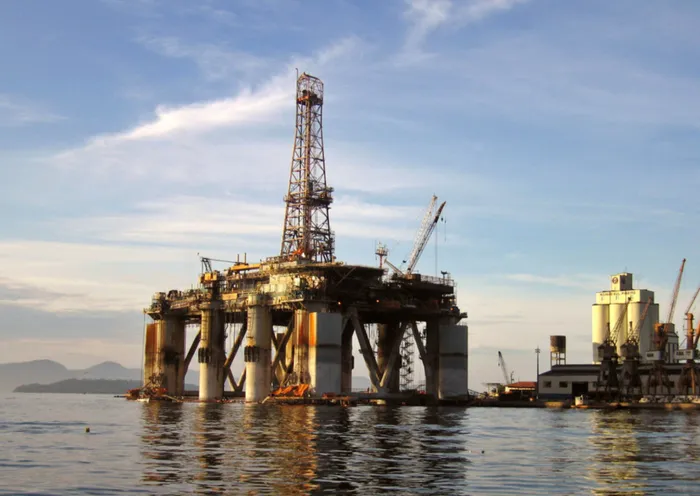
An oil rig is shown in this file photo. The benchmark Brent crude have surged into what analysts describe as “shock mode”, settling above $114 per barrel on Monday after briefly touching $119 during trading.
Image: File
Global oil prices could climb as high as $150 a barrel if disruptions to energy supply in the Middle East worsen, analysts warn, as the escalating conflict in the region drives volatility across global energy markets.
The benchmark Brent crude have surged into what analysts describe as “shock mode”, settling above $114 per barrel on Monday after briefly touching $119 during trading.
Prices had already climbed above $110 on Sunday, marking a sharp reversal from late February when oil was still trading in the low $70s. The surge represents the largest one-day gain since April 2020 and pushes prices to their highest level since June 2022, following a rally that has seen oil jump nearly 30% in a matter of days.
The sudden spike comes as geopolitical tensions in the Middle East escalate and disrupt global energy supply chains, particularly around the strategically important Strait of Hormuz. The waterway is one of the world’s most critical energy chokepoints, with roughly 20% of global oil and liquefied natural gas supplies normally passing through the strait.
Analysts on Monday said the market reaction reflects growing fears that shipping routes and regional oil production could remain disrupted for an extended period.
Ipek Ozkardeskaya, a senior analyst at Swissquote, said oil markets reacted sharply as hopes for a quick resolution to the conflict faded.
“Oil prices will reach a peak at some point – maybe they already have, maybe there’s more to come – but they are likely to fluctuate at elevated levels for weeks, perhaps months,” she said.
“Eventually – even if the war persists – energy prices will likely come down. But during this period, high energy prices will revive inflation globally and weigh notably on growth.”
Ozkardeskaya said the situation intensified after Iran appointed Mojtaba Khamenei, the son of the late Ayatollah Ali Khamenei, as the country’s new supreme leader.
The move signals a continuation of Iran’s hardline stance and suggests the conflict involving Israel and the United States could last longer than markets initially expected. The choice suggests that Iran will not back down to the US, meaning a potentially prolonged war in the Middle East, she said.
The region is home to around half of the world’s oil reserves and roughly 40% of global natural gas reserves, making any disruption there particularly significant for global markets.
Production cuts across several Gulf producers are already tightening supply. These supply disruptions follow earlier production cuts by Qatar, which reduced liquefied natural gas output last week. Analysts said further disruptions could push oil prices even higher.
Rylan Chase said oil could reach $150 per barrel under more severe supply conditions.
“Is $150 possible? Yes, but it would usually require harsher conditions than the market has fully confirmed today, such as a prolonged blockage of Hormuz flows and significant production outages across multiple Gulf producers,” Chase said.
Investment bank Goldman Sachs has also warned that prices could reach $150 if supply disruptions persist and shipping flows remain significantly restricted.
Although this is considered a stress scenario rather than the base case, historical precedents show such levels are not impossible.
Brent crude reached an all-time high of nearly $147.50 in 2008, while prices also surged above $110 during parts of 2022 following the global energy shock triggered by Russia’s invasion of Ukraine.
Economists warn that sustained high oil prices could have serious consequences for the global economy. For countries such as South Africa, rising oil prices could have multiple economic impacts beyond higher fuel costs.
Higher energy prices typically feed into broader inflation, raising the cost of transporting goods and producing consumer products.
Johann Els said current oil price levels could push South Africa’s petrol price up by as much as R4 per litre in April, potentially lifting inflation closer to 4%.
Els said that could force the South African Reserve Bank to delay expected interest rate cuts until there is greater clarity about the global outlook.
“If the conflict ends relatively soon and oil prices fall back towards pre-war levels, those rate cuts could still materialise later in the year,” Els said. “Ultimately, the duration of the conflict will determine how the outlook for inflation and interest rates evolves.”
BUSINESS REPORT