

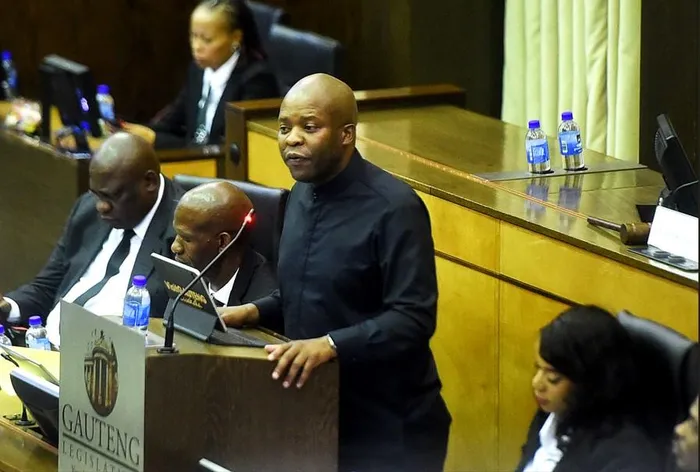
Gauteng MEC for Finance and Economic Development Lebogang Maile presented the budget to the provincial legislature on Tuesday, describing it as a plan aimed at addressing key service delivery challenges while maintaining fiscal discipline.
Image: Itumeleng English/Indepedent Newspapers
The Gauteng provincial government has tabled a R179.2 billion budget for the 2026/27 financial year, with a strong focus on improving service delivery, strengthening infrastructure, and supporting economic growth and job creation in the country’s economic hub.
The provincial government said the budget aims to balance fiscal sustainability with the urgent need to improve public services, stimulate economic growth and address the social challenges facing Gauteng’s rapidly growing population.
Gauteng MEC for Finance and Economic Development Lebogang Maile presented the budget to the provincial legislature on Tuesday, describing it as a plan aimed at addressing key service delivery challenges while maintaining fiscal discipline.
The budget forms part of a broader Medium-Term Expenditure Framework (MTEF) totalling R549.3bn over three years, with R179.2bn allocated for 2026/27, rising to R182.4bn in 2027/28 and R188.2bn in 2028/29.
Maile said the budget is guided by the theme emphasising the province’s intention to tackle structural challenges such as unemployment, failing infrastructure, crime and poor service delivery.
“These priorities include unemployment, gender-based violence, failing infrastructure, water shortages, poor services at hospitals and clinics, crime, and the growth of informal settlements,” he said.
The bulk of the provincial budget will continue to be directed toward social services, particularly health, education and social development, which collectively account for about 83% of total spending over the medium term.
Education and health remain the two largest areas of expenditure.
Education has been allocated R70.9bn in 2026/27, rising to R221.8bn over the three-year period. The funding will support early childhood development programmes, learner performance initiatives, school safety measures and pro-poor interventions such as nutrition schemes and scholar transport.
Health will receive R70.3bn in 2026/27, increasing to R218.6bn over the MTEF. The funding is intended to strengthen public health services, including maternal and child healthcare, improved emergency medical response times, digital health systems and HIV and TB interventions.
Additional funding has also been set aside to stabilise the health system and address operational pressures such as security, medicines, medical supplies and legal costs.
Infrastructure development has been identified as another major focus area in the budget, with R36.4bn allocated for infrastructure projects over the medium term. Of this amount, R22.7bn will be used to expand infrastructure capacity to meet growing demand for services, while R13.8bn will go towards maintaining and upgrading existing facilities.
Departments receiving the largest infrastructure allocations include health, education, human settlements and roads and transport, reflecting government’s efforts to improve access to social infrastructure such as hospitals, schools and housing.
Maile said infrastructure investment remains critical to economic growth, job creation and improved service delivery.
“Infrastructure is the bridge between hope and visible delivery. It is where residents see whether government can do what it says,” he said.
The provincial government is also placing renewed emphasis on economic development and investment attraction as part of its efforts to stimulate job creation.
Economic Development has been allocated R1.8bn for 2026/27, increasing to R4.9bn over the MTEF. The funding will support Special Economic Zones, township automotive hubs, industrial park revitalisation and trade initiatives linked to the African Continental Free Trade Area.
The budget also builds on the outcomes of the Gauteng Investment Conference held in 2025, which secured R312.5bn in investment pledges. According to the provincial government, about 28% of these commitments have already been converted into projects valued at more than R80bn that are currently being implemented.
The province aims to secure R800bn in investment commitments by the end of the current administration.
Roads and Transport have been allocated R10.2bn for 2026/27 to improve road infrastructure, expand public transport systems and support economic growth. Human Settlements will receive R5.5bn to upgrade informal settlements, deliver housing projects and improve access to basic services.
Community safety programmes will also receive funding, with R2.3bn allocated to strengthen policing oversight, road safety and efforts to combat gender-based violence and femicide.
Despite the increased spending, Maile cautioned that the province faces significant fiscal constraints.
Transfers from national government remain the main source of funding, while Gauteng’s own revenue accounts for only about 5% of total income, largely from motor vehicle licence fees, gambling taxes and patient fees.
The province is also dealing with major financial obligations, including the repayment of e-toll debt, which continues to place pressure on public finances.
“We must be honest about our fiscal reality and the nature of obligations that significantly narrow our room to manoeuvre. For example, the province has already paid R9.3bn against the principal e-Toll debt of R20bn, and R4.6bn is required for the next instalment in June 2026,” Maile said.
“In the last two years of the 2026 MTEF, a further R6.2bn mustbe paid. These are consequential amounts that will have a significant implication on how we plan and execute.”
Maile said maintaining fiscal discipline and improving the efficiency of government spending would be critical to ensuring that the budget delivers tangible improvements in the lives of residents.
“We must protect front-line services, but we must also demand better performance from every rand through targeted and responsible savings as an ongoing feature as we strive to close leakages and root out inefficiencies,” he said.
BUSINESS REPORT