

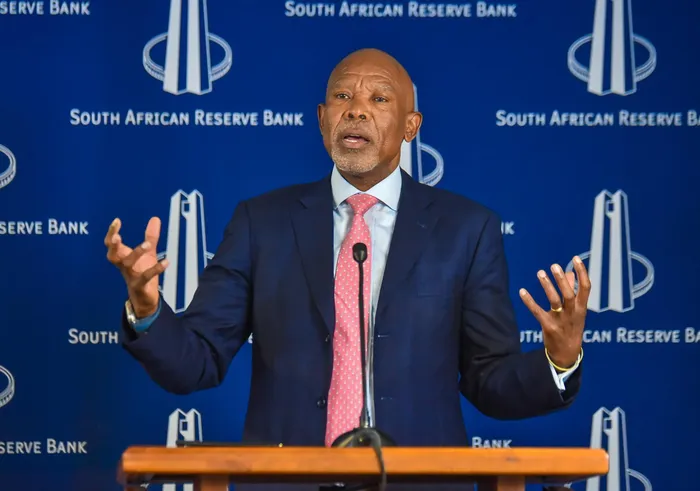
Lesetja Kganyago, Governor of the South African Reserve Bank. The Sarb's Monetary Policy Committee faces a delicate balancing act as inflation risks have emerged due to rising global oil prices on the back of escalating war in the Middle East.
Image: SARB | Facebook
South Africa’s interest rate outlook has become increasingly uncertain as escalating conflict in the Middle East drives volatility in oil prices, the rand and global financial markets, raising fresh questions about whether the South African Reserve Bank (Sarb) will proceed with further rate cuts this year.
At the start of 2026, the case for additional monetary easing appeared solid. Consumer price inflation stood at 3.5% year-on-year in January, comfortably close to the preferred 3% anchor.
With inflation well contained and economic growth modest, expectations had built around one further 25 basis point repo rate cut later this year to put the repo rate at 6.5%, and possibly another in early 2027.
The domestic growth backdrop remains subdued. GDP is forecast to improve only mildly to around 1.6% in 2026 from an estimated 1.4% in 2025. While last year’s rate reductions are still filtering through to households and businesses, the economy remains highly sensitive to credit conditions.
However, the military escalation involving the United States, Israel and Iran has altered the external environment. Oil prices surged from below $60 per barrel in early January to around $80 per barrel in recent days, at one point rising by nearly 10% in the immediate aftermath of the strikes.
For an oil-importing economy like South Africa, this introduces immediate inflationary pressure through higher fuel costs. The rand has also felt the strain, weakening to around R16.17 to the US dollar at one stage as global investors sought safe-haven assets.
The combined effect of a weaker currency and higher oil prices has lifted the rand-denominated oil price by roughly 12% in a matter of days. For now, the Sarb's Monetary Policy Committee (MPC) faces a delicate balancing act when it meets to decide on interest rates later this month.
Independent economist John Loos warned that global oil prices have become the key risk to the 2026 outlook. While the surge so far has not approached the extreme $150 per barrel spike seen in 2008, even moderate sustained increases can filter through to domestic fuel prices, lift transport costs and feed into broader inflation.
Loos said given that the Sarb has an inflation target of 3%, any oil and petrol price-driven inflation surge can quickly translate into a “premature” end to interest rate cuts, or even the onset of hiking, depending on how far it goes.
"It is not possible to predict events in the Middle East, or how they may disrupt fuel supply to the globe, but they do bring upside risk to the South African inflation rate, and by implication interest rates, due to the Sarb’s inflation targeting policy," Loos said.
However, Loos said he believed it plausible that a further two 25 basis point interest rate cuts could be implemented later in 2026 and early-2027.
Investec chief economist Annabel Bishop noted that the rand weakenness following the strikes while oil briefly touched $80 per barrel.
She said that if sustained, this could translate into a significant fuel price increase in April, potentially adding about 0.4 percentage points to monthly consumer price inflation (CPI) and lifting annual inflation towards 3.3%.
While fuel carries a relatively small weight in the CPI basket and base effects may soften the blow, Bishop said risks are skewed to the upside as further rand weakness or oil rising towards $100 per barrel could intensify inflation pressures.
"If the oil price elevated sharply further, and the rand weakened against the US dollar substantially, South Africa’s MPC would most likely look through this if it’s a temporary shock and not raise interest rates," she said.
Dr Ernst van Biljon of the IMM Graduate School added that the Strait of Hormuz, through which roughly a fifth of global crude flows, remains a critical pressure point.
He said that even perceived disruption introduces risk premiums into energy and shipping markets, raising input costs worldwide and complicating central banks’ easing plans.
Van Biljon said central banks, many of which were cautiously moving toward rate cuts, may pause if oil-driven inflation persists.
"For South Africa, the implications are amplified at a moment when everything had seemed to be improving. As a net importer of crude oil (and with already-high interest rates), the country is highly exposed to price shocks," he said.
BUSINESS REPORT