

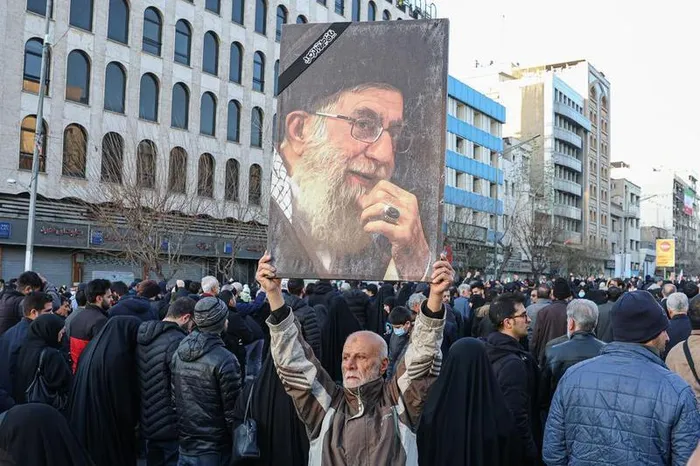
People gather to mourn the death of Iran's Supreme Leader Ayatollah Ali Khamenei in Tehran, Iran. Chairperson of the Standing Committee on Finance, Dr Joe Maswanganyi, on Monday said the conflict has direct implications not only for Asia and Africa broadly, but for South Africa in particular.
Image: Mehr News Agency/Handout via Xinhua
South African political leaders and labour groups have warned that escalating conflict in the Middle East could have far-reaching consequences for the domestic economy, with rising oil prices already translating into higher fuel costs for motorists.
Chairperson of the Standing Committee on Finance, Dr Joe Maswanganyi, on Monday noted the backdrop of intensifying hostilities involving the United States, Israel and Iran.
Maswanganyi reiterated the position of the African National Congress, which cautioned that the escalation carries “serious humanitarian, diplomatic, and economic consequences”.
Maswanganyi said the conflict has direct implications not only for Asia and Africa broadly, but for South Africa in particular. Central to these concerns is the vulnerability of the Strait of Hormuz, one of the world’s most critical maritime oil corridors.
Nearly one-fifth of global oil supply, approximately 17 million barrels per day, passes through the narrow waterway. Any disruption or sustained tension in the area could significantly affect global oil prices, with knock-on effects for transport costs, industrial production and household expenses worldwide.
"We condemn the violations of international law because this conflict is going to have a serious impact on our budget that has been tabled last week," Maswanganyi said.
"Today we live in the global village. We can't be here and say we are not worried about what is happening there. We are very worried because it has a direct impact on our economy and the countries that we trade with."
Echoing concerns about the legality and rationale of the military action, Songezo Zibi, national leader of RISE Mzansi, questioned the justification for renewed attacks on Iran.
Zibi noted that six months ago, the US and Israel conducted bombing campaigns against Iran, claiming the objective was to destroy its nuclear capability. At the time, US President Donald Trump declared that Iran’s nuclear programme had been “obliterated”.
"Therefore, there is no plausible reason why the United States would bomb Iran for the same reason as stated last year, having said that it obliterated Iran's nuclear program," Zibi said.
He maintained that unilateral military action to enforce one country’s view of another government’s conduct is unlawful under international law.
"In any event, it is not up to any one country to take unilateral action against another, especially in military terms, in order to enforce its own view of what that government should be doing," he said. "Therefore, this attack by the United States and Israel on Iran is unlawful in terms of international law."
Zibi further condemned attempts to destabilise or force regime change through military means, stating that democratic processes and established international legal mechanisms must be the only legitimate avenues for resolving such disputes.
He described the latest escalation as a threat to international peace, regional stability and global trade, warning that ordinary citizens across the world would ultimately bear the economic cost.
Those economic repercussions are already being felt at the fuel pumps as the petrol prices will rise by 20 cents per litre for both grades on Wednesday.
Wholesale diesel prices will increase sharply, with 0.05% sulphur diesel climbing by 62 cents per litre and 0.005% sulphur diesel by 65 cents per litre. Illuminating paraffin will increase by 44 cents per litre, while LP GAS will rise by 23 cents per kilogram.
There is deep concern in the markets over the recent geopolitical tensions as oil prices have surged from below $60 to above $80 per barrel during the month amid the escalating conflict.
Analysts warn that should retaliatory strikes hit Iranian infrastructure or a sustained blockade occur, we are looking at $110 per barrel oil. Although the rand showed some resilience, it was insufficient to offset the rise in international oil prices.
Prior to the attack on Iran, South Africa was enjoying a rare moment of cautious optimism as inflation had cooled to 3.5% in January, while the South African Reserve Bank (Sarb) was widely expected to initiate a rate-cutting cycle this month.
Frederick Mitchell, the chief economist at Aluma Capital, said the “inflation holiday” could be over.
"Higher international oil prices, combined with a depreciating rand, will exert massive upward pressure on the domestic fuel price. It is highly probable that the Sarb will be forced to hold the repo rate steady at 6.75% to anchor inflation expectations and defend the currency," Mitchell said.
"For the South African consumer, this means higher debt-servicing costs and a drain on disposable income just as the cost of living spikes."
BUSINESS REPORT