

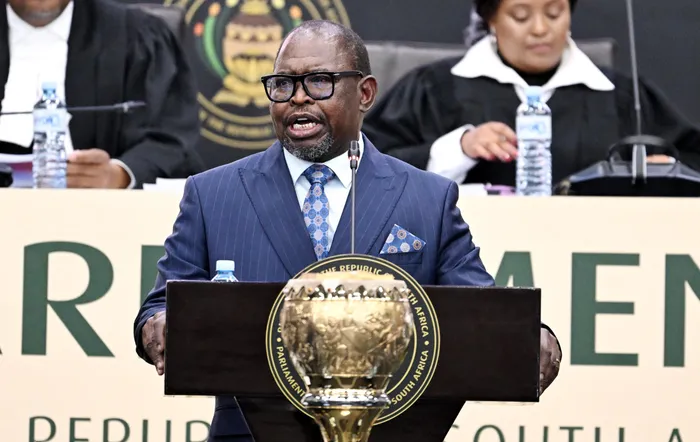
With finance minister Enoch Godongwana committing more than R1 trillion to infrastructure over the medium term, Parliamentary chairpersons across finance and oversight committees have placed municipal capacity, accountability and service delivery at the centre of the recovery agenda.
Image: GCIS
Parliamentary leaders have warned that local government performance will determine whether the country’s ambitious infrastructure drive delivers jobs and restores public trust, or falters under mismanagement and underspending.
With Finance Minister Enoch Godongwana committing more than R1 trillion to infrastructure over the medium term, Parliamentary chairpersons across finance and oversight committees have placed municipal capacity, accountability and service delivery at the centre of the recovery agenda.
Infrastructure investment of R1.07trln forms the backbone of that strategy. Of this, R205 billion is allocated to municipalities, alongside R217bn for provinces and R577bn for state-owned companies.
An additional R27.7bn over the medium term is earmarked for metro trading services reform, aimed at strengthening water, electricity and other core municipal functions.
Dr Joe Maswanganyi, the chairperson of the Standing Committee on Finance, expressed concern on Monday about persistent underspending by departments and municipalities. Parliament, he added, would intensify its oversight role to ensure value for money and labour-intensive project implementation.
The urgency is particularly acute in light of mounting service delivery failures, including water disruptions in major metros. Maswanganyi stressed that the attention currently focused on urban centres must also extend to rural municipalities, where failing infrastructure is a daily reality.
"We have seen this with the water crisis in Johannesburg. What we are looking at now in Johannesburg is what the rural people are facing daily. It is just that now it is at the metro level," he said.
"And now that there is that attention, we hope that the attention that the metros are getting will equally be given to the rural communities. The revenue collected for water and electricity must be reinvested into maintaining and expanding those systems."
This comes as the National Treasury has announced a decisive shift in the government’s approach to struggling municipalities, signalling a move from oversight to active structural intervention to address deepening governance, financial and service delivery failures at the local level.
Sanny Ndhlovu, the chairperson of the Select Committee on Finance in the National Council of Provinces (NCOP), reinforced the message that municipalities are the frontline of service delivery.
Ndhlovu raised pointed questions about whether revenue allocations to local government are sufficient, predictable and responsive to developmental backlogs.
She noted that rural municipalities often lack a meaningful property tax base and depend heavily on equitable share transfers and conditional grants. Unlike metros, they have limited industrial activity and high levels of indigence, constraining their ability to raise own revenue.
"Too often, fiscal debates are dominated by a small fraction of urban and well-resourced stakeholders. Yet the lived realities of poverty, unemployment, failing infrastructure, and weak municipal capacity are most acute in rural provinces," she said.
"While we acknowledge the severe fiscal constraints facing the country, we must interrogate whether the local sphere is adequately funded relative to its constitutional mandate.
"As a committee, we understand the importance of microeconomic stability. We are mindful of the fact that unsustainable debt could ultimately crowd out social and developmental spending to the detriment of the poor. However, fiscal consolidation must not undermine the constitutional mandate of local government."
Meanwhile, Ndhlovu said they will continue to insist on accountability, good governance, and consequence management.
That accountability theme was echoed strongly by Dr Mmusi Maimane, the chairperson of the Standing Committee on Appropriations, who acknowledged positive fiscal signals but cautioned that unemployment remains the defining crisis.
With 6 in 10 adults out of work, Maimane said, infrastructure and municipal effectiveness are essential to unlocking labour absorption and inclusive growth.
Songezo Zibi, the chairperson of the Standing Committee on Public Accounts (Scopa), said municipal dysfunction is obstructing economic recovery and undermining the impact of national policy commitments.
Zibi highlighted weak and often ineffectual Municipal Public Accounts Committees (MPACs), poor financial management and a culture of impunity around infrastructure projects.
Scopa, working closely with the Auditor-General and the Special Investigating Unit, will intensify scrutiny of municipalities, state-owned companies and departments involved in the R1 trillion infrastructure programme.
Zibi warned that mismanagement and corruption routinely erode funds intended for social and economic development, making it impossible to fulfil the promises outlined in policy statements.
"So, whenever we get the opportunity, we will examine closely the amount and quality of spending on local infrastructure maintenance and renewal," Zibi said. "We cannot grow the economy and create jobs if small, family-owned businesses and start-ups must contend with water disruptions and impassable roads."
BUSINESS REPORT