

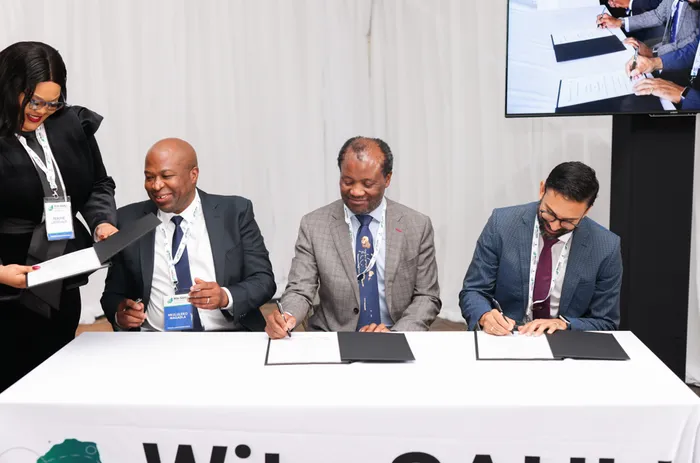
Nkululeko Magadla, CEO of Air Liquide South Africa, Professor Zeblon Vilakazi, Vice-Chancellor and Principal of Wits University and Irshaad Kathrada, CEO at the Localisation Support Fund (LSF) sign the Memorandum of Understanding for the construction of the R100 million Wits-SAHLI hydrogen plant.
Image: Supplied
South Africa’s ambition to build a competitive green hydrogen economy received a significant boost this week with the launch of the Wits–South Africa Hydrogen Localisation Initiative (Wits-SAHLI), a R100 million investment aimed at strengthening local research, skills and industrial capacity.
The initiative is a partnership between Air Liquide South Africa, the University of the Witwatersrand (Wits University) and the Localisation Support Fund (LSF). It will see the establishment of a modular pilot hydrogen plant on Wits’ West Campus, designed as a “living laboratory” for applied research, teaching and industry collaboration.
Speaking at the launch on Friday, Minister of Higher Education and Training, Buti Manamela, said South Africa has committed itself to building a competitive hydrogen economy aligned with Hydrogen Society Roadmap.
“Hydrogen is not just an alternative energy source. It represents energy security. It represents industrial diversification, export potential, but also meaningful decarbonization,” Manamela said.
“But our mission alone is obviously not enough because what matters is how we build this economy and how and who is involved in that, in the building of that economy.”
Funded by Air Liquide, the facility forms part of the company’s multi-year decarbonisation investment programme in South Africa. It is scheduled to become operational by 2028.
At the core of the plant will be a 110kW electrolyser that converts water and renewable electricity into low-carbon hydrogen. The system will have the capacity to store up to 200kg of hydrogen and reconvert it into clean power, delivering up to 200kW of electricity during peak operation.
Deputy President Paul Mashatile described the facility as both a technological milestone and a strategic intervention in South Africa’s reindustrialisation drive.
“This moment marks not only the beginning of a groundbreaking project, but also the start of a shared national endeavour to build a new industrial capability that drives innovation, creates quality jobs and contributes to a just, inclusive and sustainable economy,” Mashatile said.
South Africa’s hydrogen strategy dates back to 2007, when Cabinet approved the Hydrogen South Africa Research, Development and Innovation Strategy, implemented by the Department of Science, Technology and Innovation.
The programme sought to leverage the country’s abundant platinum group metals, which are critical for fuel cell technologies.
Mashatile noted that the new Wits-SAHLI facility builds on the foundation laid by the three Hydrogen South Africa Centres of Competence, which focus on catalysis, hydrogen production, storage, distribution and systems integration.
He also acknowledged the role of Electricity and Energy Minister, Kgosientsho Ramokgopa, in strengthening policy certainty and advancing renewable energy integration, key enablers for a viable hydrogen economy.
For business and industry, the project represents more than an academic exercise. It is intended to provide a de-risked entry point for companies seeking to explore hydrogen technologies, while simultaneously developing local suppliers and technical expertise.
Professor Zeblon Vilakazi, Vice-Chancellor and Principal of Wits University, said the initiative aligned with the institution’s mission to produce world-class research and nurture talent capable of building new industries.
“We are proud to be at the forefront of driving innovation that addresses the critical challenges of our time,” Vilakazi said.
Nicolas Poirot, the CEO of Air Liquide for Africa, the Middle East and India, said the investment formed part of a broader knowledge-transfer approach.
“By bringing Air Liquide’s 60 years of global hydrogen expertise to Wits-SAHLI, we are providing South Africa with the technical expertise needed to lead the continent's energy transition,” Poirot said.
Nkululeko Magadla, the CEO of Air Liquide South Africa, described the initiative as a milestone in fulfilling the company’s public interest commitments following its 2021 acquisition of Sasol’s air separation units.
“Our goal is to ensure that as the hydrogen economy grows, South Africa is equipped with a home-grown workforce and a competitive network of local suppliers,” Magadla said.
Irshaad Kathrada, the CEO of the LSF, emphasised the importance of localisation in building a competitive supply chain from the ground up.
“By focusing on empowering South African companies, we are ensuring that the benefits of the energy transition are shared broadly, fostering inclusive growth and industrial capacity,” Kathrada said.
The project comes at a time when South Africa is grappling with declining manufacturing output and employment. Manufacturing’s contribution to GDP has fallen from above 22% in the early 1990s to around 12–13% today, while employment in the sector has dropped significantly since 2008.
Its modular design will allow locally produced hydrogen components to be developed, tested and standardised, creating opportunities for South African firms to participate — and potentially compete globally — in emerging hydrogen markets.
As global demand for clean hydrogen accelerates, South Africa is seeking not only to produce green hydrogen, but also to localise the technologies, skills and industrial capabilities underpinning the sector.
BUSINESS REPORT