

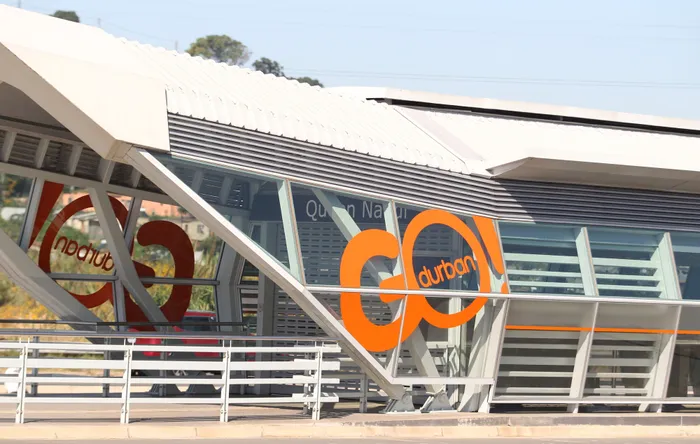
In eThekwini, the Go! Durban is long overdue and has been besieged with challenges. Initiated in 2012, more than R8bn has already been spent on this project yet not a single scheduled service is operational.
Image: DOCTOR NGCOBO Independent Newspapers
Metropolitan municipalities struggling to roll out the Integrated Public Transport Network System (IPTNS) programme, otherwise known as the Bus Rapid Transit (BRT) system, are set to lose billions in national funding after National Treasury scaled down the Public Transport Network Grant (PTNG) as part of a broader clampdown on underperforming programmes.
Announcing the move alongside the 2026 Budget, Treasury said the PTNG will be reduced by about R8.4 billion over the next three years, with funds redirected to higher-priority areas — particularly passenger rail — without increasing the overall spending ceiling.
The decision forms part of the government’s Targeted and Responsible Savings (TARS) initiative, an efficiency drive that has identified R12bn in wasteful or ineffective programmes in its first round.
The process is designed to force departments to justify allocations based on measurable outcomes, efficiency and value for money.
National Treasury director-general Duncan Pieterse on Wednesday said the scaling down of the PTNG enables a shift in funding toward passenger rail services, which government views as more effective in moving large volumes of commuters.
“The PTNG is the grant that pays for the bus rapid transit systems in the major metros. For those metros that already have a functioning system, that subsidy continues,” Pieterse said.
Budget 2026
Image: Logo
Civil organisations and some political parties have previously expressed fears that scaling down public transport subsidies will immediately lead to higher transport fares, placing additional pressure on workers’ already strained wages.
However, Pieterse said there will be “no impact on pricing or anything” as the withdrawal primarily affects metros planning to join the programme or expand existing systems, rather than those with operational BRT networks.
“It’s more for those metros that want to join the programme or expansions that are being planned. That’s where the withdrawal comes from. There is no anticipated impact on it,” he said.
The PTNG was originally introduced to support the development of integrated public transport networks in major cities, centred on dedicated bus lanes and high-frequency services aimed at improving commuter mobility.
However, government now argues that the grant has not delivered sufficient increases in ridership relative to the scale of investment.
Big municipalities like eThekwini, uMsunduzi, and Rustenburg have struggled for more than a decade to implement the IPTNS.
In eThekwini, the Go! Durban is long overdue and has been besieged with challenges. Initiated in 2012, more than R8bn has already been spent on this project yet not a single scheduled service is operational. Various challenges with the system include inconsistencies with budget allocations, negotiations with the taxi industry and the pending winding down of the programme in three years’ time.
For the current year, uMsunduzi has been allocated R100 million and the municipality for implementing the programme. The municipality intends to procure 22 buses initially, however changes in leadership in the taxi industry has caused various problems and led to project stagnation.
Despite breaking ground in 2012, the Rustenburg Rapid Transport (RRT) system has faced significant delays, cost overruns (over R3.9bn spent), and only partial, limited operations under "Yarona Services" as of 2025. The project is largely incomplete, with many bus stations on major routes still unfinished, leading to low commuter usage.
Finance Minister Enoch Godongwana also echoed the view about PTNG in his Budget Speech, stating that the grant “has not improved access to public transport relative to the investments made.”
He confirmed that while new investment will be curtailed, the grant will continue to cover indirect operational costs in cities that already run bus services as part of integrated transport networks.
“As part of this process, the Public Transport Network Grant has been scaled down by about R8.4bn over the next three years,” Godongwana said.
“The grant has not improved access to public transport relative to the investments made. The grant will, however, continue to help cover indirect costs in cities that run bus services.”
Treasury documents indicate that the savings from the PTNG reduction, along with improved targeting and fraud reduction in the social grants system, have helped fund priority spending increases elsewhere in the budget.
The reallocation signals a broader shift in transport policy toward integrated, multimodal systems linked to higher-density housing and a revitalised passenger rail network. With rail seen as better suited to moving large commuter volumes at lower per-passenger cost, government appears to be recalibrating its urban mobility strategy.
Godongwana emphasised that the TARS initiative is not a once-off exercise but will become a permanent feature of the budgeting process.
“Targeted and responsible savings are not a once-off initiative. They will be an ongoing and entrenched part of the budget process going forward to weed out inefficiencies and low-performing programmes. Every programme and every allocation must demonstrate value, efficiency and accountability,” he said.
BUSINESS REPORT