

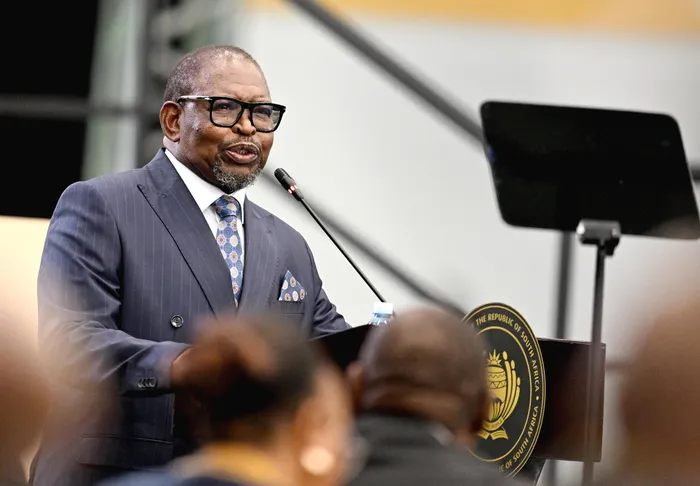
Finance Minister Enoch Godongwana deliver the Budget Speech 2026 at Parliament on Wednesday.
Image: GCIS
South Africa’s business community has broadly welcomed the 2026 Budget delivered by Finance Minister Enoch Godongwana, describing it as credible, reform-oriented and supportive of renewed macroeconomic stability, even as economists caution that growth remains too modest to transform the economy.
Godongwana on Wednesday said the government debt would stabilise for the first time in 17 years as the budget deficit narrows and debt-service costs ease.
The 2026 Budget Review projects the debt-to-GDP ratio peaking at 78.9% in 2025/26, slightly above prior estimates due to weaker nominal growth and higher borrowing. However, debt-service costs as a share of revenue are expected to fall to 20.2% by 2028/29.
In separate statements, Business Leadership South Africa (BLSA), Business Unity South Africa (BUSA) and South African Chamber of Commerce and Industry (SACCI) all endorsed the fiscal consolidation path and reform momentum outlined in the Budget Speech.
The positive tone from organised business was reinforced by favourable market reaction, with the rand strengthening to below R16 to the dollar, near its strongest level since 2022, as investors responded to projections that public debt will stabilise for the first time in 17 years.
BLSA said the Budget marked a sharp contrast to last year’s fiscal uncertainty and demonstrated a coordinated “whole-of-government” approach to macroeconomic management.
The organisation highlighted Treasury’s projection that growth will reach 1.6% in 2026, rising gradually to 2% by 2028, representing South Africa’s first sustained stretch of growth in a decade.
“While [the] Budget Speech does not mean that the country’s economy is out of the woods, BLSA believes that it firmly signals South Africa’s ability to sustain the reform momentum needed to turn early gains into enduring progress – a momentum that will restore investor confidence and spur economic optimism,” said BLSA CEO Busi Mavuso.
Crucially, BLSA noted that debt is expected to peak before beginning a gradual decline, while the consolidated budget deficit narrows from 4.5% to 3.1% over the medium term.
BLSA welcomed tax relief measures, including adjustments to personal income tax brackets, higher tax-free savings limits and improved retirement deduction incentives, arguing these would support savings and infrastructure investment. It also praised the increase in VAT registration thresholds and expanded turnover tax relief for micro businesses.
The organisation strongly supported reforms to public-private partnership regulations and municipal performance-linked funding, particularly in metro trading services such as electricity and water — an issue of acute importance in Johannesburg.
BUSA similarly welcomed the Budget’s fiscal prudence and noted South Africa’s removal from the FATF greylist, a recent credit rating upgrade, and easing borrowing costs as evidence that reform efforts are bearing fruit
However, BUSA cautioned that projected economic growth remains insufficient to tackle unemployment at scale. It also praised the absence of surprise tax hikes and the closing of a previously anticipated R20 billion funding gap without additional tax increases.
However, BUSA CEO Khulekani Mathe cautioned that the country’s progress will be constrained unless service delivery at local government level improves materially.
Mathe said the failure of some municipalities to fulfil basic service delivery functions continues to impose direct costs on households and businesses.
“Dry taps, potholes, sewage running through the streets and non-functional traffic lights have become daily occurrences that erode confidence and undermine the positive narrative of a country on the mend,” Mathe said.
“BUSA is concerned that the measures announced do not go far enough to address this rapidly deteriorating situation.”
The group also endorsed structural reforms under Operation Vulindlela and expanded private-sector participation in energy, logistics and infrastructure.
SACCI struck a slightly more cautious tone, acknowledging the Godongwana's attempt to balance expenditure within tight revenue constraints. It welcomed the reduced debt servicing outlook and higher VAT threshold, saying these would benefit small businesses.
However, the chamber expressed concern that expenditure remains weighted more heavily toward social development (R446 billion) than economic development (R283bn).
“We need to be spending more money in building the economy and creating job opportunities and tax revenues, given the challenges of high unemployment and low economic growth that South Africa faces,” said SACCI CEO, Alan Mukoki.
SACCI also emphasised that poor returns on public service spending are pushing taxpayers toward private alternatives such as private security and education — limiting savings and productive consumption in the broader economy.
BUSINESS REPORT