
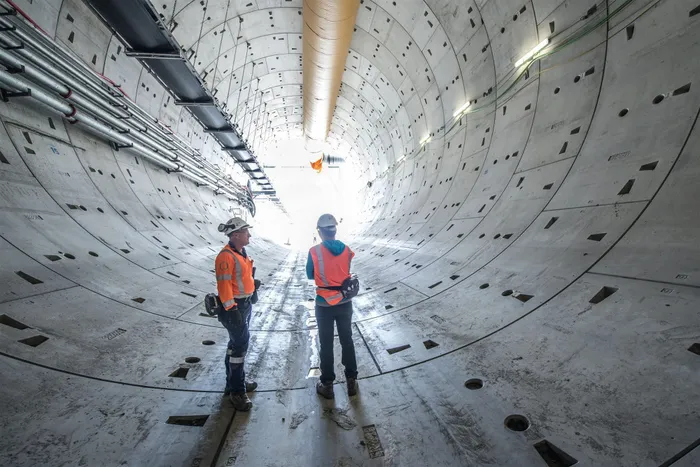
A picture of the Waterview Connection in New Zealand. Aveng plans to keep its Australia-based construction and engineering business McConnell Dowell as a subsidiary.
Image: Supplied
Aveng’s mining contracting unit Moolmans’ disputes on the Tshipi manganese mining project have resulted in talks for the disposal of Moolmans to be terminated.
The decision to dispose of Moolmans was taken some two years ago, and in the six months to December 31, the JSE-listed group’s board also investigated a range of options for the separation of the group’s Australasian civil engineering and construction business McConnell Dowell - the decision on this was that it should remain within Aveng.
Aveng CFO Adrian Macartney said in an interview on Wednesday that the Tshipi contract - the mine is 60% owned by Exxaro - is not sustainable in its current format, and management are considering all options to bring this to resolution. “To put it quite simply, we can’t continue to fund this project for them,” he said.
Renewed efforts had been made to seek a commercial settlement, whilst formal claims processes continued. The commercial disputes on the Tshipi contract, and the uncertainty created, had negatively impacted the ability to conclude a disposal transaction for Moolmans.
As a result, negotiations had been terminated. Macartney said the disposal was partly aimed to satisfy the BEE-ownership aspect at Moolmans, and the party with whom they had been negotiating over the past year had been disappointed about the talks ending, said Macartney.
Pieter van Greunen had been appointed as managing director of Moolmans to improve operational performance on project contracts and bring resolution to the Tshipi contract.
Meanwhile, the focus at McConnell Dowell was to deliver consistent operating performance through enhanced risk management processes, resolve existing commercial matters and grow the work in hand within selected disciplines, and within an appropriate risk profile. This would require a longer time horizon than was previously anticipated, said Macartney.
Aveng reported a turnaround, with headline earnings per share of 3 cents for the six months to December 31, versus a 309 cents a share loss a year before.
Revenue of R14,.2 billion was slightly below R16,6bn last year. Operating earnings, however, came to R107m versus a R356m loss at the same time last year. Work in hand remained robust at R38,6bn versus R37,5bn previously, the results showed.
Aveng's revenue of A$1,2bn (R14,2bn) for the six months was lower by 10.8%, following an expected softening of infrastructure markets in Australia and New Zealand.
Gross earnings reflected a return to a profitability of all segments across the group and losses of A$20.2m from the Jurong Region Line (J108) project in the Infrastructure Southeast Asia business unit, and the Kidston Pumped Storage Hydro (Kidston) project in the Infrastructure Australia business unit.
The return to modest operating earnings before capital items of R107 million was bolstered by continued good delivery in the Infrastructure New Zealand & Pacific Islands business unit and Building segment, with the Infrastructure Australia business unit returning to a modest operating profit.
The J108 project had been de-risked through basic structural completion, including handing over the last of three stations in December 2025. Negotiations continued for a commercial settlement.
The Moolmans business reported “disappointing” operating earnings of R3m when compared with R15m a year before. The Gamsberg zinc project performed well, but inefficiencies on the Tshipi project persisted where planned volumes and profitability had not been achieved and unresolved, ongoing contractual claims negatively impact the performance.
The group enters the second half of the 2026 financial year with combined work in hand amounting to A$3,5bn, up from A$3,2bn in June 2025.
Work in hand in the Mining segment decreased to R11,6bn from R13,4bn in June 2025. The focus was on delivering existing contracts profitably before seeking further extensions or new contracts.
Greater scrutiny was being placed on the "Pursue / No Pursue" decision to ensure that projects being entered into fit the risk profile of the group.
David Simpson had been appointed as interim CEO with the focus on commercial resolution and delivery of the underperforming projects.
On the JSE, Aveng’s share price fell 3.5% to R4.68 by midday Wednesday, a price well down from R8 per share 12 months before.
Visit:www.businessreport.co.za