

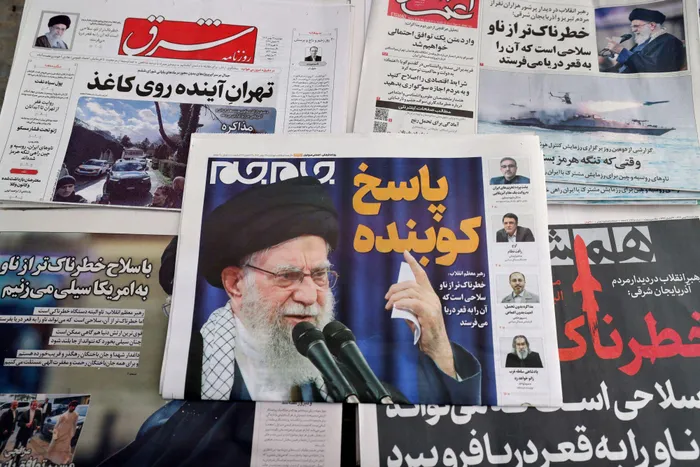
Investor anxiety has been fuelled by reports suggesting that any possible US military response could unfold over several weeks as diplomatic efforts between Washington and Tehran have so far produced little clarity.
Image: Atta Kenare / AFP
Brent crude oil prices climbed more than 1% to above $71 (R1,150) per barrel on Thursday, extending gains of more than 4% from Wednesday in what marked the strongest rally since late October 2025.
The sharp move reflected growing geopolitical tensions, with markets reacting to fears of escalation in the conflict involving the United States and Iran.
Investor anxiety has been fuelled by reports suggesting that any possible US military response could unfold over several weeks as diplomatic efforts between Washington and Tehran have so far produced little clarity.
US President Donald Trump said on Wednesday if Iran refuses to make a deal, the United States may need to use Diego Garcia, hinting at possible military action from the strategic Indian Ocean base.
However, Iranian foreign minister Abbas Araghchi reiterated that Iran will not forego its right to nuclear technology for peaceful purposes, saying Tehran will not compromise on its right as a signatory to the Nuclear Non-Proliferation Treaty.
The geopolitical backdrop has heightened concerns about potential supply disruptions, a key driver of oil price volatility. Even absent immediate physical constraints, the risk premium embedded in prices has increased as traders assess worst-case scenarios.
For South Africa, movements in the oil price carry significant domestic implications, particularly for inflation and fuel costs.
Maarten Ackerman, chief economist at Citadel, warned that rising oil prices presented a clear inflation risk for South Africa. He said oil remains one of the country’s largest import items, meaning even temporary spikes can quickly filter through to petrol and diesel prices.
“These increases tend to spill over into other components of the inflation basket, particularly those linked to transport and energy costs,” Ackerman said, noting that higher fuel prices often raise logistics and production costs, contributing to broader price pressures across the economy.
However, Ackerman emphasised that the relationship between oil prices and the rand is less direct. The currency is influenced by a wide range of global and domestic variables, including US dollar movements, commodity prices, political developments, and growth prospects.
Annabel Bishop, chief economist at Investec, noted that despite the recent rise in crude prices, March is still likely to see limited changes in local fuel prices following a significant fuel price decrease this month.
“March is seeing little likelihood of a change in the fuel price due to the lift in the oil price,” Bishop said. "A higher oil price would push up the fuel price, particularly given as well the Fed’s recent less dovish stance.
However, Bishop cautioned that sustained upward pressure on oil could alter the outlook, especially when combined with global monetary policy dynamics. She said a higher oil price, alongside the US Federal Reserve’s less dovish posture, could place upward pressure on domestic fuel costs.
The latest minutes from the Federal Open Market Committee (FOMC) meeting held in late January underscored the Fed’s cautious stance on inflation. Policymakers signalled that interest rate cuts are not guaranteed, with some members raising the possibility of further tightening should inflation remain above target.
The implications for emerging markets, including South Africa, are notable. A more hawkish Fed typically strengthens the US dollar, which in turn exerts pressure on currencies such as the rand. Currency weakness can amplify the domestic impact of higher oil prices, as crude is priced in dollars.
"As a result, higher oil prices may place some pressure on the rand at the margin, but there are typically much larger forces at play," Ackerman said. "For example, a meaningful pullback in gold and platinum prices would likely have a far greater impact on the rand via the trade balance than an increase in the oil price alone."
From an investment perspective, some analysts see limited immediate risks to South Africa’s inflation trajectory.
Nolan Wapenaar, co-chief investment officer at Anchor, said current conditions do not yet justify expectations of a fuel price adjustment.
“If things stay as they are right now, then we would anticipate no adjustment to the fuel price next month,” Wapenaar said.
Wapenaar also pointed to a degree of natural hedging within South Africa’s external accounts. He said factors that could push oil prices lower may simultaneously support gold prices, providing indirect support to the rand.
BUSINESS REPORT