

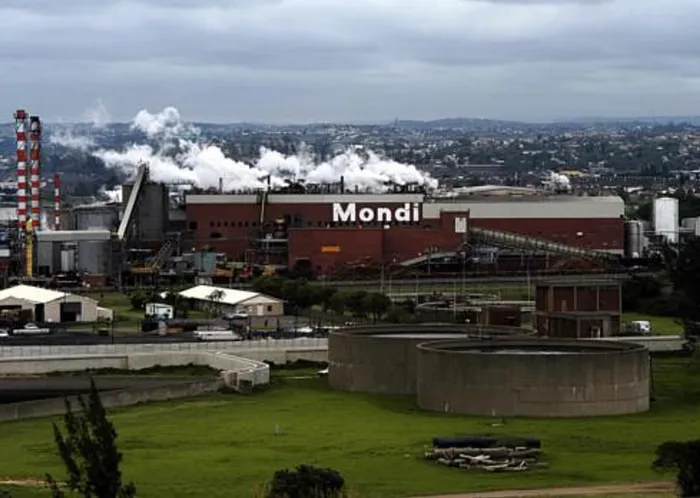
A Mondi paper factory in Merebank, eThekwini. The group drastically cut its final dividend for the 2025 financial year as it continued to trade through a cyclical downturn.
Image: Supplied
Mondi's management say they are confident in being able to manage industry headwinds, including falling paper prices, by increasing volumes and better management of margins, CEO Andrew King said Thursday.
The global sustainable paper and packaging group, with tree plantations and paper, pulp and packaging facilities in KwaZulu-Natal and Mpumulanga, South Afruca, released financial results on Thursday for the year to December 31, that showed that underlying earnings before interest tax depreciation and amortisation of €1,001 million, which was 5% lower than a year before.
"Our industry continues to work through a prolonged cyclical downturn, yet we delivered a resilient full year financial performance," said King.The board suggested dividends be realigned after a period of high payouts, announcing a proposed final dividend of 4.92 euro cents per share, which was well down on the 46.67 euro cents at the same time last year.
The total dividend per share for the full year came to 28.35 euro cents, well down from 70 euro cents in 2024.
"Our team's commitment, with our product offerings and cost-advantaged assets, allowed us to deliver a strong performance," said King.
The integration of Corrugated Packaging and Uncoated Fine Paper had accelerated operational synergies, which King described as "vital during this downturn."
Revenue grew by 3% to €7.66 billion. Pre-tax profit fell by 29% to €269m and basic underlying earnings per share dropped by 32% to 56.5 euro cents.
As part of plans to maintain a robust financial position, Mondi implemented cost discipline, introduced measures to optimise operations, and shifted capital allocation from a focus on investment in growth markets, to instead prioritising maintenance and optimisation opportunities.
Key to this strategy was the integration of Schumacher, which was expected to yield further synergies. "We are confident in the delivery of €32m cost synergies over the three years from completion, an increase from the €22m initially envisaged."
At the same time, the production footprint was being optimised, including the recently announced closures of three plants across the paper bags and corrugated solutions network.
"In Corrugated Packaging, we are focused on optimising and developing our strength in Europe and adjacent geographies, leveraging our upstream paper platform and recently enlarged converting network," said King.
The uncoated fine paper assets were being optimised and costs tightly managed.
In Flexible Packaging segment-differentiated growth was being pursued.
"In industrial end markets we continue to grow globally as a high quality, global leader in sack kraft paper and industrial bags, with significant integration and scale advantage."
Capabilities were being leveraged in consumer applications, including speciality kraft paper, MailerBags and consumer flexibles
"Going into 2024, it remains unclear when geopolitical and macroeconomic conditions will improve. Paper prices are modestly lower, on average, than those seen in the final quarter of 2023. We are, however, confident in our ability to navigate these headwinds," said King.
"With some of the most productive and lowest cost pulp and paper mills in Europe, we already benefit from strong cost leadership, further strengthened by an integrated business model offering significant value chain synergies."
"Our focus is on delivering full productivity ramp-up, executing our commercial strategy, driving cash generation and delivering strong returns," he said.
BUSINESS REPORT