

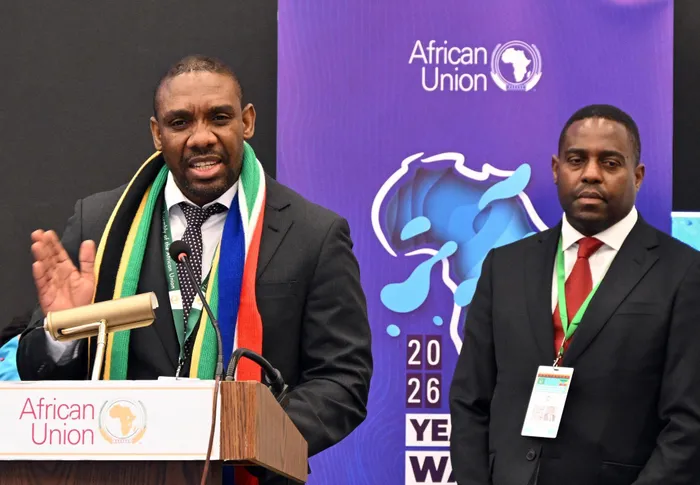
Dr Risimati Mathye, the director-general for water and sanitation services in South Africa, and Alex Simalwambi, CEO of the Global Water Partnership Organisation, speaking at the high-level continental gathering in Addis Ababa on the sidelines of the 39th Ordinary Session of the African Union (AU) Assembly of Heads of State and Government on Sunday.
Image: GovernmentZA/X
African leaders and development finance institutions have reaffirmed their commitment to turning water investment pledges into bankable projects, as the Africa Investment Programme (AIP) reported significant progress following last year’s landmark water summit in Cape Town.
Speaking at a high-level continental gathering in Addis Ababa on the sidelines of the 39th Ordinary Session of the African Union (AU) Assembly of Heads of State and Government on Sunday, Alex Simalwambi, CEO of the Global Water Partnership Organisation, outlined how the AIP was structured to move beyond declarations and deliver tangible infrastructure outcomes.
“When the African Union conceptualised the summit, they were very clear — we do not want a talk show. We want concrete projects,” Simalwambi said.
The Cape Town summit, hosted under the auspices of the AU, featured 80 investment-ready water projects from 38 African countries, with a combined portfolio value of approximately $32 billion.
Project sizes ranged from $800,000 to $1.5 billion and covered water supply, sanitation, hydropower, irrigation, ecosystem management and climate-resilient infrastructure.
Countries represented included Burkina Faso, Chad, Côte d’Ivoire, Eswatini, Malawi, Morocco, Niger, Rwanda, South Africa, Uganda, Zimbabwe, Egypt, Ghana, Madagascar, Mali and Mozambique.
Crucially, ministers arrived prepared to pitch projects directly to financial institutions in structured “deal rooms”, allowing for real-time engagement. Several projects reportedly secured funding commitments during the summit itself, including a Namibian project that received backing from the African Development Bank (AfDB).
More than 180 private companies and financial institutions participated, a notable achievement given long-standing perceptions that water projects are less commercially attractive.
“Financial institutions often hear about water challenges, but they don’t see viable projects,” Simalwambi said. “This summit demonstrated that Africa has bankable, investment-ready projects.”
Major financiers highlighted substantial portfolios. The World Bank referenced around $6bn across more than 30 projects on the continent. The AfDB similarly cited a $6bn pipeline, with plans to scale up.
Commercial lenders such as Standard Bank indicated approximately $3bn in available funding, while the Development Bank of Southern Africa outlined a broader infrastructure pipeline of $18.2bn.
Climate-focused finance is also expanding, with the Green Climate Fund and the United Arab Emirates signalling multi-billion-dollar commitments toward climate-resilient water initiatives.
However, speakers stressed that unlocking finance requires domestic reforms.
Simalwambi noted that while capital exists, bottlenecks remain in governance, tariff reform, pricing structures and public sector water management.
“These are basic issues, but they require strong political leadership,” he said.
South Africa’s Director-General for Water and Sanitation, Dr Risimati Mathye, highlighted that water had been sidelined globally for decades.
South Africa is currently gripped by an ongoing water crisis, which has prompted President Cyril Ramaphosa on Thursday to announce the establishment of a National Water Crisis Committee to coordinate the government's interventions.
Mathye noted that the previous United Nations water conference before 2023 had been held in 1977. With the Sustainable Development Goals (SDGs) targeted for 2030, he said Africa is lagging behind on access to safe water and sanitation.
“There is enough scientific evidence showing the challenge is not just about accelerating progress, but about removing systemic bottlenecks,” Mathye said, pointing to investment readiness and governance reforms as key.
The AU Commissioner for Agriculture, Rural Development, Blue Economy and Sustainable Environment, Moses Vilakati, reinforced that Africa is not short of priority projects.
“Our collective task now is to ensure that commitments are translated into financed projects and tangible outcomes on the ground,” he said, announcing new tools including guidelines for developing national climate-resilient water investment programmes and an AU-AIP Water Investment Scorecard to track progress.
South Africa’s Minister of Water and Sanitation, Pemmy Majodina, said the focus now is accountability, ensuring that the estimated $10–12bn in annual investment pledges become real infrastructure.
“We can do everything else, but if we don’t invest in water and infrastructure, our people will continue to struggle,” she said. “Therefore, AU having declared this year as 'the year of water and sanitation', it is in line with what the UN has also declared.”
Majodina said Africa is also preparing for a stronger global presence at the 2026 UN Water Conference in the UAE, where Senegal will co-host and Ghana, Zambia, Egypt and South Africa will co-chair key sessions.
BUSINESS REPORT