

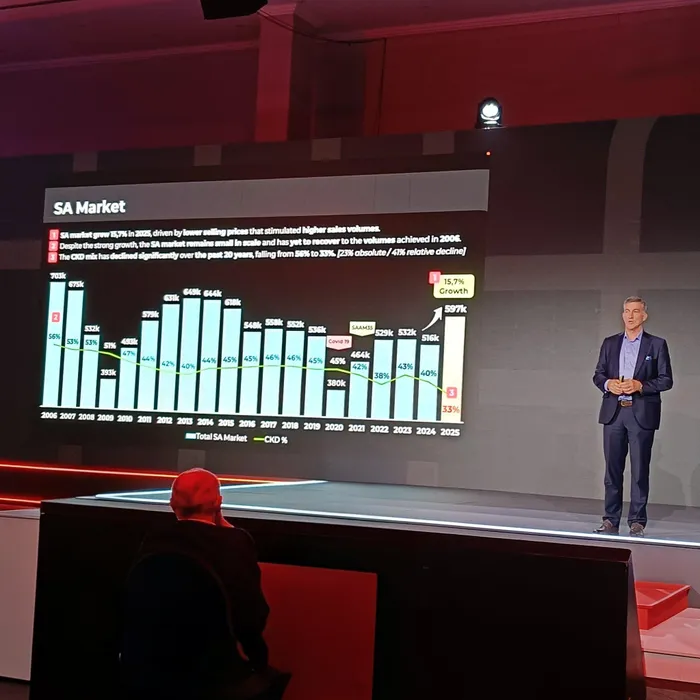
Toyota South Africa Motors (TSAM) President and CEO, Andrew Kirby, speaking at TSAM’s 9th State of the Motor Industry address on Thursday.
Image: Thami Masemola/X
Toyota South Africa Motors (TSAM) President and CEO, Andrew Kirby, has placed competition at the centre of the country’s automotive debate, arguing that embracing rivalry rather than resisting it was critical to sustaining the industry through a period of structural change.
This comes as the government is currently reviewing measures, including higher import duties and excise taxes, and updating the country’s tariff schedule in a bid to support the domestic automotive industry on the back of calls for up to 50% duty in imported vehicles from China and India.
Speaking at TSAM’s 9th State of the Motor Industry address on Thursday, Kirby framed competition not as a threat but as a catalyst for resilience, innovation, and long-term growth.
In a global environment defined by disruption, regulatory uncertainty, and technological transition, he said the industry’s survival would depend on its ability to adapt faster than ever before.
"In a way that makes us stronger and one of our values as TSAM is to welcome competition, find smart ways of doing things, be inquisitive, and continuously strive to get better than before,"Kirby said.
Kirby’s remarks came against the backdrop of a South African market that has shown recovery but remains constrained.
While new vehicle sales recorded headline growth of 15.7% last year, Kirby cautioned that much of the increase was driven by pricing dynamics and a shift toward entry-level models rather than broad-based consumer strength.
"We've seen a big growth in new vehicle sales but it's not all that it seems. We're seeing a lot of pricing impact on that volume and we need to be very mindful of that as we go into 2026."
The domestic market, at roughly 600,000 units, still lacks the scale needed to comfortably support the country’s manufacturing ambitions.
In this context, competition is becoming more intense across multiple fronts. Imported vehicles continue to expand consumer choice and introduce new technologies, but they also place pressure on local production.
Kirby argued that imports are essential for market vibrancy, yet warned that the balance between imports and domestic manufacturing is becoming increasingly delicate.
"Imports create a vibrant market that bring in a lot of different styles of vehicles that our customers need. We can't expect to produce everything in South Africa. And for our size market and where we are on the continent, that would be an unrealistic expectation," he said.
"So, the strength of imports in South Africa is extremely important. Even as manufacturers we import a whole range of vehicles. So it's very important. They bring technology that create a lot of vibrancy in the market. But do we have the right balance?"
Competition is also accelerating in the transition to new energy vehicles (NEVs). Although NEVs account for a small share of overall sales, the number of new models entering the market has surged, particularly in battery electric and hybrid categories.
Kirby maintained that customers are increasingly discerning, understanding the trade-offs between different technologies and gravitating toward solutions that deliver clear value.
Rather than advocating protectionism, Kirby called for targeted, fiscally neutral interventions to strengthen the competitiveness of South Africa’s completely knocked down (CKD) manufacturing base.
He said that competition, if harnessed correctly, can be a strategic advantage.
"Take a thoughtful approach to improving the competitiveness of local manufacturing in a fiscally neutral way. We're not suggesting a big blunt instrument to suddenly correct this. What we're suggesting is tweaking and small changes on a variety of different elements that can improve our competitiveness and create that solid base because we need a solid base in South Africa.
"I think we should also not just be defensive and say well, let's protect, or sustain. No, let's grow. We need to create jobs we need to create economic activity. I'm very confident that South African market should and could exceed 700,000 vehicles sales. I'm very confident that the South African production could and should exceed 720,000 production."
BUSINESS REPORT