

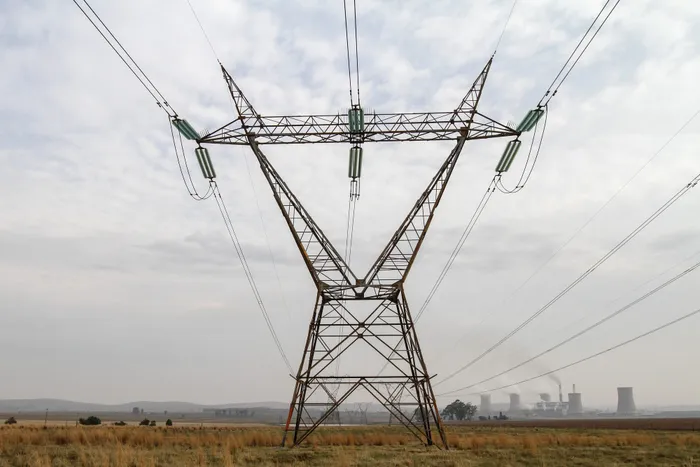
Pylons carry high voltage electricity cables from the Grootvlei power station, operated by Eskom Holdings. South Africa needs to build up to 14 000 kilometers of new electricity transmission infrastructure to meet its growing electricity demand and new renewable energy generation capacity:
Image: Dean Hutton/Bloomberg
The Southern Africa Power Pool will be linking with the Eastern Africa Power Pool later this year, bringing significant benefits to the electricity sector in Southern Africa, including access to East Africa's hydro electricity generation capacity, according to Andrew Etzinger, GM for Energy Market Services and International Trade at the National Transmission Company South Africa.
The Southern African Power Pool is a regional organisation that coordinates the planning and operation of electricity systems across 12 Southern African Development Community (SADC) countries. The Eastern Africa Power Pool was established as a regional institution in 2005 to interconnect electricity grids, facilitate cross-border power trade and optimise usage among 13 Eastern Africa countries.
The question of sufficient electricity transmission capacity has become critical in Africa because many mines and industrial companies already struggle with sufficient and stable electricity supply, while the world is also looking to the continent for large quantities of minerals critical to the energy transition and industry, the mining of which is often in remote places where little electrical transmission exists.
Etzinger said that considering the need to include private sector investment partners into the expansion of the electricity grid, utilities in the power pools need to make sure they were well governed and investment grade, otherwise private sector companies would not invest in the grid.
In addition, utilities and governments should also lend their support to multi-national power pool agreements., he said.
South Africa's deputy minister for electricity and energy, Samantha Graham-Mare, said load shedding in South Africa and the subsequent creation of new renewable power generation capacity by the private sector through the Renewable Energy Independent Power Producer Procurement Programme (REIPPP) had exposed years of under investment in South Africa's electricity grid.
She said some renewable energy plants - most are located in the Eastern, Western and Northern Capes - have not been able to become operational because they cannot transmit their electrons onto the grid.
South Africa's grid requires about 14 000 kilometres of new transmission lines at a cost of about R450 billion, funds which the government did not have.
She said the lack of investment in transmission infrastructure is not a uniquely South African experience, but a problem that is prevalent in many countries because transmission lines do not generate revenue, and for instance, some 14 000 companies could not establish themselves in the Netherlands recently due to the lack of transmission capacity. She said an important consideration also was that Eskom did not allow private operators to move electricity over the grid due to issues of power security.
She said the government planned try to attract private sector developers of power transmission lines, in much the same way the private sector had swiftly established additional private electricity generation capacity in South Africa. The private sector also brought innovation, funding and creative ways to solve problems, she added.
She said the Independent Transmission Programme would initially develop 1 164 kilometres of transmission lines via a request for proposals (RFP) by the government. She said they hoped to have a preferred bidder by the end of the year. She said that as soon as the first project was rolled out, she expected others would roll-out quite swiftly thereafter.
Bradley Reddy, GM at Rio Tinto's Richards Bay Minerals, said energy security was key for the group to operate, grow and decarbonise. Currently, the inability of some renewable energy operations to connect with the grid was impeding the group's decarbonisation progress.
He said the company was a big energy user, and it had signed three power purchase agreements, with R13bn invested in generation capacity and plans to invest R2bn in Eskom substations and transmission line infrastructure.
He said there needed to be stability and clarity of energy policy, and the mining sector could play a pivotal role in accelerating transmission infrastructure in South Africa and Africa as well. The success of this could be seen in how well the private sector had rallied around Eskom and the government to establish and fund new energy capacity following the problems at Eskom, he said.
BUSINESS REPORT