

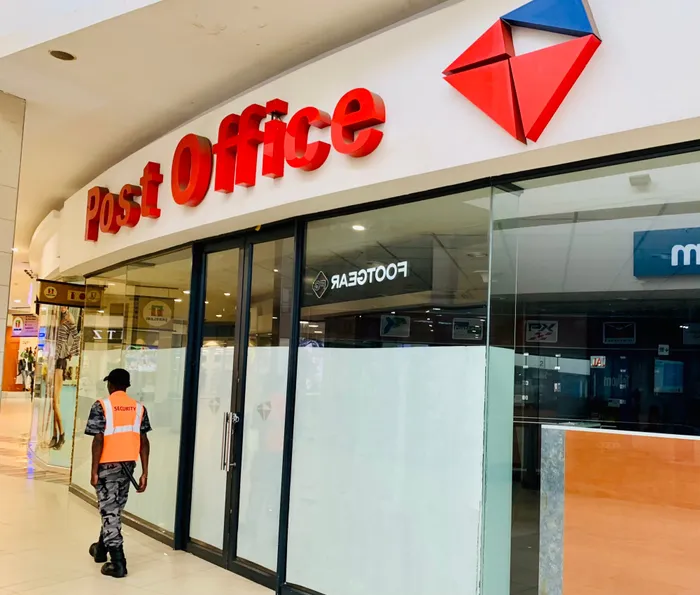
SAPO business rescue practitioners Anoosh Rooplal and Juanito Damons have previously said the R3.8 billion is critical to support revenue-generating initiatives as the Post Office seeks to compete in a modern and increasingly digital economy.
Image: Bhekikhaya Mabaso / Independent Newspapers
Banele Ginindza
National Treasury has no legal obligation to provide the South African Post Office (SAPO) with the R3.8 billion required to recapitalise the restructured entity, Parliament’s legal adviser has warned, as lawmakers push for an urgent meeting with Finance Minister Enoch Godongwana to lobby for the funds.
Advocate Aadielah Arnold, Parliament’s legal adviser, told the Portfolio Committee on Digital Technologies that the R3.8bn cited by SAPO’s business rescue practitioners cannot be regarded as a binding commitment by Treasury under the national budget framework set out in the Constitution and the Public Finance Management Act (PFMA).
"In our view, the facts present a scenario where the commitment made can be described as a tentative, provisional, conditional or a non-committal. So, I think it's evident that the R3.8bn will not be forthcoming or does not appear to be forthcoming," Arnold said.
"Any payment of money to SAPO will have to be done via an Appropriation Act. It is evident from the North Gauteng High Court and the Business Rescue Plan itself, in our view, that the payment of the R3.8bn to SAPO was subject to an application to Treasury during the October Budget process. Treasury has further expressed its view and rationale for its refusal to pay."
Arnold noted that the committee had repeatedly engaged with Treasury, SAPO and the business rescue practitioners on numerous occasions, and said the situation remained fluid.
"The situation appears fluid with constant developments. In our view, the committee should continue to exercise its constitutional obligation of oversight. This could possibly involve further engagement by the committee with the latest developments, which appears to indicate the reported imminent strategic private partnership," Arnold said.
"Specifically, also in relation to the business rescue plan, it may be prudent to ascertain the consequences of SAPO and creditors and the risk of liquidation or any other issues or matters as they may present to the committee.
She emphasised that none of the key documents underpinning the rescue process, including the business rescue plan, affidavits, Cabinet statements or court orders, amounted to a firm promise that SAPO would receive the R3.8 billion.
Committee chairperson Khusela Diko said discussions with the Minister of Finance and the chair of the Standing Committee on Appropriations had revealed that Treasury was not opposed to funding SAPO in principle, but remained concerned that key conditions had not been met.
"I would wish to propose that we schedule a meeting where we ask them to come and present on how far that process is and also to engage once again. It doesn't have to be a joint meeting, but continue engagement with the Standing Committee on Appropriations and any other relevant avenues to ensure that everybody's on board," Diko said.
"The same way we've done with the funding model. Everybody's on board with regards to the path that SAPO takes."
SAPO business rescue practitioners Anoosh Rooplal and Juanito Damons have previously said the R3.8 billion is critical to support revenue-generating initiatives, including the improvement of postal services and the expansion of digital offerings, as the Post Office seeks to compete in a modern and increasingly digital economy.
BUSINESS REPORT