

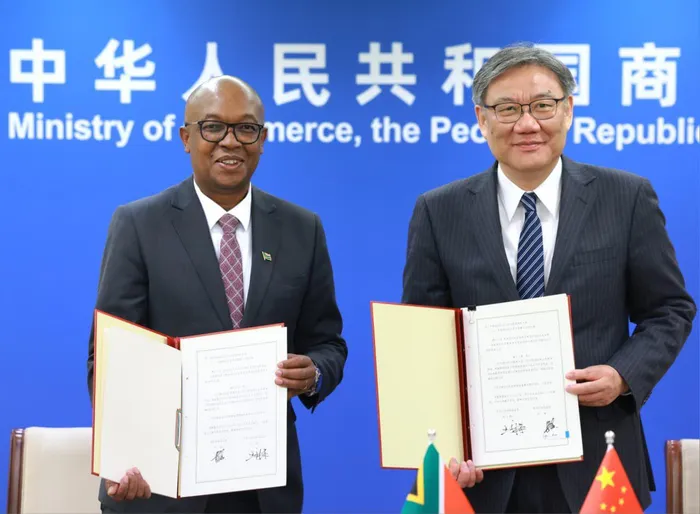
Minister Parks Tau and China’s Minister of Commerce, Wang Wentao, have signed the China–Africa Economic Partnership Agreement (CAEPA), a landmark deal set to grant South African exports duty-free access to the Chinese market while boosting investment into South Africa’s economy.
Image: Supplied
China has signalled a strong appetite to scale up investment in South Africa, calling on Pretoria to further improve facilitation and policy support for Chinese companies operating in the country, following the signing of a new China–South Africa economic partnership agreement.
The appeal came as the two countries on Friday concluded the China–Africa Economic Partnership for Shared Development, a framework agreement that will grant South Africa zero-tariff access on 100% of tariff lines for its exports to China, in line with World Trade Organization (WTO) rules.
While the trade benefits are significant, Chinese officials were explicit that the agreement is also intended to unlock a new phase of investment-led cooperation.
Chinese Minister of Commerce, Wang Wentao, said China is ready to actively respond to South Africa’s “new investment initiative”, with a particular focus on expanding cooperation in sectors such as automobiles, mining, agriculture and new energy.
He added that China hopes South Africa will provide greater facilitation and support for Chinese enterprises investing and operating in the country, as the two sides work to build more stable and resilient industrial and supply chains.
"This year marks the start of China's 15th Five-Year Plan (2026-30), during which China will continue to advance high-quality development and firmly expand high-level opening-up, bringing new opportunities for China-South Africa cooperation," Wang said.
"China is willing to work with South Africa to further tap the potential of bilateral trade."
Wang was speaking on Friday in Beijing after co-chairing the 9th meeting of the China–South Africa Joint Economic and Trade Commission with the Minister of Trade, Industry and Competition, Parks Tau.
The talks covered areas such as industrialisation, infrastructure development, agricultural trade, green energy, and technology exchange.
South Africa is a major destination for Chinese investment in Africa and the leading African country in terms of actual investments in China.
In recent years, trade between South Africa and China has grown steadily, with China serving as a major destination for South African minerals, agricultural products and manufactured goods. South Africa imports a wide range of machinery, electronics and consumer goods from China.
South Africa has positioned investment attraction as a central pillar of its economic recovery strategy, and Tau welcomed China’s interest, saying the agreement would help rebuild domestic industrial capacity while boosting exports.
Tau said this agreement will enhance trade with China, "while increasing exports and rebuilding our industrial capacity".
"We have seen a significant and steady increase in Chinese investments in South Africa, while South African companies are showing a growing interest in investing in the Chinese market," Tau said.
"Chinese automotive companies are investing into the South African economy and creating much needed employment opportunities. We look forward to attracting even more Chinese investment into South Africa, and also introducing many South African products into the Chinese market."
According to government’s website, the framework agreement will be followed by negotiations on an Early Harvest Agreement by the end of March 2026. That deal is expected to provide immediate duty-free access for selected South African exports while further encouraging Chinese investment into South Africa.
The agreement makes South Africa the 33rd African country to sign such a framework with China, following Beijing’s commitment last year to extend zero-tariff treatment on 100% of tariff lines to 53 African countries with diplomatic relations with China.
Beyond trade preferences, Chinese officials have framed the policy as a mechanism to integrate African economies more deeply into China’s vast domestic market while supporting industrial development on the continent.
China has already emerged as a major investor in key South African industries, particularly in the automotive sector, where Chinese manufacturers are expanding local assembly and supply chain operations.
Both sides also stressed the importance of cooperation in a challenging global environment marked by rising protectionism.
Wang said China and South Africa would strengthen coordination within multilateral platforms such as the WTO and BRICS, while Tau reaffirmed South Africa’s commitment to providing a favourable policy environment for Chinese investors.
"We hope that the signing of the Framework Agreement and the outcomes of our Joint Economic Trade Commission meeting will signal the urgency we attach to growing our bilateral trade and investment relations," Tau said.
"Together with the Framework Agreement, these outcomes should provide a strong foundation for a mutually beneficial partnership and for our respective private sectors to do more business together."
BUSINESS REPORT