

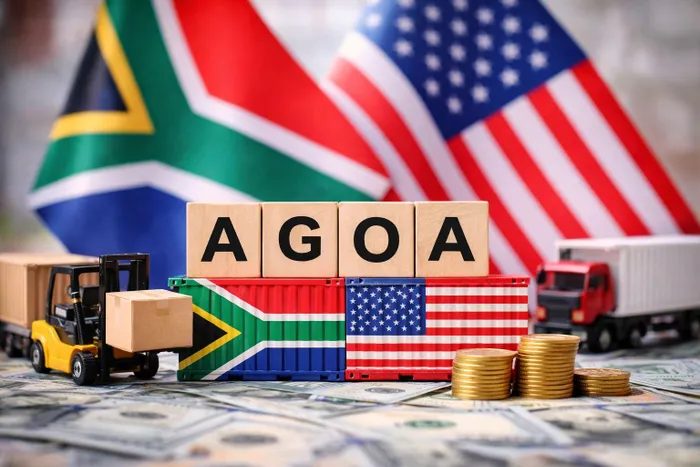
The United States this week confirmed the extension of the beneficial trade agreement, while signalling that the programme would need to evolve.
Image: Supplied
Banele Ginindza
South Africa’s inclusion in the extension of the Africa Growth and Opportunity Act (Agoa) through to the end of December 2026 has been welcomed as an important interim reprieve, even as commentators caution that strained relations with the United States underscore the need to secure more durable and diversified trade arrangements.
The United States this week confirmed the extension of the beneficial trade agreement, while signalling that the programme would need to evolve.
Washington said a modernised Agoa should demand more from its trading partners and deliver greater market access for US businesses, farmers and ranchers, in line with its broader trade policy priorities.
In a statement, US Trade Representative Jamieson Greer said his office would work with relevant agencies to implement changes to the Harmonised Tariff Schedule of the United States following the legislation reauthorising AGOA.
“We must also make sure that the program enhances U.S.-Africa trade and will work with Congress over the next year to modernize the program to align with President Trump’s America First Trade Policy,” Greer said.
Agricultural Business Chamber (Agbiz) senior economist, Wandile Sihlobo, said the extension was welcome but argued that South Africa’s strategic priority should be to transition from Agoa to a bilateral trade agreement with the United States.
"From a South African perspective, what must now be a focus is transitioning from Agoa to a trade agreement with the US. This would be an ideal path for South Africa and the US for long-term stability though the 30% Liberation Day tariffs distort the benefit of Agoa," Sihlobo said.
"Still, without it, some South African goods wouldn't face a 30% tariff but rather around 33%. The roughly 3% is the US Most-Favoured Nation tariff, which would be added to the Liberation Day tariff.
"It is also worth highlighting that the US has decided to modify its reciprocal tariffs and exempt some food products, thus easing agricultural trade friction, which is costly to both exporting countries and U.S. consumers."
Agbiz Fruit desk manager, Wolfe Braude, said the industry had welcomed the signing of new phytosanitary protocols opening access to several Asian markets, but cautioned that building volumes and consumer demand in new destinations takes time.
"We expect to see these markets play an increasing role in SA’s export basket, but in the short term the outlook is not yet clear as we are also competing with other exporters who have similarly been impacted by the US tariff changes of 2025. i.e., the export landscape is currently in flux." Braude said.
He said the export landscape was in flux, but the sector remained optimistic given the competitiveness and quality of South Africa’s agricultural products.
Braude added that efforts to expand access to the Middle East and Asia should complement, rather than replace, traditional export markets such as the US.
"Not at the expense of our traditional markets, but alongside these markets," Braude said.
The automotive sector, however, has been among the hardest hit by Agoa disruptions.
The Motor Industry Staff Association (MISA) said the suspension of Agoa in 2025 led to vehicle and component exports plunging by between 55% and 80% year-on-year, falling from R26.5 billion in the January–July 2024 period to R9.8bn in 2025.
Under Agoa, more than 1 800 South African products were previously exported to the US duty-free.
MISA chief executive for operations Martlé Keyter said that from August 2025 South Africa was subjected to a 30% blanket tariff, sharply increasing costs for US importers of South African vehicles.
She said this placed South Africa at a disadvantage compared with other vehicle-exporting countries paying tariffs of around 25%.
Efficient Group chief economist, Dawie Roodt, said it was clearly in South Africa’s economic interest to retain access to AGOA, particularly for the automotive industry.
“This means that the government should remain neutral on international issues where the United States are involved instead of taking an opposing position in the best interest of the economy,” Roodt.
Political analyst Professor Piet Croucamp argued that US trade policy was being used as a form of political pressure.
“There is nothing wrong with South Africa’s foreign relationships. The country’s relationship with Iran for example, is insignificant when compared to other countries,” said Croukamp.
Charles Dednam, secretary general for the South African Steel and Iron Institute, said exports from the Duferco Steel Processing plant in Saldanha and stainless steel producer Columbus were particularly exposed, noting that last year 77% of DSP’s exports, or 106 000 tons out of 137 000 tons that were destined for the US market.
BUSINESS REPORT