

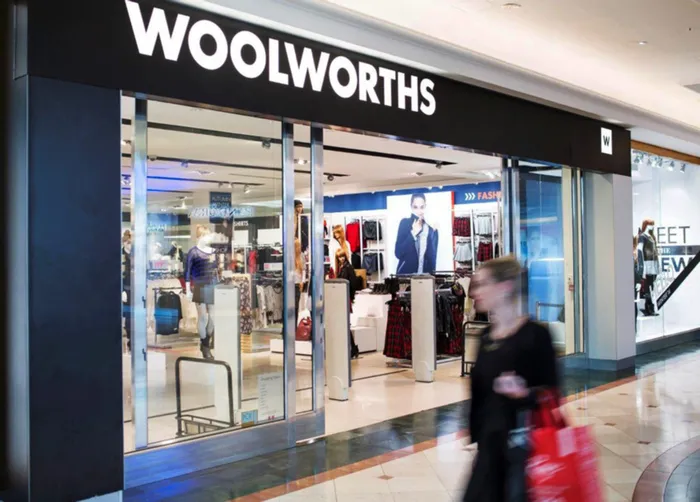
Woolworths Holdings' sales fell unexpectedly at its Country Road unit in Australia during the last 7 weeks of a 26-week period to December 28, 2025.
Image: Supplied
Woolworths Holdings' share price fell sharply by 4.23% on the JSE Thursday morning after it reported that its sales in Australia had unexpectedly moderated in the weeks of a 26-week period to December 28.
The slowing sales occurred through the peak holiday trading season, when sales traditionally increase. The group said in a trading update that in the last seven weeks, sales growth slowed to 5.3%, with price movement steadily declining, and averaging 4.6% for the first half of its financial year.
The share price traded 4.23% lower at R57.22 on Thursday morning on the JSE. The price was R58.52 at the same time a year ago.
Over the full 26-week period however, group turnover and concession sales growth was well above inflation, at 5.4%, and by 6.1%. Positive sales growth in all segments of the business was reported, notwithstanding the generally constrained macroeconomic environment across both South Africa and Australia. South Africa's inflation rate at the end of December was 3.6%.
Woolworths South Africa delivered above-market turnover and concession sales growth of 6.8% for the 26 week period, year-on-year. Within this, the Food business saw strong turnover and concession sales growth of 7% and 5.2%, with month-on-month market share gains and positive underlying volume growth, supported by a focus and investment in the premium food offering and customer experience.
Revenue through Woolies Dash grew by 23%, with the online channel contributing 7.2% to SA Food sales. Net trading space increased by 4.3% on the prior period. The expansion of the Midrand distribution centre (DC) progressed well, albeit impacting the near-term gross profit margin given the increased depreciation arising from the significant investment.
Fashion, Beauty and Home (FBH) turnover and concession sales increased 6.2% and 6.4%, supported by improved product availability due to value chain initiatives. This momentum was maintained over Black Friday and the festive season, with sales growth of 6.1% in the last seven weeks, implying market share gains over the half and positive volume growth.
Price movement averaged 2.8%. This included Fashion inflation at 1.3%, resulting from price investment in Kidswear, and clearance of excess inventory from the prior period's DC transition. This impacted GP margin in the period.
"Our Beauty and Home businesses delivered stronger growth of 8.9% and 14%, respectively. The initiative to optimise space and efficiency metrics, resulted in net trading space decreasing 1.9% relative to the prior period."
The Woolworths Financial Services book increased by 1.8% on a year-on-year basis to the end of December 2023, and by 2.6% when excluding the sale of part of the legal book.This was driven by "quality" growth through both new accounts and credit limit increases on existing accounts, Woolworths directors said. The impairment rate was "industry leading" 6.4%.
The directors said Country Road Group (CRG) continued to trade in an environment in Australia and New Zealand that was challenging and highly promotional driven, even though conditions appeared to gradually improve.
CRG sales increased by 2.3% and by 2.5% on a comparable-store basis. The Country Road, Witchery and Politix brands benefited from repositioning the brand portfolio and restructuring of CRG's operating model.
After a strong Black Friday and Cyber Monday in November, Australia's December retail trading performance was "softer than anticipated," directors said. CRG's sales growth averaged 1% for the last seven weeks of the period. Net trading space increased by 0.2%, with the online contribution to sales broadly unchanged at 27.2%.
The calculation of adHEPS (adjusted headline earnings per share) reflected once-off costs from the restructure of CRG's operating model, as well as unrealised forex losses versus a gain in the prior period).
As a result, adHEPS was expected to range between a decline of 2% and an increase of 3% for the 26-week period, or to between 165.7 cents a share and 174.2 cents a share, versus 169.1 a share previously.
HEPS was expected to increase between 7% and 12%, to between 163.5 cents and 171.1 cents, compared to 152.8 cents a year previously.
The share buyback programme commenced in September, with 6.9 million shares repurchased at an average share price of R51.23 each. The interim results are expected to be released on March 4, 2024.
Visit:www.businessreport.co.za