ASP Isotopes reports significant progress on Renergen helium project
Industrial
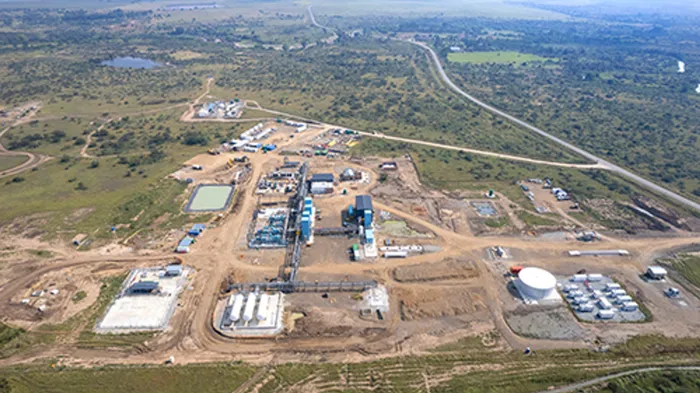
Renergen's helium and liquid natural gas production facility near Virgina in the Free State. The new owner ASP Isotopes plans to have Phase 1 fully commissioned through the second half of this year.
Image: Supplied
JSE-listed ASP Isotopes said Thursday that Phase 1C of the Renergen Helium Project (RHP) in South Africa continues to progress toward full commercial operation, following a "restart of operations in April 2025."
In an update, ASP said following its bridge loan prior to completion of the acquisition of Renergen, the RHP had advanced materially across drilling execution, gas production, plant readiness, and commercial contracting.
"These developments represent a meaningful improvement in operational performance compared to the period prior to ASPI's involvement. Based on current progress, management expects the project to achieve positive operational cash flow before the end of 2026," ASP's directors said.
Following the restart of drilling and production in April 2025, the Phase 1 processing plant had been upgraded to support increased gas throughput and stable operations as additional wells were brought online.
"Since ASP Isotopes began funding the project, management estimates that gas throughput has increased by approximately 60%," the company said.
Key elements of the plant build and upgrade include an additional compressor station, completion of a dewar filling system, optimisations to enable efficient liquid helium offtake, and cold box and system modifications.
"Final commissioning activities are ongoing, including commissioning of Compressor Station C, which is expected to be completed by the end of the first quarter of 2026," ASP said.
Since the restart of operations, the drilling and subsurface program focused on increasing gas supply while materially improving geological confidence. A key change was the engagement of Kinley Exploration, an independent exploration modelling specialist, to support seismic interpretation, reservoir modelling, well placement, well design and drilling execution.
"This represents a departure from prior drilling approaches and has directly informed improved target selection and well design." To date, 15 of 18 wells drilled in the fractured reservoir intersected gas.
A trial workover of an existing well had materially increased gas flow rates, and similar workovers were planned for other wells. Based on these results, management believed the drilling outcomes support the accuracy of the current subsurface model.
Overall gas gathering infrastructure was estimated to be more than 70% complete and wiould continue to be expanded on a well-by-well basis as new production wells are drilled and commissioned.
During 2026, completion of the Phase 1 drilling campaign would be the focus during the first half. Positive operational cash flow was hoped for by the end of 2026. Phase 1 project commissioning was being targeted to be fully completed during the second half. A further focus would be to initiate pre-development activities for Phase 2.
BUSINESS REPORT