

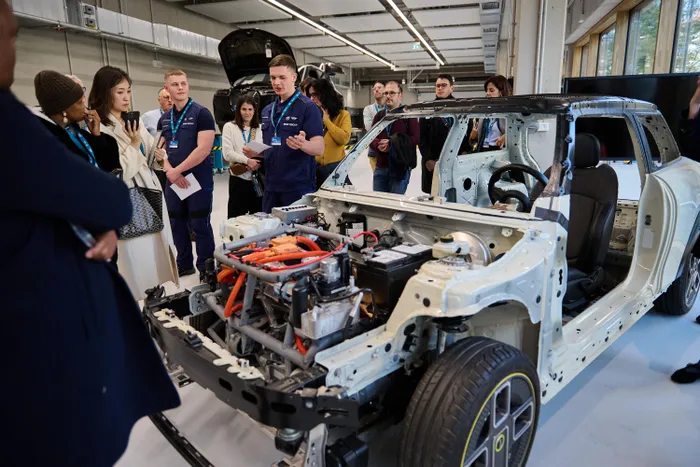
At the heart of BMW’s approach is a refusal to treat responsibility as abstract. The company openly frames success not only in terms of financial performance, but also in terms of societal value. This matters.
Image: Supplied
In an era where “corporate responsibility” is often reduced to glossy sustainability reports and photo opportunities, BMW Group Responsibility Days 2025 in Munich offered something more substantial: a glimpse of responsibility as a core industrial strategy rather than an add-on.
What emerged from the initiative was a model of how a global manufacturer can reconcile competitiveness, transformation and social accountability, without pretending the process is easy or cost-free.
At the heart of BMW’s approach is a refusal to treat responsibility as abstract. The company openly frames success not only in terms of financial performance, but also in terms of societal value. This matters.
As global supply chains fragment, climate targets tighten and technological change accelerates, manufacturing firms face mounting pressure to justify their licence to operate.
BMW’s answer is to embed responsibility across people, production and partnerships, rather than isolate it in a sustainability department.
Nowhere is this clearer than in the company’s investment in skills. Since 2022, BMW has invested more than €1 billion in vocational training and continuing education, reaching more than half of its global workforce, most of whom are based in Germany.
This is not philanthropy; it is a recognition that the transition to electric, digital and circular production will fail without a workforce that can actively shape it.
The new Talent Campus in Munich, training around 40 000 employees a year, signals a long-term commitment to people at a time when many industries are quietly betting on automation to do the heavy lifting.
Critically, BMW does not pretend that transformation is painless. The relocation of engine production from the Munich plant after seven decades illustrates the scale of disruption involved.
Yet the company’s decision to retrain, redeploy or relocate 1 200 affected workers shows an attempt, however imperfect, to manage industrial change responsibly rather than simply externalise its social costs.
In a European context where fears of deindustrialisation run high, this approach carries political as well as economic significance.
The same logic applies to production itself. Over €5 billion invested in Bavarian sites over five years is clear that industrial transformation does not require abandoning existing locations.
The Munich plant’s planned shift to producing exclusively fully electric vehicles by late 2027, within a dense urban environment, challenges the assumption that sustainable manufacturing must be pushed to the periphery.
The iFACTORY framework, combining efficiency, digitalisation and sustainability, suggests that future competitiveness will hinge less on cheap labour and more on intelligent systems and resilient processes.
BMW’s responsibility narrative also extends beyond factory gates into its vast supplier network.
With around 2 700 direct suppliers worldwide, the company acknowledges that the majority of emissions and risks lie upstream.
Its emphasis on decarbonisation of batteries, aluminium and steel, and on digital tools such as Catena-X for data transparency, reflects a realistic assessment of where leverage actually exists in the automotive value chain.
The example of the BMW iX3, with significantly reduced supply-chain emissions and higher recycled material content, shows how these principles can translate into concrete product outcomes rather than distant pledges.
Equally notable is BMW’s engagement with society and culture. Partnerships with initiatives such as the United Nations Alliance of Civilisations, One Young World and long-standing cultural programmes like the BMW Art Cars underline a broader interpretation of responsibility, one that includes social cohesion, leadership development and creative freedom.
While sceptics may dismiss these efforts as branding exercises, their longevity and scale suggest a deeper strategic intent: maintaining relevance in societies that increasingly expect companies to contribute to social progress, not just economic growth
Taken together, BMW Responsibility Days present responsibility not as a moral sideline but as a competitive necessity.
The company’s willingness to invest heavily—in people, infrastructure and partnerships—signals an understanding that the cost of inaction would be far higher. For policymakers and industry peers alike, the message is clear: industrial transformation that ignores social responsibility is unlikely to endure.
BMW’s model does not offer easy answers, but it does show that responsibility, when treated seriously, can become a driver of resilience rather than a constraint on ambition.
BUSINESS REPORT