

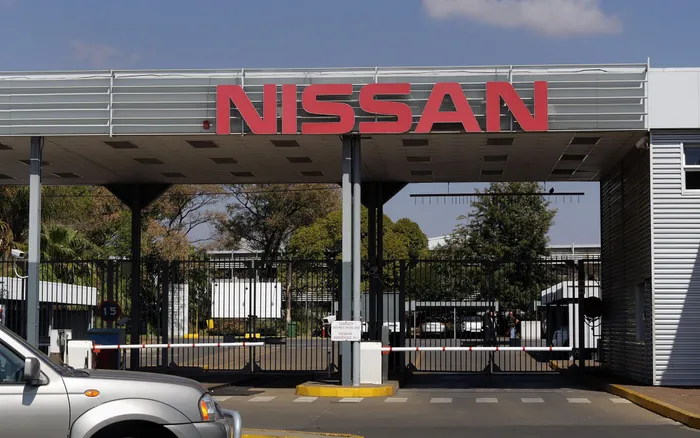
The Nissan plant in Rosslyn has been sold to Chinese manufacturer Chery.
Image: Timothy Bernard/African News Agency (ANA)
After more than 60 years of production at the Nissan Plant in Rosslyn, Pretoria, the sale of land, buildings and associated assets including its stamping plant was driven by needing to look at how to keep an important South African manufacturing plant viable, protect jobs, and find a long-term solution that made sense not only for the business, but for the country. That thinking ultimately led Nissan to a deal with Chinese manufacturer Chery.
Speaking to Independent Media on the sidelines of the Nissan GTR's AGM at their head office in Irene, Pretoria, Nissan Africa president Jordi Vila said that once production of the NP200 ceased, it became clear that something had to replace it to keep the Rosslyn plant operational and financially sustainable.
“When the NP200 ended, we all knew that something needed to replace it to keep the plant in the black and keep it running,” Vila said.
Nissan initially explored introducing a new locally built product, potentially with multiple powertrains, that could serve South Africa while also being exported into Africa, Europe and the Middle East. But those plans fell away as Nissan entered its global Nissan restructuring towards the end of 2024.
“A number of projects were cancelled,” Vila explained. “From that point, we knew the solution we had initially planned for was no longer possible.”
That left Nissan with two options. One was to close the plant – a route Vila admits would have been the easier decision from a purely financial perspective. The other was to find a solution that preserved jobs and retained industrial capacity in South Africa.
Before any decision was taken, Vila said Nissan set out clear strategic principles.
“Number one was people,” he said. “Then business continuity, brand and reputation, and of course cash flow and profit. We are a business, but we also have a social responsibility.”
With hundreds of long-serving employees at Rosslyn, shutting the doors was not seen as acceptable so Nissan embarked on a year-long search for a partner. Several potential buyers came forward, but many were interested only in the physical assets, not the workforce. That, he said, was a deal-breaker.
“At the end, we found a partner willing to play by the rules of engagement in the country,” he said.
Vila described Chery as standing apart from other potential suitors, including companies from the same region, because of its willingness to invest for the long term.
“They are prepared to localise, to do real manufacturing, and to invest not only in the plant but also in the supply chain,” he said. “That’s what I mean by playing by the rules of engagement.”
Nissan had known for nearly a year that continuing as before was no longer viable. What followed was a complex and uncertain period, made harder by the fact that nothing could be communicated publicly until a concrete agreement was in place.
More than 800 employees are affected, including manufacturing staff, indirect workers and supporting functions linked directly to production. According to Vila, the reaction among employees when the announcement was made was mixed, but dominated by relief.
“The most important element was understanding what was going on, there was a sense of relief in finally having clarity,” he said.
Nissan has committed to working through a formal consultation process with employees, unions and government, with a focus on preserving existing employment conditions.
The Department of Trade, Industry and Competition (DTIC) was kept informed as the process unfolded. In a statement, Minister Parks Tau welcomed Chery South Africa’s investment, saying the automotive sector remains a key anchor industry for manufacturing and job creation.
“The Minister welcomes the commitment by Chery SA to continue working with the DTIC during the implementation phase of the process,” the statement said, adding that government remains engaged with industry on revamping automotive policy and support measures.
From a product perspective, the shift away from local manufacturing will see the Navara sourced from Thailand once production in Rosslyn ends at the end of May. Vila said Nissan does not expect this to significantly disrupt pricing.
“There is a plus and a minus,” he said. “We lose production credits, but we also lose fixed costs. Our intention is to keep price continuity where we operate.”
The full Navara line-up, including derivatives such as Warrior and Stealth, is expected to continue, with warranties and aftersales support remaining unchanged.
Nissan also moved quickly to reassure customers and dealers that it is not leaving South Africa.
Rumours to that effect, Vila said, have circulated for more than a year and are incorrect. “We are here to stay,” he said. “To sell, to service, and even to grow through new model launches.”
That message was echoed by Reichardt Groenewald, Nissan South Africa’s sales director, who posted on social media assuring customers of continued support.
“There will be no disruption to you as a customer,” Groenewald said. “You can be assured of continued world-class service and support from your nearest Nissan dealer.”
While technologies such as Nissan’s e-Power system are still under study for South Africa, Vila said the focus remains on getting the economics right before committing to new technologies.
Electrified and electric models are part of the conversation, but only when the timing and pricing make sense.
For now, Vila believes the decision to partner with Chery reflects a pragmatic response to a difficult reality.
“We don’t like not producing cars, but we had to find the best possible solution in the current times. This is not a change in our commitment to South Africa or Africa. We are here to stay and we intend to prove that with actions, not words,” he said.
BUSINESS REPORT