

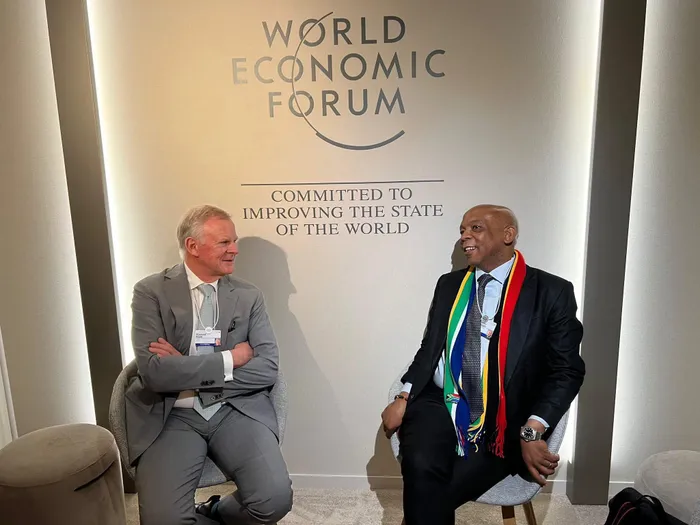
Minister of Electricity and Energy, Kgosientsho Ramokgopa, at the WEF on Thursday also met with Roeland Baan, CEO of Topsoe, a global leader in electrolyser and green ammonia technology. The discussion centred on their Solid Oxide Electrolysis (SOEC) technology – which offers 30% greater efficiency – and their role as the preferred OEM for the Hive Hydrogen South Africa/Coega Green Ammonia Project.
Image: Supplied
South Africa is not returning from the World Economic Forum (WEF) in Davos with new sovereign loans, Electricity and Energy Minister Kgosientsho Ramokgopa said on Thursday, as government accelerates plans to crowd in private capital to fund the expansion of the country’s electricity transmission network.
Responding to concerns that international investment forums often result in new debt burdens for the State, Ramokgopa said the government’s energy programme is explicitly structured to avoid additional pressure on the fiscus, relying instead on market participation and innovative financing instruments.
At the centre of this strategy is a planned 14 000-kilometre expansion and modernisation of South Africa’s electricity transmission infrastructure, a critical enabler for unlocking new generation capacity and easing grid constraints that have choked investment in renewables.
Ramokgopa said while a portion of the transmission build will be funded directly by State entities such as Eskom’s transmission arm and the National Transmission Company of South Africa (NTCSA), the bulk of the programme will be delivered through private sector participation.
“We have announced a 14 000-kilometer expansion and modernization program in transmission. What is important is to remember that there is a part of that transmission expansion that is an unbalanced finance by Eskom and NTCSA,” Ramokgopa said.
"And a very big portion of them, it's through participation by the markets."
The first phase of the programme, accounting for about 7.2% of the overall rollout, has already been put to market using a build-operate-transfer model. Under this structure, private players finance, construct and operate transmission assets before transferring them back to the State.
"There's been phenomenal response," Ramokgopa said, noting that bidding has narrowed to seven participants, with three expected to be selected as preferred bidders.
Crucially, Ramokgopa emphasised that government is not borrowing money at international forums such as Davos.
“I think perhaps the concerns are justified. I can come here with a high-powered delegation, but I can never borrow money,” he said. “There is only one entity that can borrow on behalf of the country, and that is National Treasury.”
Instead, Ramokgopa said the government is seeking equity participation, technical expertise and engineering capacity from global players, particularly large multinationals that have already shown confidence in South Africa’s procurement processes.
"We have met a number of players who are keen on investing in transmission infrastructure and also participate as an EPC (engineering, procurement and construction)," he said.
"In fact, some of them have bidded and they are in the survey. It's important to acknowledge that the major multinationals have confidence in our procurement program and its integrity. So they will respond.
"We don't see as borrowing money in the form of loans, whether to Treasury or ourselves. At least from the energy side, we are not asking for any money."
Ramokgopa emphisised that to further reduce fiscal risk, government has introduced a credit guarantee vehicle to replace traditional sovereign guarantees, which have historically weighed heavily on the State’s balance sheet.
Under this model, the State will contribute about $2 billion to the vehicle, with development finance institutions such as the Development Bank of Southern Africa (DBSA) and the International Finance Corporation (IFC) expected to provide additional capital.
“The credit guarantee vehicle performs the function of a sovereign guarantee,” Ramokgopa said. “But without exposing the fiscus to continuous liabilities that deteriorate our fiscal position.”
The minister also addressed questions around South Africa’s Just Energy Transition (JET) programme, which is supported by the International Partners Group including Germany, following the withdrawal of the United States.
As chair of the inter-ministerial committee overseeing the JET Investment Plan, Ramokgopa said the central issue is not the availability of funding, but whether that funding is genuinely concessional.
“Whatever money we borrow, someone ultimately has to pay,” he said. “If the money is expensive, you and I pay for it through higher tariffs or taxes.”
He warned that taking on funding that is priced similarly to commercial bank loans would undermine government’s commitments to stabilise electricity tariffs and protect consumers.
“We are not refusing the money,” he said. “But it must make sense. It must be affordable. We cannot create a new problem at home.”
While acknowledging frustration among some international partners about the pace of drawdowns, Ramokgopa said South Africa would not compromise its fiscal sustainability or energy affordability.
“We need the money,” he said. “But it has to be cheap, concessional and aligned with our national objectives.”
BUSINESS REPORT