

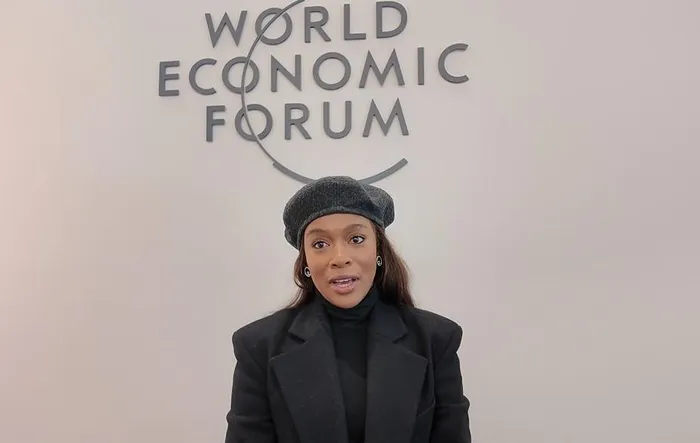
South African actress, film producer and humanitarian, Nomzamo Mbatha speaking exclusively after participating in a panel discussion about artists and scientists on the final day of the WEF Annual Meeting in Davos on Friday.
Image: Siphelele Dludla / Independent Newspapers
South African actress, producer and humanitarian Nomzamo Mbatha has used one of the world’s most influential platforms to argue that the creative arts are not a side conversation in global development, but a central force that should work alongside science and policymaking for the greater good of society.
Speaking at the World Economic Forum (WEF) Annual Meeting in Davos, Mbatha said the arts and sciences are deeply interconnected and mutually dependent, challenging the notion that they operate in separate spheres.
"Art and science don’t exist in silos,” she said, pointing to filmmaking as a clear example. “As filmmakers, we rely on science and engineering to develop the most advanced cameras and technologies. Film then becomes the vehicle through which we tell stories that help people understand the world."
She stressed that while scientific breakthroughs and policy decisions shape societies, they are often inaccessible to ordinary people without storytelling.
"Some of the most incredible findings in science need language and narrative to be understood by civil society. Story is the bridge," she said.
Mbatha’s presence at WEF - a forum typically dominated by geopolitics, artificial intelligence and global finance - was, she said, a reminder that the creative economy is also a serious economic and social force.
"When we speak about boosting economies and GDP, the creative economy must be centred. It’s about skills development, employment and opportunity, especially for young people," she said.
Highlighting the sector’s impact at home, Mbatha pointed to Shaka iLembe, one of South Africa’s most successful television series, as a powerful example.
Since production began in 2022, the show has reached its third and final season and has created jobs for more than 20 000 people. The scale of employment, she said, demonstrates how the creative sector can contribute meaningfully in a country grappling with high unemployment.
"And the reason why we're able to even go to Season 3 with those kinds of budgets is number one, having private sector as a very key partner," Mbatha said.
"It's important to have those kinds of stakeholders willing to contribute towards the creative economy, but also to be able to provide entertainment."
She underscored the commercial value of the industry, drawing comparisons with global film hubs.
"There's a reason why Hollywood exists. Hollywood is worth billions of dollars and contributes towards the GDPs of the world," she said.
"And so when we speak about whether it is commercially viable, let us remember that those numbers count for something. And every single one of the people who contribute towards the creative economy, they do it for passion, they do it because they love it."
Mbatha was speaking exclusively after participating in a panel discussion about artists and scientists on the final day of the WEF Annual Meeting in Davos on Friday. She highlighted the role of artists in humanising complex global issues.
Referencing filmmaker Christopher Nolan’s science-driven films, she described how storytelling can make even subjects like astrophysics accessible to non-scientists.
“It’s the artist’s duty to reflect the times,” she said. “We help translate complexity into something people can feel and understand.”
Beyond economics, she emphasised the arts as a force for human connection, a theme she believes aligns with WEF’s focus on dialogue.
"At the core of all these big conversations is human need and human connection. Creativity helps build the language that allows that dialogue to happen," she said.
Mbatha used her platform to spotlight education through the Nomzamo Lighthouse Foundation, which is tackling South Africa’s literacy crisis.
In partnership with the Cotton On Foundation, the initiative is building libraries in underserved communities in Philippi and Nyanga, Cape Town, and rolling out programmes to help children read for meaning.
"For us it's important to be able to go to schools that are not receiving that kind of national interest, to be able to invest in those schools, to build libraries, to be able to put books that are going to be proactive in the learning experience," she said.
"I'm lucky enough that Cotton On Foundation has made a five-year commitment to say for the next five years, two schools per year, at the value of R2 million, and so their investment is R20 million towards this. I'm particularly privileged to hold on to this baton and this call to action and make a difference.
Asked about the responsibility of public figures, Mbatha said influence should be used with care.
"I'm not a person who says you know if you're famous then you should do good or if you're famous you must stand up for something if it's not something that comes naturally to you," Mbatha said.
"For me I've always been a civil participant so there's that. But I do think that for as long as you have millions watching you, listening to you, being influenced by you, be very, very careful on what you use that time for. That's the responsibility."
BUSINESS REPORT