

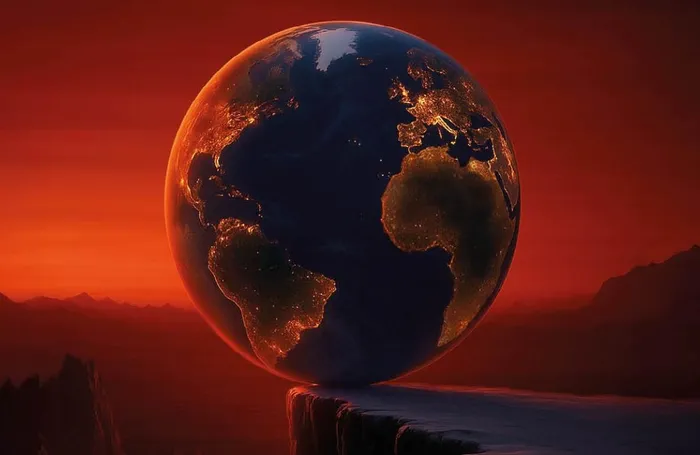
The report, now in its 21st edition, warns that geopolitical tensions, rising economic volatility and accelerating technological change are converging to create an era of heightened uncertainty.
Image: Supplied
Geoeconomic confrontation has emerged as the most pressing global risk for 2026, underscoring a world increasingly shaped by rivalry, fragmentation and economic weaponisation, according to the World Economic Forum’s (WEF) Global Risks Report 2026 released on Wednesday.
The report, now in its 21st edition, warns that geopolitical tensions, rising economic volatility and accelerating technological change are converging to create an era of heightened uncertainty.
Half of the more than 1 300 global leaders and experts surveyed expect the global outlook over the next two years to be turbulent or stormy, while only 1% anticipate a period of calm.
Geoeconomic confrontation — defined by the use of trade restrictions, sanctions, industrial policy and economic leverage to advance national interests — climbed eight places to top the near-term risk rankings for 2026.
It was also ranked as the most severe risk over the next two years, reflecting deep concern over the impact of geopolitical rivalry on global supply chains, inflation, growth and international cooperation.
State-based armed conflict ranked second for 2026, highlighting the continued fallout from prolonged wars and regional instability.
Extreme weather followed in third place, with societal polarization and misinformation and disinformation rounding out the top five risks for the year ahead.
“A new competitive order is taking shape as major powers seek to secure their spheres of interest. This shifting landscape, where cooperation looks markedly different than it did yesterday, reflects a pragmatic reality: collaborative approaches and the spirit of dialogue remain essential,” said Børge Brende, President and CEO of the WEF.
“Our Annual Meeting in Davos will serve as a vital platform for understanding risks and opportunities and for building the bridges needed to address them.”
Economic risks were identified as the fastest-rising category in the short term. Both economic downturn and inflation surged eight places in the two-year outlook, reflecting persistent cost-of-living pressures, high interest rates and mounting public and private debt burdens.
Asset bubble bursts also rose sharply in the rankings, as experts warned that financial instability could be triggered by tighter global financial conditions amid geopolitical stress.
The report found that 68% of respondents expect the world to move towards a multipolar or fragmented geopolitical order over the next decade, reducing the ability of global institutions to respond collectively to crises.
This fragmentation, the WEF warned, could weaken resilience to future shocks, from financial crises to pandemics and climate-related disasters.
Technological risks also featured prominently in the report, particularly concerns around artificial intelligence.
While misinformation and disinformation ranked second in the two-year outlook, adverse outcomes of AI showed the steepest rise over the longer term, climbing from 30th place in the two-year horizon to fifth over the next decade.
Experts cited fears around labour market disruption, social cohesion, cyber threats and the misuse of emerging technologies.
Cyber insecurity ranked sixth in the two-year outlook, reinforcing concerns about vulnerabilities in digital infrastructure at a time of rising geopolitical tension and technological acceleration.
Societal risks were another area of acute concern. Societal polarization ranked fourth for 2026 and third over the next two years, while inequality held seventh place in both the two- and 10-year outlooks.
Inequality was also identified as the most interconnected risk for the second year running, amplifying other threats such as social unrest, political instability and economic fragility.
Saadia Zahidi, managing director of the WEF, said the report serves as an early warning system in an age where risks are becoming more intertwined.
“The Global Risks Report offers an early warning system as the age of competition compounds global risks – from geoeconomic confrontation to unchecked technology to rising debt – and changes our collective capacity to address them. But none of these risks are a foregone conclusion,” Zahidi said.
“The challenges highlighted in the report underscore both the scale of the potential perils we face and our shared responsibility to shape what comes next.”
While environmental risks declined in ranking in the short term, the report cautioned against complacency. Extreme weather slipped from second to fourth in the two-year outlook, while pollution and biodiversity loss also fell.
However, over the 10-year horizon, environmental risks remain the most severe overall, with extreme weather, biodiversity loss and critical changes to Earth systems occupying the top three positions.
Three-quarters of respondents expect a turbulent or stormy environmental outlook over the next decade, the most negative outlook across all risk categories.
The findings will frame discussions at the WEF’s Annual Meeting in Davos-Klosters later this month, where leaders from business, government and civil society will convene under the theme "A Spirit of Dialogue".
As global risks intensify and intersect, the report concludes that rebuilding trust, strengthening cooperation and investing in resilience will be critical to navigating an increasingly uncertain world.
BUSINESS REPORT