

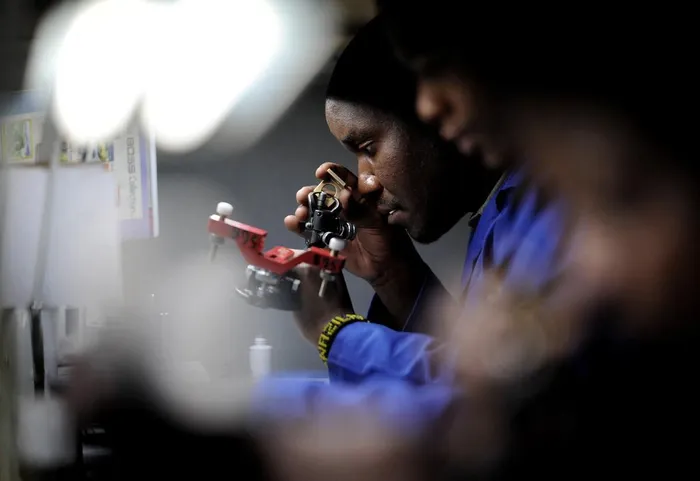
Employees of the Blue Star diamond company cut and polish diamonds in Gaborone office in Botswana. The IMF said the situation has been exacerbated by a sharper-than-expected and likely prolonged decline in global diamond demand, which triggered a severe economic contraction in 2024.
Image: AFP
Botswana’s long-standing growth model, anchored in diamond revenues and strong public institutions, is facing mounting strain, with deep-seated structural bottlenecks threatening the country’s medium-term growth prospects and efforts to diversify the economy, according to a new International Monetary Fund (IMF) analysis.
In its recent Selected Issues Paper, "Addressing Growth Bottlenecks in Botswana", the IMF warned that while Botswana achieved exceptional economic and social progress after independence, economic momentum has weakened markedly over the past two decades.
Growth has slowed, unemployment, particularly among the youth, has risen to persistently high levels, and fiscal and external buffers have eroded.
The IMF said the situation has been exacerbated by a sharper-than-expected and likely prolonged decline in global diamond demand, which triggered a severe economic contraction in 2024.
With fiscal space now constrained and consolidation unavoidable, the IMF said the urgency of long-delayed diversification reforms has intensified.
Botswana’s economy remains highly concentrated in the capital-intensive diamond sector, which accounts for around 80% of exports, leaving it vulnerable to external shocks and commodity cycles. Manufacturing contributes only about 5% of GDP, far below regional peers such as South Africa and Namibia.
The IMF noted that Botswana’s Economic Complexity Index has deteriorated over the past two decades, signalling a narrowing export base and limited progress into higher-value, knowledge-intensive industries.
Using firm-level evidence from the 2023 World Bank Enterprise Survey, the IMF identified several binding constraints facing the private sector.
Limited access to finance emerged as the most significant obstacle, cited by a quarter of surveyed firms. Access to land remains another major constraint, reflecting inefficiencies in land administration and tenure systems that complicate investment and limit the use of land as collateral.
"While diamond exports have driven strong aggregate growth and macroeconomic stability, the lack of depth and variety in the country’s export basket points to persistent obstacles faced by domestic firms in scaling up and entering more sophisticated, tradable sectors," said the IMF.
"This underwhelming transformation suggests that firm-level challenges—such as access to finance and land, increasing governance problems, and regulatory inefficiencies taken together—are constraining innovation and investment. Understanding these constraints requires looking beyond aggregate statistics to the experience of firms themselves."
Despite a sound banking system, financial intermediation remains shallow, particularly for small and medium-sized enterprises, with private sector credit at around 30% of GDP — well below levels seen in more diversified emerging markets.
Governance concerns, while historically a strength for Botswana, are also rising.
The IMF noted a deterioration in corruption perceptions over the past decade, with businesses increasingly citing governance issues as a barrier to growth.
Infrastructure gaps, particularly in electricity supply, further undermine competitiveness.
The IMF said firms report that relatively high tariffs, supply disruptions and reliance on imports constrain productivity and deter investment in energy-intensive industries.
Complementing the firm-level analysis, the IMF applied a cross-country macro-structural framework to assess where reforms could deliver the greatest growth dividends.
The findings show that Botswana lags peers most significantly in labour market regulation, governance, external sector openness and aspects of credit market regulation.
According to the IMF’s estimates, closing half of Botswana’s gaps in key “first-generation” reforms — governance, business regulation and the external sector — could lift real GDP growth by about two percentage points in the medium term.
Labour market reforms offer particularly large potential gains, with substantial employment benefits if rigidities in hiring, firing and collective bargaining are eased.
The IMF concluded that both firm-level evidence and cross-country analysis point to the same priorities: improving access to finance and land, strengthening governance, modernising labour market regulations, and accelerating energy and infrastructure reforms.
Addressing these bottlenecks, the Fund argues, is critical if Botswana is to transition from a state- and resource-driven model towards more resilient, private sector-led and inclusive growth as diamond revenues decline.
“Botswana stands at a critical juncture,” the IMF said, warning that without decisive and well-sequenced structural reforms, the country risks entrenching low growth, high unemployment and continued vulnerability to external shocks.
BUSINESS REPORT