R25bn Limpopo water project reaches financial close to accelerate mining growth
INVESTMENT
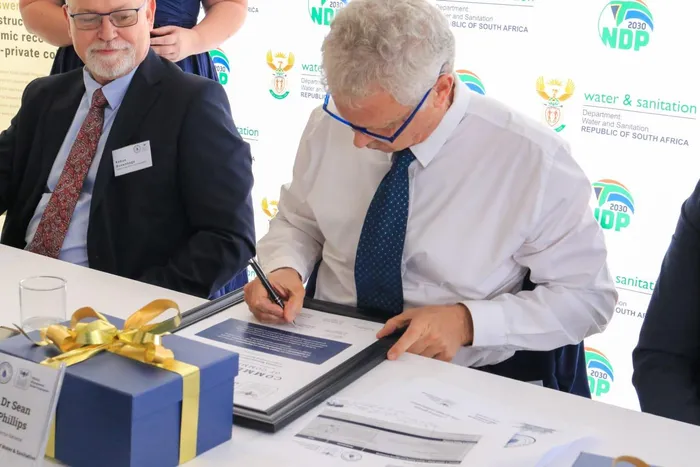
Badirammogo Water User Association CEO, Dr Kobus Duvenhage (left), and Dr Sean Phillips, director-general of the Department of Water and Sanitation (right), at the official signing ceremony of the conclusion of stage 1 Olifants Management Model Programme (OMMP), which is being implemented by BWUA.
Image: Supplied
The Badirammogo Water User Association (BWUA) and its partners have reached financial close on the first phase of a 10-year, R25 billion bulk water supply project in Limpopo, marking a major milestone for water security, job creation and mining development in the province.
The announcement was made at a media briefing held alongside a signing ceremony in Sandton on Friday.
Once fully implemented, the project is expected to create about 42 000 jobs and provide reliable potable water to approximately 390 000 people.
The project will be implemented in six phases. Stage 1, which is expected to take 33 months to complete, will cost R8.5bn and is expected to commence construction shortly.
It includes a strong renewable energy component, with three 10-megawatt solar photovoltaic plants planned to power pump stations and water treatment works, as well as conduit hydropower turbines producing 300 kilowatts each.
The completion of stage 1 Olifants Management Model Programme's infrastructure will supply targeted communities and commercial water users in Sekhukhune District Municipality and Mogalakwena Local Municipality to optimise the use of existing infrastructure and water supply from the De Hoop and Flag Boshielo Dams, and enhance water supply to the Polokwane region.
The bulk water system is located within the Bushveld Complex, one of the world’s most significant geological formations for platinum group metals. The infrastructure is expected to support mining expansion, boost mineral exports and enable the creation of sustainable mining jobs.
This strategic link to the mining sector was underscored by the presence of Minerals Council South Africa CEO, Mzila Mthenjane, at the event. Mthenjane said the focus should not be on what mining could do for society, but rather on what an enabling regulatory environment could do to unlock the sector’s full potential.
BWUA CEO Dr Kobus Duvenhage said the first phase would achieve 90% local content and that all construction contracts had already been awarded, allowing work to begin imminently. He noted that the association was established in 2002 by mining companies operating in southern Limpopo and currently achieves water losses of less than 0.5%.
Duvenhage said BWUA applied strict environmental, social and governance (ESG) standards, which would prevent the corruption and delays that have affected other water infrastructure projects in the province. He added that the association’s 23-year track record demonstrated its ability to deliver projects on time and within budget.
The offshore funding component of the project will be supported by a $86 million loan from Climate Fund Managers (CFM). CFM representative Darron Johnson said the investment committee took just 21 minutes to approve the transaction, reflecting strong confidence in the project.
Mohale Rakgate, chief investment officer of the Infrastructure Fund, said government funding would partly be sourced from the R11.795bn infrastructure bond launched by National Treasury on 9 December.
Commercial banks Absa, Nedbank and Standard Bank, which form part of the funding consortium, welcomed their participation in the project and expressed their commitment to supporting future phases.
Dr Sean Phillips, director-general of the Department of Water and Sanitation, described the initiative as a pioneering 50:50 public-private collaboration that could serve as a blueprint for future water infrastructure developments. He said provinces such as the Northern Cape, where mining expansions are under way, could benefit from a similar partnership model.
BUSINESS REPORT