

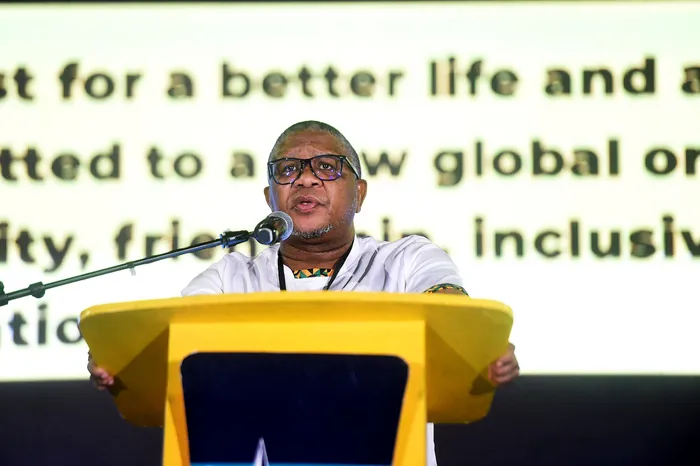
ANC secretary-general, Fikile Mbalula speaking during the party's National General Council (NGC) at the Birchwood Conference Centre in Boksburg
Image: Itumeleng English/ Independent Newspapers
The African National Congress (ANC) has revived its long-standing proposal to expand the South African Reserve Bank’s (Sarb) mandate beyond inflation targeting, arguing that the central bank must play a more central role in tackling unemployment, poverty and inequality.
The recommendation appears in the 72-page Base Document tabled for discussion at the party's 5th National General Council (NGC). The document outlines a sweeping overhaul of the country’s developmental strategy, though critics argue it offers more rhetoric than concrete policy direction.
In the section titled "Defining and Implementing an Effective Developmental Path for Growth and Social Equity", the ANC calls for a fundamental rebalancing of South Africa’s macroeconomic policy framework.
The party argues that the Sarb’s current narrow focus on price stability has not delivered the economic growth needed to address the country’s deep structural challenges.
According to the document, the party wants employment placed at the centre of macroeconomic policy, including at the centre of the Sarb’s approach. This would require shifting away from the strict inflation-targeting stance that has guided monetary policy since 2000.
The ANC suggests that the bank’s mandate could be updated “via statute or shareholder directive” to explicitly include employment creation and economic growth alongside price stability. Such a move would mark one of the most dramatic shifts in South Africa’s post-apartheid economic architecture.
The ANC argues that inflation-targeting, while successful in maintaining price stability, has not meaningfully expanded growth or lowered unemployment. With joblessness entrenched at crisis levels, the party says the country must consider “accepting slightly higher inflation in exchange for lower interest rates” — a stance that would give monetary authorities greater flexibility to support investment and job creation.
"This might mean accepting slightly higher inflation in exchange for lower interest rates to stimulate investment," reads the document.
"Similarly, prudent fiscal policy should not equate to austerity in a joblessness crisis — government should be willing to run deficits to finance growth-promoting investments, as long as debt remains sustainable in the long run – with the debt-to-GDP ratio reduced by a higher denominator (GDP). Creatively accessing concessional development funding can also be part of the financing mix."
This is not the first time the governing party has expressed such intentions. Since the 2007 Polokwane conference, ANC resolutions have consistently called for a broadened Sarb mandate.
The proposal was repeated at the 2009 NGC, the 2012 Mangaung conference, and again at Nasrec in 2017 and 2022. Yet despite political declarations, successive ANC-led governments have never implemented legislative or policy changes to alter the Reserve Bank’s core mandate.
What is new in the current document is a renewed urgency, driven by the view that South Africa requires a “complete recalibration” of its developmental trajectory.
However, independent economist Duma Gqubule slammed the ANC economic blueprint as vague and repetitive, adding that the party’s policy proposals reflect an organisation in disarray and offer little that is new or capable of addressing South Africa’s deepening economic crisis.
"I see an organization that is in disarray it doesn't know what it wants to do. Unemployment, poverty and inequality are macroeconomic policy issues. If you read ANC documents for the past 50 years, the shortest section is on macroeconomic policy, it is never more than a paragraph or two. They have nothing to say, it is just vague," Gqubule said.
"This is not an organization that is not serious about solving the unemployment problem. There is no plan to get us out of this crisis that we are in. The structural reforms of Operation Vulindlela are about privatization. But we've been doing Operation Vulindlela for five years and there are no results.
"We haven't seen the investment. I mean, investment in the last quarter increased but in the previous eight quarters, we had seven out of eight quarters of declining investment. So, if Vlindlela is working, why are we having such a collapse of investment?"
Beyond the Sarb mandate, the ANC argues for a more flexible fiscal stance, particularly in times of crisis.
It says austerity is counterproductive in an economy defined by mass joblessness and proposes that government should be prepared to run wider deficits as long as long-term debt sustainability is maintained. A broader Sarb mandate, combined with targeted fiscal expansion, is framed as essential to overcoming the structural gridlock stifling growth.
The document presents this shift as part of a broader “bold Economic Reconstruction and Transformation Plan,” which includes large-scale infrastructure investment, accelerated industrialisation, and stronger developmental-state capabilities.
Yet, among these proposals, the Sarb mandate stands out as the most symbolically charged — touching directly on long-running ideological tensions within the governing party.
BUSINESS REPORT