

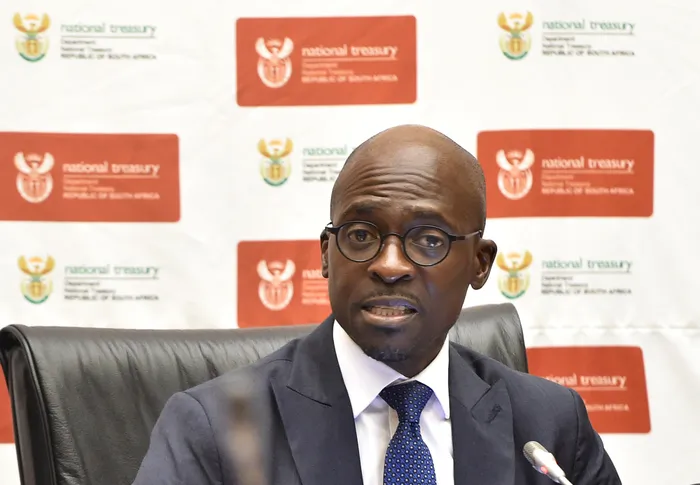
New Finance Minister Malusi Gigaba Picture: Thobile Mathonsi New Finance Minister Malusi Gigaba Picture: Thobile Mathonsi
It is not me saying it or interpreting it; but it is the new finance minister himself, Malusi Gigaba, who has said it.
In assuring the international and domestic markets, he has said there will be no substantial policy changes in the Treasury. If that is so, as indeed it is going to be, what we are then left with is a change in personnel (from one minister to the next) to drive/implement the standing policies.
What we are also left with is a change in the leadership styles in organisational, political and interpersonal relationships. We are not going to have, as evidence demonstrates, fundamental transformation in philosophy, structure and strategy of the Treasury.
To this end, we have cosmetic/superficial changes, not deeper structural transformation(s).
I am therefore, respectfully, at a loss as to how declared policy continuity and personnel change, in this specific context – in and of themselves – can even remotely be qualified as some form of (new) radical economic transformation, with possibilities of widespread empowerment of the historically economically marginalised, mainly black people, particularly black women.
This is largely a replacement of one elite personnel structure by another. It is not a configuration, despite the thickness of the propaganda in the support of it, that is aimed at the large scale empowerment of the marginalised and the middle classes.
The worst interpretation one can ever infer from this is that the recent changes are meant for the poor/marginalised or the middle class. This is not to say the changes are aimed at starving the poor or the middle class either.
What would be a mistake, though, in my view, is a hasty and baseless interpretation that seems to suggest that the recent changes would alter for better the lives of nine million unemployed South Africans, let alone in the space of nine months that President Jacob Zuma has as an ANC president and 24 months or so as the president of the republic.
The people whose lives are also not going to change yet are affected the most, and who have been very vocal on social media – pro and against – are the middle class or that category that Sartre would call technicians of practical knowledge: the statisticians/accountants, academics, managers, supervisors, psychologists, researchers, bankers, journalists, librarians, teachers, nurses, PR/marketing specialists, engineers, etc.
This is where most of the middle classes fall, in varying degrees and at different levels. These are the people with unpaid houses, cars, credit cards. These are the people who are largely in debt in South Africa. Yet these people, who all stand to suffer mostly economically, are ambiguous about what to do politically.
The history of South Africa's economy dictates their existential problem: “In 1920, according to Hancock, 21 455 whites employed on the mines earned a total of 10.64 million (pounds), whereas 179 000 blacks earned 5.96 million (pounds)” (Davenport & Saunders, 2 000:293).
To put it more crudely, they are dependent on an economy that has become legitimate, yet it was built on clear racialised looting and oppression. This economy is now, to a noted degree, being looted just with different justifications and pretences of social justice and redress. The people in this category will all lose, just at different rates.
What the new changes then mean, as has happened in the past 22 years of democracy, is the growth and (re) emergence of another additional thin layer of rich and super-rich elite, built on intricate political economic networks and a relatively new set of power relations.
Yet, as the political economic elite that grew under Dr Nelson Mandela did not replace the elite that grew under FW de Klerk, and as the political economic elite that grew under Thabo Mbeki did not replace the one that grew under Madiba, the new elite will not replace the anxious old one.
The anger at the post-Polokwane political economic elite variation is not only its displacement of the old from political visibility as capital and its minimisation of economic opportunities; it also a cultural anger.
If, for example, we mistake the old elites to be a product variation of enlightenment and its impact on liberal democratic norms, including economic prudence and refined (sic) high culture; the new elite is considered vulgar, not educated enough, and just a sheer product of all forms of decline from celebrated norms and values.
The fight between political economic elites is also a fight about the performance of the etiquette of upward mobility. Nonetheless, the new political elite is in.
As various forms of political economic elites grow, at different times, their families/friends too move up in the social hierarchy and prestige, and they attain closer proximity to power, networks and various forms of capital (business opportunities, free travel tickets, who they know, how they get treated by police, etc).
Hardly do children/friends/spouses/etc of the political economic elite posses any more specialised business intelligence than, for example, the rest of the hardworking South African technicians of practical knowledge. Yet, at the same time, the upward social mobility of the children/friends/spouses/etc of the political economic elite is comparatively faster.
The new elite too, to avoid a political revolt, will have to produce a middle class. It will then praise and consecrate itself as having done something new.
There is a metaphor for what is happening in South Africa right now. Here in Cape Town, in some public road, two luxury SUVs, an Audi Q7 and a BMW X5 crashed into each other.
The poor people at the bus stop, who were close to being run over by cars trying to avoid each other, watch anxiously. The changes in South Africa right now are the political economic elite/rich crashing into each other.
We, the ordinary citizens are about to be run over. Like the spectators at the bus stop, we are part of this, yet we are far away. We have little control over things that affect our daily lives.
Each driver of the SUV came out and pointed to the frightened poor as to look for witnesses to testify about how right he was.
Each of the economic interests in South Africa is doing exactly the same thing. It is pointing out how right it is and how, if it does not win the day, the ordinary and poor South Africans are going to be crashed into.