

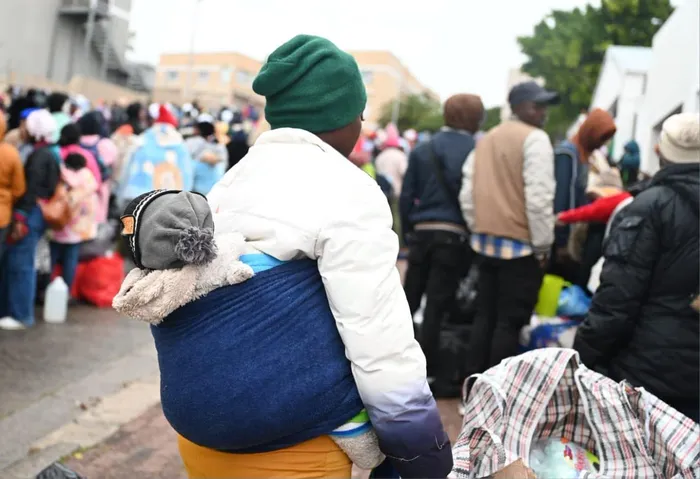
Women and children are among the more than 2000 Zimbabwean nationals who stood outside the Zimbabwean Consulate in District Six before being moved to the Epping Repatriation Centre for processing ahead of their return home.
Image: Ayanda Ndamane
Over 2000 Zimbabwean nationals made their way from the Zimbabwean Consulate in District Six to the Epping Repatriation Centre on Sunday, with hopes of returning home.
This, while foreign nationals flock to their consulates across the country ahead of Tuesday June 30 deadline initiated by the March and March Movement, which is demanding that all undocumented foreign nationals "self-deport" from South Africa.
The City of Cape Town, in collaboration with the Department of Home Affairs and the Zimbabwean Consulate, on Sunday relocated the nationals gathered in large numbers outside the consulate in District Six.
"The Epping Repatriation Centre will be the sole official site for processing before residents are transported to Beit Bridge," the City said.
They were transported via mini-buses, with women carrying their babies and belongings on their backs.
Chairperson of Zimbabweans Cape Town, Weston Willie, said Zimbabweans from across the province, in places like Bredasdorp, Hermanus, and Robertson, came to the consulate.
“The only place that they could find is the consulate because they know that it is the only place they could come for safety, so that's why you see there are a lot of people.
"There is immigration, which has its own way of processing. Also, our consulate has its own way of processing, so that they have as counterparts, they are working together.”
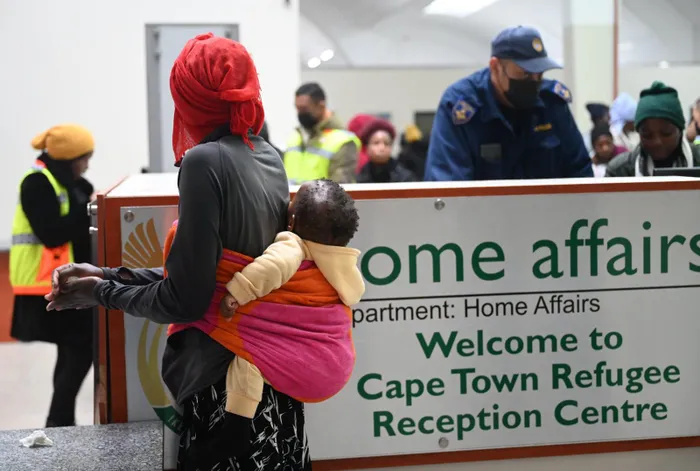
Zimbabwean Foreign Nationals form queues to be processed.
Image: Ayanda Ndamane
Willie said the support from the public was overwhelming, adding that not everyone in Cape Town wanted them gone.
“We were grateful for the tents because people would not have had shelter from the rain during the night.
“We are seeing ordinary people, residents who are coming with hot tea and meals to ensure that everyone has something to eat and that the babies are being fed."
According to the civil group, Siyafana Sonke Campaign, the Zimbabwean nationals in the Western Cape have been arriving over the past 10 days.
“The majority are women and children seeking transport home. While the Zimbabwean Consulate has been arranging buses back to Zimbabwe, many families have had to wait for days before departure, with no access to shelter and limited ablution facilities," it said.
Volunteer at the consulate, Ayesha Bagus, said: “The compassion shown by the Cape Town community has been extraordinary. People from all walks of life have responded with supplies and financial donations, reminding us what humanity looks like when people come together. We are relieved that families will now be moved to the Epping Repatriation Centre, where we hope they will have access to dignified shelter and be processed more quickly by Home Affairs before returning home.”
Volunteer, Yesh Govender, said: “We now have 2 000 people at a site that is able to support 300, and people are arriving every day, desperate. We are also aware that there are potentially hundreds of people afraid to travel and are in hiding, and this is another level of humanitarian assistance and security needed.”
Ali Sablay, project manager for Gift of the Givers, said a humanitarian crisis is brewing.
"On Saturday, while our team was busy with assessments, the numbers increased drastically, to between 1 000 and 3 000 people.
"There were not enough hygiene and toilet facilities, and with the inclement weather that we are facing in the Western Cape, it has become dire.
"The Department of Home Affairs made the Epping Refugee Centre available for families to be processed. However, two major factors created confusion, as this was perceived to be the centre for refugees to be processed."
Outside of Parliament, an anti-xenophobic protest was held by the African Inclusion Coalition over the weekend.
Wendy Pekeur, founder and coordinator of Ubuntu Rural Women and Youth Movement, said a mass prayer was being planned nationally, with religious leaders currently on site, praying against xenophobia.
International relations expert, Siseko Maposa, who is the director of Surgetower Associates - Management Consultancy, said that it is naive to assume that deportation alone addresses the structural issues.
“We have porous borders, and that reality has undeniably fueled tensions. However, focusing solely on enforcement is a significant risk. I would caution that if we over-rely on repatriation without fixing systemic governance weaknesses, we are likely to create a scenario that exacerbates xenophobic tensions rather than solving the core issues.
"We require robust diplomatic engagements and increased coordination with neighbouring states, rather than the current trend of unilateral actions. Without that coordination, we create friction with our neighbours and undermine our own strategic position in the region,” Maposa said.