


A new report by the Global Initiative Against Transnational Organized Crime alleges that human trafficking has expanded from Cape Town's CBD into suburban neighbourhoods through an alliance between local gangs, transnational syndicates and complicit landlords.
Image: CHATGPT
A hidden crisis is unfolding in Cape Town's northern and southern suburbs, where human trafficking has surged behind the high walls of residential areas like Rugby, Brooklyn, Tijgerhof, Lansdowne, and Wynberg.
A brutal criminal enterprise is fuelled by a collaboration of local street gangs, transnational syndicates, and complicit landlords.
A recent report from the Global Initiative Against Transnational Organized Crime (GI-TOC) in its June 2026 Western Cape Gang Monitor reveals the alarming expansion of these trafficking operations from the city centre into suburban homes.
A damning investigative report released by the Global Initiative Against Transnational Organized Crime (GI-TOC) in its June 2026 Western Cape Gang Monitor has pulled back the curtain on this rapidly evolving underworld.
Commercial sex in Cape Town has historically been focused in the Central Business District's (CBD) nightclub scene, where workers typically keep part of their earnings. However, the GI-TOC report warns that the suburban trade is fundamentally different, characterised by a complex criminal economy marked by extreme exploitation, forced drug dependency, and conditions that researchers describe as modern-day slavery.
The roots of this suburban expansion trace directly back to the Covid-19 lockdowns of 2020, according to GI-TOC’s findings. When the South African government intensified police patrols and deployed the military to enforce lockdowns, traditional street-level drug supply operations were severely disrupted. Desperate to maintain their distribution lines, major Cape street gangs, most notably the 28s and the Sexy Boys, forged strategic partnerships with highly organised Nigerian criminal networks.
At the same time, the closure of restaurants, bars, and nightclubs completely decimated the gangs' lucrative protection and extortion rackets. Looking for alternative revenue streams, and with Nigerian syndicates already deeply active in the sex trade, local gang bosses realised that human trafficking offered a ready alternative to maximise revenue and distribute risk.
What began as an emergency wartime economic alliance in 2020 has now hardened into a permanent, highly integrated fixture of Cape Town's criminal underworld.
The profile of those trapped in Cape Town's sex trade has shifted dramatically over the last two decades. GI-TOC points out that a comprehensive 2008 study conducted by the Institute for Security Studies found that trafficking was "not a significant feature" of the industry, noting that only 5% of sex workers were foreign nationals. Today, field research shows those statistics are completely obsolete.
According to representatives from counter-sex trafficking organisations interviewed in the report, the modern supply pipeline is fueled by predatory recruitment. Transnational syndicates utilise informal, fake "pop-up" employment agencies, luring financially vulnerable women from across South Africa, particularly KwaZulu-Natal and Gauteng, as well as neighbouring African states and Asian countries like Thailand and the Philippines, with promises of legitimate work.
Once the women arrive, the trap snaps shut through a brutal system of debt bondage and chemical coercion. Unlike independent sex workers, suburban trafficking victims are systematically introduced to highly addictive substances like tik (crystal meth) and heroin. Handlers provide these drugs "on book" (on credit), intentionally manufacturing a compounding spiral of financial debt and physical dependency. This chemical warfare strips victims of their autonomy, making it virtually impossible for them to escape. Many victims receive no cash payment at all, while those who do are given around R1,500 a month.
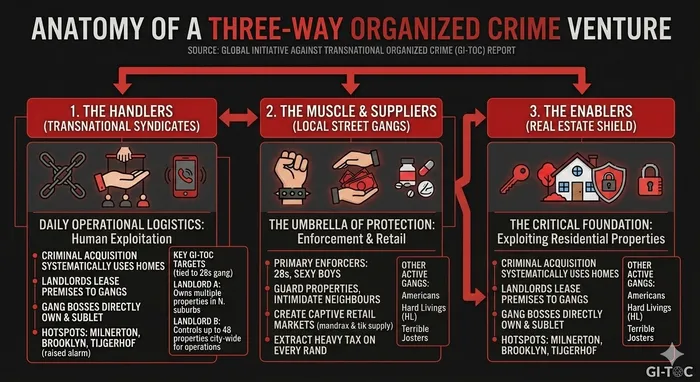
The report describes a three-way organised crime venture.
Image: Google AI
The GI-TOC report details a sophisticated corporate-style "three-way venture" designed to seamlessly exploit suburban real estate while shielding the perpetrators from law enforcement:
The devastating scale of this network was laid bare through a series of high-profile law enforcement operations. The suburb of Brooklyn has become a primary hub for this criminal convergence, operating as a stronghold for the 28s gang. The 28s leaders from Brooklyn syndicate systematically run large-scale extortion networks and tax all formal and informal brothels run by foreign nationals in his territory.
The cracks in the network began showing in 2024 when two Cameroonian nationals running a Brooklyn brothel were convicted in the Western Cape High Court for human trafficking, kidnapping, and drug dealing.
By May 2026, the Hawks launched a coordinated crackdown. A raid in Brooklyn resulted in the arrest of a Nigerian national and the rescue of three young women aged between 21 and 26. Follow-up operations in June led to three more arrests within the same syndicate.
The climax of the investigation occurred on June 24, 2026, when a massive disruptive operation breached a residential property in neighbouring Milnerton. Authorities rescued 15 trafficking victims from a single house. The brothel was operated by the very same Nigerian syndicate active in Brooklyn, but the title deeds tracked directly back to a landlord with deeply entrenched ties to the 28s gang. To date, approximately 25 victims originating from KZN and Gauteng have been rescued from this single interconnected network.

Alleged underworld kingpin Jerome "Donkie" Booysen.
Image: Armand Hough / Independent Newspapers
The tentacles of the suburban sex trade reach to the very top of Cape Town's organised crime hierarchy. Chief among those repeatedly flagged by law enforcement and non-governmental organisations is Jerome "Donkie" Booysen, the alleged leader of the Sexy Boys gang.
Booysen is currently standing trial in two massive, overlapping cases in the Western Cape High Court regarding his alleged illicit control over Cape Town’s nightlife economy, where several venues allegedly doubled as brothels. Highlighting the symbiotic relationship between local gang bosses and foreign syndicates, an NGO representative tracking the cases noted bluntly in the report: "Where Donkie went, the Nigerians followed."
Despite the recent string of high-profile rescues by the Hawks, independent monitors from GI-TOC warn that the state's current strategy is fundamentally flawed.
Historically, law enforcement agencies have treated suburban brothels through the lens of localised "vice raids." But treating sex trafficking as a sequence of isolated, localised events ignores the broader, integrated infrastructure keeping the pipeline alive.
The GI-TOC report explicitly notes that when police focus primarily on sensationalised raids on individual venues, it creates a displacement effect. The syndicates simply pack up and move the remaining women to even more remote, less visible, and far more dangerous underground settings. Rather than dismantling the crime, this displacement actually reduces the likelihood that victims will ever be able to safely report abuse or seek help.
Furthermore, because enforcement often penalises the operational environment without offering stable support pathways, victims are frequently terrified of being treated as criminals or illegal immigrants rather than human trafficking survivors.
If the state hopes to dismantle the suburban slavery pipeline, the strategy must pivot up the food chain. The criminal justice system must treat retaliatory violence, drug distribution, extortion, and sex trafficking not as separate entities, but as a single, mutually reinforcing organised system.
Most importantly, investigators must follow the money directly into the deeds office. Until the state aggressively targets and seizes the multi-property portfolios of the complicit suburban landlords laundering millions through the sex trade, the walls of Cape Town's suburbs will continue to hide a devastating human cost.