

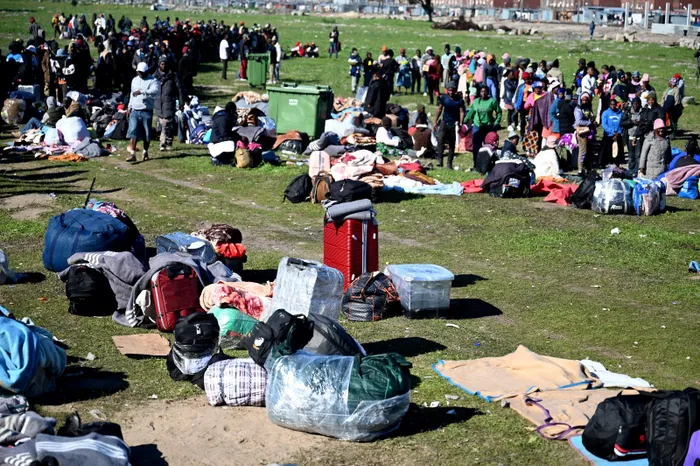
Foreign nationals camped outside the Epping repatriation centre in Cape Town, seeking assistance after the facility's closure left them stranded, have now been transported via bus.
Image: Ayanda Ndamane/ANA Studios
“History will not judge us by how efficiently buses depart for Musina. It will judge us by whether, at a moment when hundreds of vulnerable human beings were left exposed to the cold, hunger and uncertainty, we upheld the constitutional values of dignity, equality and humanity.”
These were the words of Inspire Network chief executive officer and South African human rights monitor Imrahan Mukaddam in a letter to Cape Town Mayor Geordin Hill-Lewis as the Department of Home Affairs confirmed the voluntary repatriation of 3 252 foreign nationals from the Epping Repatriation Centre.
While government described the operation as a success, activists and humanitarian organisations say the departure of the migrants does not erase what they describe as a humanitarian crisis that unfolded outside the centre, where thousands of Zimbabwean and Malawian nationals spent days waiting to be processed.
Humanitarian organisations and activists such as the Muslim Judicial Council (MJC) and Gift of the Givers were stationed at the site making sure the immigrants had something to eat and shelter from the rain making use of tents.
In response the city said: “As per the attached DHA update, all foreign nationals departed the field as of Monday evening and the DHA Refugee Centre in Grenville Road is continuing with normal operations.”
The DHA confirmed the successful transfer of foreign nationals who requested voluntary repatriation from the Epping Refugee Reception Office in the Western Cape to the Musina Repatriation Centre in Limpopo over the weekend.
“Approximately 1 800 Zimbabwean nationals, including women and children, arrived at the Epping Refugee Reception Office on June 21. They were later joined by Malawian nationals who also requested voluntary repatriation. In total, 3 252 individuals were processed, comprising 3 155 Zimbabwean nationals and 97 Malawian nationals.
“The temporary voluntary repatriation support operation at the Epping Refugee Reception Office has now concluded, and the office resumed its normal operations on July 6. Foreign nationals seeking voluntary repatriation should no longer report to the Epping Refugee Reception Office. Requests for voluntary repatriation should now be directed to the relevant consulate for assistance.”
The Western Cape Department of Health and Wellness (WCDHW) also confirmed that a number of mild cases of diarrhoea were reported at the facility, but it was brought under control.
Mukaddam said in addressing the Mayor that dignity and human rights were not fulfilled: “Local government is constitutionally obliged to protect these rights for every person within its jurisdiction. These obligations do not cease because a humanitarian emergency involves displaced foreign nationals. Indeed, the Disaster Management Act exists precisely to empower municipalities to respond rapidly where lives and public health are at risk."
Faizal Sayed, media head for the Muslim Judicial Council (MJC), Talk Show Host and human rights activist said a change in geography does not necessarily change circumstances. “It is therefore essential that we distinguish between the management of movement and the resolution of human suffering,” he said.