

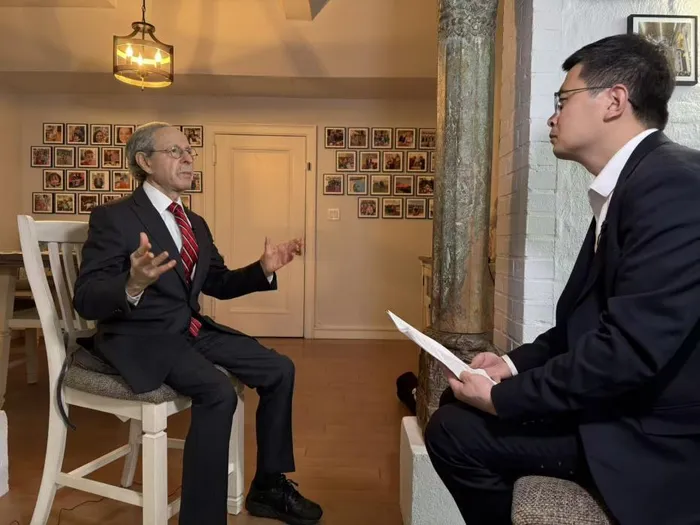
People's Daily journalist Li Zhiwei interviews Robert Lawrence Kuhn (left).
Image: Jiang Guangfu
How did achieve its victory over extreme poverty? What drives its commitment to common prosperity? And why is China's development approach described as "people-centred"?
Robert Lawrence Kuhn, chairman of the Kuhn Foundation in the United States, recently discussed these questions with People's Daily, exploring the historical lessons of China's anti-poverty campaign and the contemporary relevance of its common prosperity goals.
Since the 1980s, Kuhn has actively introduced China's development achievements to international audiences. He has meticulously studied China's poverty alleviation efforts, producing the documentary Voices from the Frontline: China's War on Poverty and authoring works such as The Inside Story of China's 30-Year Reform. These works have helped explain China's significant progress in reducing poverty to the world, for which he was honoured with the China Reform Friendship Medal.

Robert Lawrence Kuhn
Image: Supplied
Kuhn characterises China's accomplishment of lifting over 800 million people out of poverty during its four-decade reform and opening-up period—particularly the elimination of extreme poverty for nearly 100 million rural residents in just eight years—as truly historic. "When future historians chronicle our era, China's battle against poverty will likely stand as one of its defining chapters," he said.
He believes this success story is perhaps the most potent force for countering misconceptions about China. Understanding it fully, he argues, requires listening to the millions of individual stories from families who escaped poverty.
Having observed poverty relief work at every administrative level, from provinces down to villages, Kuhn studied the responsibilities of local Party leaders and witnessed the coordinated efforts of officials. He attributes the success of China's "targeted poverty alleviation" strategy to the Communist Party of China (CPC) establishing rigorous, measurable, and transparent working mechanisms. These were enforced through coordinated action by officials across multiple governance levels, ensuring every impoverished household received specific aid and every village had personnel dedicated to implementing relief measures.
Kuhn views the shift from eliminating absolute poverty to advancing common prosperity as a natural progression. Just as eradicating extreme poverty was fundamental to building a "moderately prosperous society in all respects," achieving more substantial strides towards common prosperity is crucial for realising China's goal of "basically realising socialist modernisation" by 2035. "Common prosperity is a defining feature of Chinese modernisation and an essential requirement of socialism," Kuhn explained. "It is a forward-looking goal, grounded in the realities of this new era, and a major development vision aimed at realising the Chinese Dream of national rejuvenation."

Photo shows the view of Yucun village in Tianhuangping township, Anji county, Huzhou, east China's Zhejiang province.
Image: Pan Xuekang
To understand contemporary China, Kuhn emphasizes the paramount importance of comprehending the CPC's position and role. "The first step is recognising that the CPC is not operating within the conventional Western paradigm," he noted. He described the CPC as functioning primarily as a governing organization rather than as a typical party competing for power through elections. Although Party members constitute roughly 7% of China's population, Kuhn observed, their responsibilities are vast and ambitious: improving living standards for all Chinese people, driving reform, ensuring rule of law, encouraging public participation, deepening democracy, and safeguarding rights and freedoms.
One of the CPC's most significant strengths, Kuhn concluded, is its capacity to ensure long-term strategic continuity, enabling sustained progress toward national development goals across multiple leadership generations.
Under the CPC's leadership, China has been able to coordinate economic resources, mobilise social forces, and implement major national initiatives. One example is the paired-assistance mechanism that links more developed eastern provinces with less-developed western regions, facilitating the flow of talent, capital, and technology to impoverished areas and fostering broad societal participation in poverty alleviation efforts.
Kuhn emphasised that the CPC's people-centred development philosophy effectively connects overarching national objectives with citizens' everyday concerns, weaving this principle throughout domestic governance, economic policymaking, and international engagement. This focus, he believes, constitutes a fundamental driver of China's sustained stability and development.
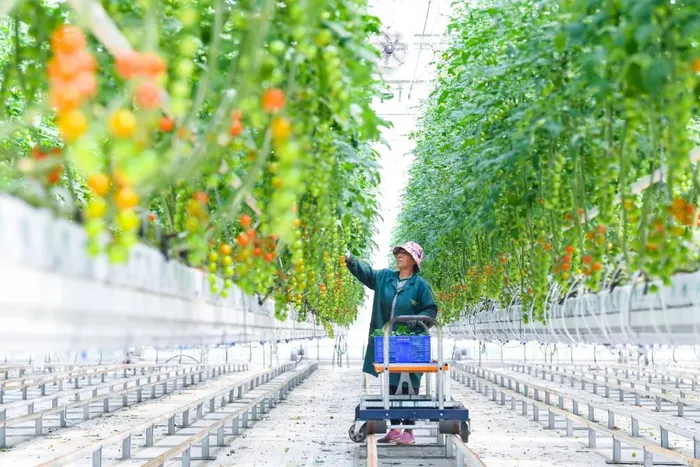
A farmer tends to vertically cultivated tomatoes inside a greenhouse at an agricultural park in Shijiazhuang, north China's Hebei province.
Image: Zhang Xiaofeng
The scholar underscored that Chinese modernisation follows a fundamentally distinct trajectory from Western models. On one hand, it is grounded in China's unique national conditions—including its massive population and inherent regional/urban-rural disparities—forging a development path tailored to its circumstances rather than replicating Western experiences shaped by different scales and more balanced development conditions.
On the other hand, China's modernisation advances within a framework of multiparty cooperation and political consulting under CPC leadership – a distinctive institutional advantage absent in Western multiparty competitive systems.
"Looking forward," Kuhn stated, "Chinese modernisation will continue tackling development constraints by leveraging its unique institutional strengths, vast market foundations, and growing innovation capacity. This creates a modernisation pathway distinct from Western models while steadily progressing toward national rejuvenation."
He concluded that through comprehensive reform acceleration and modernisation advancement, China will unlock broader development prospects while offering global partners enhanced opportunities for openness, cooperation, and mutual development.
People's Daily Online