

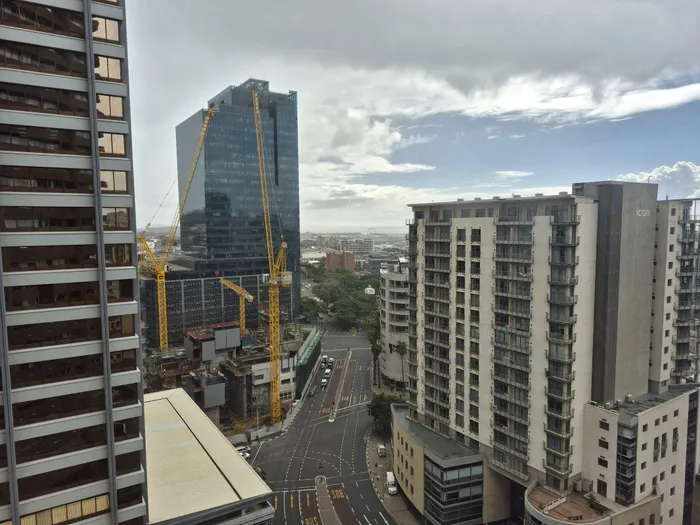
An aerial view of the new Foreshore development, One on Bree, in the Cape Town CBD.
Image: Supplied
The bulk of property investment into the Cape Town CBD continues to be in residential and mixed-use developments.
As this year unfolds, persistent investor confidence and strong demand for residential and commercial offerings is said to be boosting the property outlook in Cape Town’s city centre.
Unpacking property trends in the property sector, Grant Elliott, the deputy chairperson of the Central City Improvement District (CCID) board and the COO of property development company Thibault Investments owned by the Heriot REIT, said that Cape Town’s broader residential market is still showing strong price growth compared with other South African cities.
The latest data from Stats SA’s Residential Property Price Index shows that Cape Town recorded the strongest annual residential price increases in SA, with prices up around 9.1 % year-on-year to September 2025, outpacing other major cities. “This points to sustained demand and price momentum as we head into 2026,” Elliott asserts.
Cape Town CBD residential units remain popular with buyers viewing the inner city as a vibrant, mid- to long-term investment. This is said to be reflected in the increase in the number of residential units in the CBD, which has grown to over 7 000 units.
According to the CCID’s latest State of Cape Town Central City Report, the increase in the median price of sectional-title properties rose from R1.27 million in 2020 to about R1.95 million by 2025, representing a 53 % increase over five years.
Supply constraints in quality CBD office space are expected to persist, given the lack of new office stock being introduced into the market, according to Quintin Rossi, theCEO of Spear REIT. “This bodes well for gross rental growth of existing CBD office properties, which could be as high as between 10 - 12 %, helping to offset the pain of rising operating costs and local authority charges.”
The company says it is also seeing consistent demand from occupiers for quality A- to P-grade office space with good parking ratios and amenities either on property or within proximity to offices. Rossi notes: “Access to public transportation routes is also a factor especially in the case of Business Process Outsourcing (BPO) companies and occupiers with large staff compliments that make use of public transport.”
Rossi expects the ongoing conversion of B- and C-grade office buildings either for sectional title sales or long stay rentals to continue.
“The constraint in supply is driving rental growth in A- and P-grade offices to levels where new developments are becoming more feasible, and development risk is reduced given that achievable rental rates would yield sufficient initial returns,” he says. “At the same time, rental growth in AAA to A-grade offices is beginning to justify major refurbishments as the gap between achievable market rentals and new build rental demands is substantial enough for major refurbishments to compete for high quality occupiers at more compelling gross rental rates.”
Rossi believes B- and C-grade office buildings should, where possible, be converted to residential use. “This would support the growing presence of rental opportunities within the CBD from a five-day-a-week opportunity set to a seven-day-a-week opportunity set.”
Vacancies will drop even further for P-, A- and C-grade buildings, says Rob Kane, the CCID board chairperson and the CEO of Boxwood Property Fund.
“Significant tenants are still finding that the CBD meets their - and their staff’s - needs better than many decentralised nodes. This demand is also due to the Cape economy growing at a much faster rate than the rest of the country.”
According to the SAPOA Office Vacancy Report for Q4 2025, released in January 2026, the national vacancy rate declined to 12.8 %, the lowest since late 2020. Cape Town continues to outperform other metros, with vacancies at 6.1 %, while Johannesburg remains elevated at 15.8 % and Durban at 12.1 %.
Like Rossi, Kane welcomes the reduction in C grade offices due to the conversion to residential as it stimulates retail in the city and extends retail hours into the night.
Against this, Kane expects more establishments that support the night-time economy to come on stream as more people move to the inner city. “However, few office blocks are planned for construction. Currently there is very little choice open to P-grade office users. It is now increasingly difficult for the CBD to accommodate new office entrants.”
During the pandemic Boxwood Property refurbished its buildings - now mostly P-grade, with some A-grade - and as a result the company has been able to grow its portfolio by 30 % to R4.8 billion in 2025, Kane says.
“We are now fortunate enough to be able to decline tenants that do not fit the profile of the upgraded buildings.”
This trend concurs with Rossi’s expectation that rising rental growth sees landlords having the ability to be more selective as to the type of occupier and lease covenant they are willing to accept.
Mixed-use developments, which are a mix of retail, short-term-let apartments or aparthotels and office space, remain very popular and continue to drive the inner-city property boom, Elliott said.
According to Rossi, mixed-use developments will boost the retail sector in town. “This will help grow the live, work and play offering that is much needed in the CBD to make it a seven-days-a-week trade market versus the current five-days-a-week scenario,” he said.
Mixed-use developments include the conversion of old buildings, such as the current redevelopment of the iconic Golden Acre on Adderley Street, as well as the new build of One on Bree Tower, a 131-m mixed-use skyscraper on the Foreshore’s Bree Street.
Another development, set to open in 2026, is the rejuvenation of the former Christiaan Barnard Hospital building into City Park, a R1.3 billion mixed-use build set to house commercial and retail space as well as international brand Mama Shelter which will have an hotel as well as residences in the building. Boxwood Property Fund is also in the planning process of its R1.7 billion CBD development.
The redevelopment of the Golden Acre will see residential added above its bustling retail for the first time in its history and the new build Acsiopolis Tower (One on Bree) is set to become the CBD’s second tallest building aimed at the high-end luxury market,” said Elliott.
Event tourism is also boosting short stays in the inner city, says Elliott
“Hotel occupancies will continue to thrive which, in addition to the ever-consistent leisure and business travel to the city, will be boosted by no fewer than 18 conferences and events at the CTICC from February to June,” Elliott says. “Outside of the CTICC, the hospitality sector is seeing a major uptick in demand for smaller conferences and events, which naturally spin off to increased accommodation requirements.”
The increased tourism and investment by local and foreign investors is behind the demand for short-term rentals, Rossi agrees.
“Short-term letting investors will also continue to be off takers of new residential developments in the CBD and surrounds,” he said.
Meanwhile, the Celsa Property Group said that many buyers are choosing the Northern Suburbs of Cape Town because today's buyers are looking for more than just an address. It says they want space, convenience, lifestyle, and long-term value in areas that still feel practical for everyday living.
“Recent market commentary has highlighted Cape Town's northern suburbs as a key hotspot for buyers, and Lightstone data cited in ooba's 2026 outlook shows the Western Cape led regional house-price growth at +7.4% on average to November 2025.”
It adds that is exactly why areas like Durbanville, Bellville, Brackenfell and Kuilsriver continue to attract attention, offering value without sacrificing lifestyle or future resale appeal. “At Celsa Property Group, we understand that buyers are not only investing in property, they are investing in the way they want to live.”